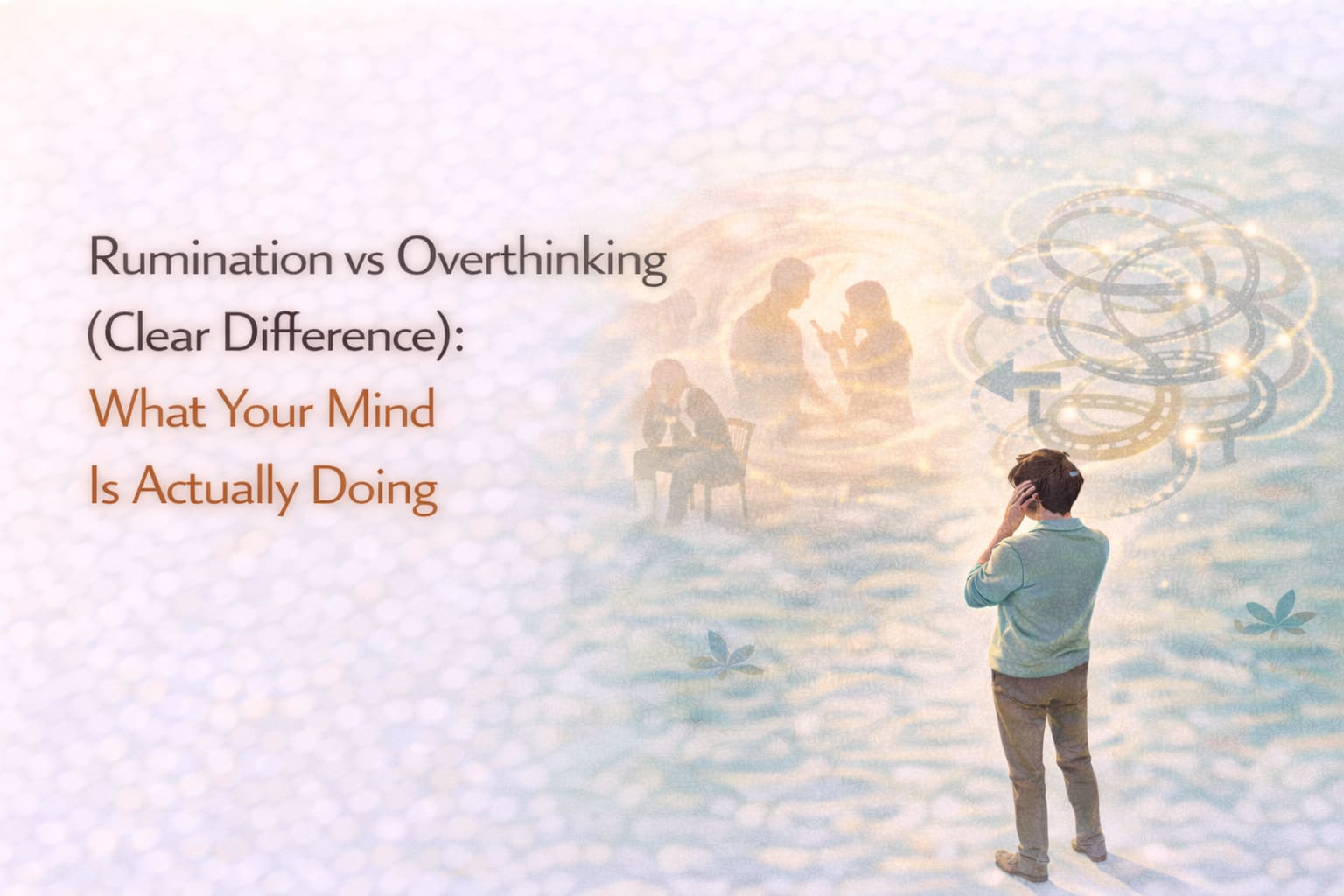
Rumination vs Overthinking (Clear Difference)
Rumination vs overthinking is a difference most people feel… but don’t clearly see.
Your mind is active.
But the direction feels different depending on the moment.
Sometimes you’re stuck in the past.
Replaying something that already happened.
Other times, you’re stuck in the future.
Thinking about what could happen… or what might go wrong.
Both feel similar.
Both feel like thinking.
But if you look closely, something interesting appears.
They are not the same pattern.
What this actually means
Rumination vs overthinking comes down to where the mind is focused and what it is trying to do.
Rumination is when the mind repeatedly returns to the past.
It replays events.
It revisits conversations.
It focuses on what happened and how it could have been different.
It is backward-looking.
Overthinking is when the mind loops around decisions, possibilities, or uncertain outcomes.
It analyzes.
It compares.
It tries to figure out what to do.
It is forward-focused or present-focused.
Both involve repetition.
But the intention is different.
Rumination tries to resolve something that already happened.
Overthinking tries to control something that has not happened yet.
Overthinking often forms structured overthinking loops.
You can explore that pattern here:
The behavior most people don’t notice
Most people don’t separate these two.
They just say:
“I’m overthinking.”
But if you look closely, the behavior changes depending on the situation.
Rumination looks like:
Replaying a conversation hours later.
Mentally rewriting what you said.
Thinking about how something could have gone differently.
Overthinking looks like:
Delaying a decision.
Comparing options repeatedly.
Trying to find the “right” choice.
They feel similar because both involve repetition.
But the emotional tone is different.
Rumination often feels heavier.
Overthinking often feels tense or uncertain.
That difference is subtle.
But important.
Why the mind does this
The brain is trying to solve something.
But the type of problem changes.
Rumination
The mind is trying to create closure.
It wants to understand what happened.
It wants to resolve emotional tension.
But past events cannot be changed.
So the mind keeps returning.
Overthinking
The mind is trying to reduce uncertainty.
It wants to predict outcomes.
It wants to avoid mistakes.
But future outcomes cannot be fully controlled.
So the mind keeps analyzing.
Both patterns are driven by similar forces.
Self-doubt cycles
You question your judgment or past actions.
Fear of failure
You want to avoid making the wrong move.
Perfectionism patterns
You expect the “best” version of events or decisions.
Control illusion
Thinking creates the feeling of control.
Even when nothing is changing.
This is why both patterns connect to:
Not because you are doing something wrong.
But because the mind is trying to solve things that cannot be solved through thinking alone.
Where this pattern appears in daily life
You might notice rumination after something has already happened.
A conversation.
A mistake.
A moment that didn’t feel right.
Your mind returns to it later.
And stays there.
You might notice overthinking before something happens.
A decision.
A conversation you’re about to have.
A step you’re about to take.
Your mind tries to prepare for it.
And keeps going.
Sometimes both appear together.
You replay the past…
And then overthink the future version of it.
That’s where the patterns begin to overlap.
The hidden effect of this pattern
Both rumination and overthinking create a similar outcome.
Delay.
But they do it differently.
Rumination keeps you mentally attached to the past.
Overthinking keeps you mentally stuck before action.
Together, they create a cycle.
You replay what happened.
Then you overthink what to do next.
Then you hesitate.
Over time, something subtle begins to shift.
Confidence weakens.
Not because you lack ability.
But because your mind keeps correcting you.
Decisions feel heavier.
Not because they are complex.
But because they feel important.
This is how both patterns quietly become forms of self-sabotage.
Not through failure.
But through repetition.
What this reveals about human behavior
Rumination vs overthinking reveals something important about the mind.
The brain struggles with unfinished experiences.
Past moments without closure.
Future decisions without certainty.
So it tries to solve both.
Through thinking.
But something interesting happens.
The thinking continues…
Even when the situation cannot be changed.
You might not notice it at first.
But if you look closely, something becomes clear.
The mind is not always trying to find answers.
Sometimes, it is trying to feel complete.
To feel certain.
To feel like nothing is unresolved.
And when that feeling doesn’t arrive…
The loop continues.
Final reflection
Rumination vs overthinking is not just a difference in thinking.
It’s a difference in direction.
One looks backward.
One looks forward.
But both can keep you in the same place.
You might not notice it at first.
Because both feel like thinking.
Both feel like effort.
But if you look closely, something interesting appears.
Neither is always creating clarity.
Sometimes, they are just repeating.
And once you begin to see that, something changes.
You start recognizing the pattern earlier.
Not as thinking.
But as a loop.
And in that moment, something simple becomes visible.
Not every thought needs to be solved.
Some just need to end.
Q: What is the difference between rumination and overthinking?
A: Rumination focuses on past events, while overthinking focuses on decisions and future outcomes.
Q: Is rumination a form of overthinking?
A: They are related but different. Rumination is past-focused repetition, while overthinking is decision-focused analysis.
Q: Why do both patterns feel similar?
A: Because both involve repeated thinking, even though they are directed at different types of problems.
Q: How can I recognize which one I’m experiencing?
A: If you’re replaying past events, it’s rumination. If you’re stuck on decisions or possibilities, it’s overthinking.
Related Patterns
If this pattern feels familiar, it often connects to other behaviors.
