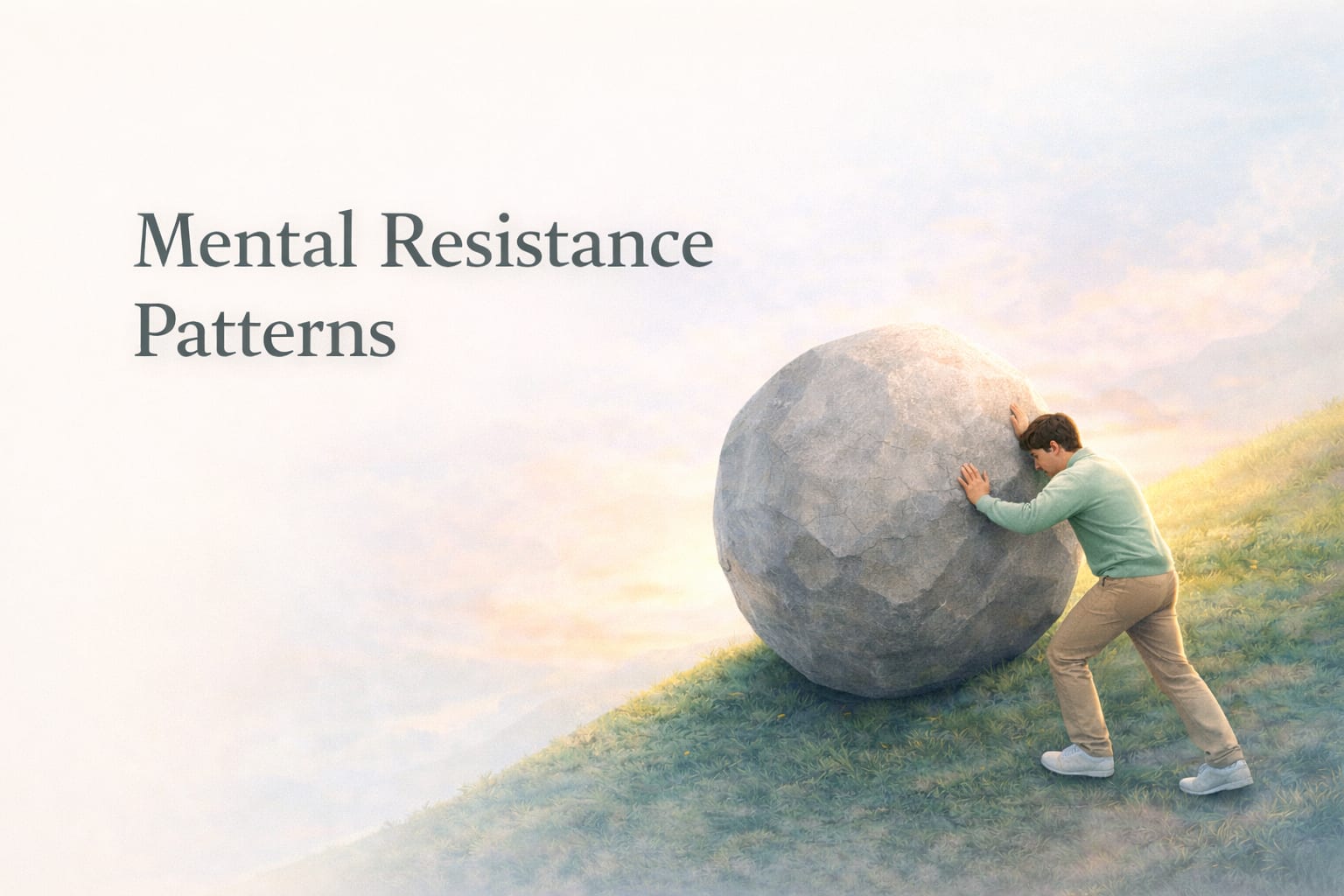
Mental Resistance Patterns
Mental resistance shows up in moments that feel small.
You sit down to begin something.
You know what to do.
Nothing is technically stopping you.
And yet… you don’t start.
You check something else first.
You think about it a little longer.
You tell yourself you’ll begin in a moment.
You might not notice it at first.
But if you look closely, something interesting appears.
The resistance isn’t coming from the task.
It’s coming from the space just before action.
Truth Pill Guide
If this pattern feels familiar, explore the deeper system behind it:
What This Behavior Actually Is
Mental resistance psychology describes the quiet friction between intention and action.
It is the moment where you could move forward…
…but don’t.
Not because you decided not to.
But because something slows you down.
It rarely feels dramatic.
It feels like a pause.
A delay.
A small shift away from the task.
The mind stays close.
Thinking about the task.
Planning it.
Revisiting it.
But not beginning it.
This is what makes mental resistance difficult to notice.
From the inside, it feels like thinking.
From the outside, it looks like delay.
Why the Brain Does This
The brain is not designed for constant action.
It is designed for efficiency and safety.
Anything that introduces uncertainty or effort creates tension.
Even if the task is meaningful.
Even if it leads to growth.
The mind prefers what is familiar.
Because familiar feels predictable.
And predictable feels safe.
So when a task introduces change, the brain responds with resistance.
Not by stopping you completely.
But by slowing you down.
Just enough to avoid discomfort.
This is why resistance often turns into
/overthinking-loops.
The mind keeps thinking about the task instead of doing it.
Because thinking feels safer than acting.
Where It Appears in Everyday Life
Mental resistance patterns are subtle, but consistent.
Starting important work
The first step feels heavier than expected.
Even when the task is simple.
Making decisions
You keep revisiting the same options.
Thinking instead of choosing.
Creative output
You delay finishing or sharing your work.
Not because it isn’t ready.
But because it will become visible.
Small actions
Even simple tasks get postponed.
Opening a document.
Sending a message.
Beginning something familiar.
The pattern repeats across different situations.
Not because the tasks are difficult.
But because they require movement.
The Hidden Cost
Mental resistance feels small in the moment.
But over time, it compounds.
Tasks take longer than they should.
Decisions become more draining.
Momentum disappears.
And something subtle changes inside the mind.
The brain begins associating action with effort.
And delay with relief.
So it chooses delay more often.
This is how resistance slowly becomes part of
/self-sabotage-patterns.
Not through large decisions.
But through repeated hesitation.
Small moments that add up over time.
The Pattern Most People Miss
The most important part of mental resistance psychology is where it appears.
It shows up right before action.
Not during.
Not after.
But at the exact moment when movement begins.
That timing reveals something important.
The mind is not resisting the task itself.
It is resisting the transition.
The shift from thinking to doing.
Because action makes things real.
And real things carry consequences.
So the brain delays that moment.
Just slightly.
Just enough to stay in the safe space of thought.
Final Reflection
Once you understand mental resistance psychology, the pattern becomes easier to see.
A task appears.
You intend to act.
Then something slows you down.
At first, it feels like a small pause.
But if you observe closely, something interesting appears.
The mind is not always resisting the work.
It is resisting the moment where the work begins.
Because beginnings create change.
And change introduces uncertainty.
But most of the time, the resistance disappears once you start.
Which means the hardest part is rarely the task.
It is the moment just before it.
Q: What is mental resistance psychology?
A: Mental resistance psychology describes the internal hesitation that delays action, often caused by discomfort, uncertainty, or effort.
Q: Why do I feel resistance before starting tasks?
A: The brain tries to avoid discomfort and conserve energy, which creates hesitation before beginning something new or demanding.
Q: Is mental resistance the same as procrastination?
A: Mental resistance is the internal feeling, while procrastination is the behavior that follows it.
Q: How can I reduce mental resistance?
A: Recognizing the hesitation and starting with small actions can help interrupt the pattern.
