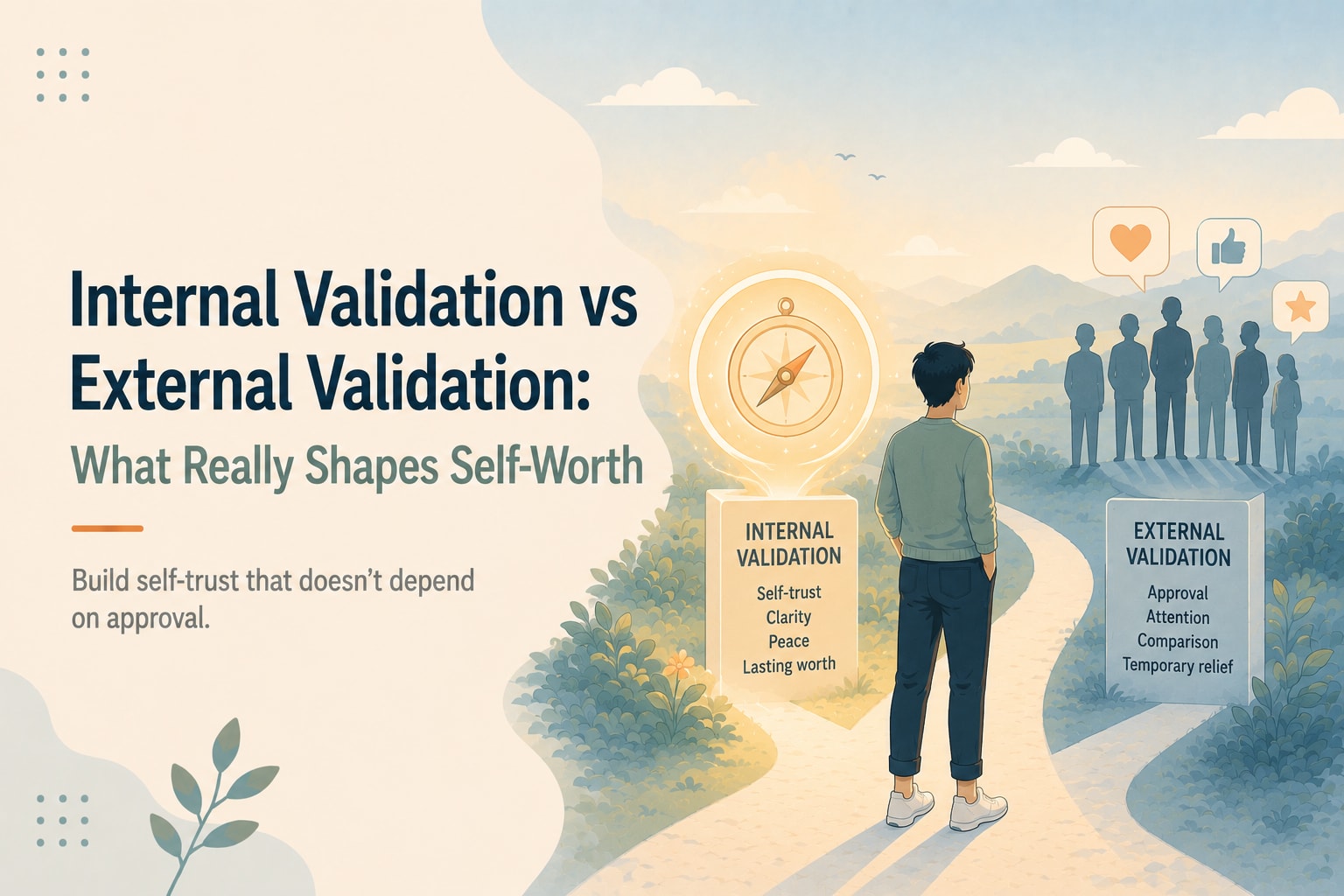
Internal Validation vs External Validation: What Really Shapes Self-Worth
Internal validation vs external validation often becomes visible in the few seconds after you make a decision.
You feel certain.
Then someone reacts differently than expected.
Their expression changes.
Their enthusiasm is lower than you imagined.
They ask a question you had not considered.
Suddenly, the decision that felt reasonable begins to feel uncertain.
Nothing about the decision itself has changed.
Only the response around it has changed.
That small shift reveals something important.
Sometimes your sense of being right, capable, attractive, valuable, or acceptable depends less on what you believe and more on what other people reflect back to you.
External validation is not always harmful.
Approval feels good because human beings are social.
Encouragement can help you recognise strengths you have overlooked.
Feedback can reveal blind spots.
The pattern becomes limiting when outside reactions do not simply influence how you feel.
They determine what you are allowed to believe about yourself.
Internal validation works differently.
It does not mean ignoring advice or assuming you are always correct.
It means your sense of worth, effort, judgment, and emotional experience does not disappear the moment someone fails to confirm it.
This distinction often sits underneath larger self-sabotage patterns, especially when the need for approval creates repeated overthinking loops, reassurance-seeking, and difficulty trusting personal decisions.
The Behavior Most People Don’t Notice
Most people do not consciously decide to depend on external validation.
The dependence develops quietly.
You share an idea and watch the room before deciding whether you still believe in it.
You post something online and feel proud until the response is smaller than expected.
You set a boundary, then begin questioning whether it was fair because the other person becomes upset.
You finish a piece of work, but it does not feel good until someone praises it.
The original experience is replaced by the reaction that follows.
This is external validation.
Something outside you confirms whether the experience, achievement, choice, or feeling is acceptable.
Internal validation begins earlier.
You examine what happened.
You consider your values, intentions, effort, and available evidence.
You decide what the experience means before asking the outside world to define it.
The difference is not that one person enjoys praise and the other does not.
Both usually do.
The difference appears when praise is absent.
A person with internal validation may feel disappointed but still recognise the value of what they did.
A person dependent on external validation may lose access to that value completely.
The work no longer seems strong.
The decision no longer seems reasonable.
The boundary begins to feel selfish.
You might not notice it at first.
Approval does not simply add to the experience.
It quietly becomes the experience.
Why the Brain Does This
The brain pays close attention to social feedback because belonging has always mattered.
Acceptance can signal safety.
Disapproval can feel like a warning.
Even when the situation is not dangerous, the nervous system may still react as though social rejection carries serious consequences.
This is why a small criticism can outweigh several compliments.
Approval creates relief.
Criticism creates uncertainty.
Silence creates space for interpretation.
If your sense of self is already unstable, outside reactions become a quick way to decide what to believe.
You do not have to sit with uncertainty or form your own judgment.
Someone else’s response provides the answer.
Past experiences can strengthen this pattern.
If praise was given only when you performed well, achievement may have become closely connected to worth.
If your emotions were often dismissed, you may now wait for other people to confirm whether your feelings are reasonable.
If disagreement led to conflict, you may have learned to adjust yourself quickly whenever someone became uncomfortable.
That is where the pattern begins.
External validation becomes more than encouragement.
It becomes a form of emotional permission.
You feel allowed to be proud only when someone admires you.
You feel allowed to be hurt only when someone agrees that the situation was unfair.
You feel allowed to trust a decision only when others approve of it.
Where This Pattern Shows Up in Daily Life
Internal validation vs external validation appears in ordinary moments.
At work
You complete a difficult task.
Internally validated thinking recognises the effort, preparation, and result even before feedback arrives.
Externally dependent thinking waits for a manager’s reaction before deciding whether the work was good.
If the response is brief, the mind may assume the work was disappointing.
In relationships
You express a need.
Internal validation allows you to recognise that the need matters, even if the other person does not understand it immediately.
External validation makes the need feel legitimate only when the other person responds warmly.
Their discomfort becomes evidence that you asked for too much.
On social media
You like what you created.
Then you notice the number of likes, shares, or comments.
The response becomes a measurement of quality.
A quiet post feels like a poor post, even when the content still reflects what you wanted to say.
During decision-making
You choose what seems right.
Then you ask several people what they think.
The opinions conflict.
Instead of helping, the feedback creates more doubt.
This overlaps with Why You Trust Others More Than Yourself and Why You Seek Constant Reassurance.
The problem is not that you asked for input.
The problem is that your own judgment disappears once another opinion enters the room.
When receiving criticism
Internal validation does not make criticism painless.
It allows you to examine it without immediately turning it into a verdict on your worth.
You can ask whether the feedback is accurate, useful, incomplete, or shaped by someone else’s preferences.
Without that internal filter, every criticism can feel authoritative.
The Hidden Effect of This Pattern
The obvious effect of external validation is emotional instability.
Praise lifts you.
Silence unsettles you.
Criticism lowers you.
The deeper effect is that your identity becomes difficult to maintain.
You may behave differently around different people because each group reflects something different back to you.
One person makes you feel intelligent.
Another makes you feel inadequate.
One environment makes you feel attractive.
Another makes you question yourself.
Your self-perception shifts with the room.
This can create excessive self-monitoring.
You begin watching how people react instead of staying connected to what you are saying or doing.
During a conversation, part of your attention remains on the other person’s face.
Do they agree?
Are they bored?
Did that sound foolish?
The more attention moves outward, the less access you have to your own experience.
External validation can also produce avoidance.
You may stop sharing ideas unless success seems likely.
You may avoid setting boundaries that could disappoint someone.
You may hide unfinished work because criticism feels too personal.
You may choose what attracts approval rather than what genuinely matters to you.
The person does not simply seek acceptance.
They quietly organise their life around avoiding disapproval.
What This Reveals About Human Behavior
Human beings do not develop a sense of self in isolation.
Other people matter.
Their reactions teach us how we are seen.
Their encouragement can expand what we believe is possible.
The issue is not whether external validation should matter.
It is whether it should have the final word.
Internal validation is sometimes misunderstood as unquestioning self-belief.
It is closer to self-recognition.
You notice your own effort.
You acknowledge your emotions.
You examine your intentions.
You assess your choices against your values and available evidence.
You remain open to correction without assuming every disagreement proves you are wrong.
This creates a different relationship with feedback.
Praise becomes enjoyable rather than necessary.
Criticism becomes information rather than identity.
Silence becomes ambiguous rather than automatically negative.
You can still change your mind.
But the change comes from reflection, not immediate emotional surrender.
This distinction also explains why repeated reassurance offers only temporary relief.
External validation can calm a doubt.
It cannot create lasting self-trust when your own judgment is repeatedly excluded from the process.
The mind keeps returning to other people because it has not learned to let internal evidence count.
Final Reflection
Internal validation vs external validation is not a choice between caring about people and ignoring them.
It is a question of where meaning is finally decided.
External validation asks:
"What do their reactions say about me?"
Internal validation asks:
"What do I understand about this experience, even before anyone responds?"
Both voices can exist.
You can appreciate praise while recognising your own effort.
You can consider criticism while deciding whether it is accurate.
You can feel disappointed by a response without allowing that response to erase what you know.
But if you look closely, something interesting appears.
The need for approval often grows strongest when your own interpretation feels least available.
You search outside yourself because the internal answer does not feel convincing enough.
That does not mean the answer is absent.
It may simply be unfamiliar.
The pattern is quiet.
You do something meaningful.
You look outward.
The reaction arrives.
You use it to decide what the moment was worth.
Over time, your own voice becomes softer because it is rarely asked to speak first.
Internal validation begins when that order changes.
Not when you stop listening to others.
When their voices become part of the conversation rather than the final authority.
Q: What is the difference between internal and external validation?
A: Internal validation comes from recognising your own feelings, effort, values, and judgment. External validation depends on approval, praise, agreement, or reassurance from other people.
Q: Is external validation unhealthy?
A: Not always. Encouragement and feedback can be valuable. It becomes limiting when your sense of worth or confidence disappears without outside confirmation.
Q: Why do I need other people to approve my decisions?
A: Approval can reduce uncertainty and the fear of making a mistake. If your judgment has often been criticised or dismissed, external confirmation may feel safer than trusting yourself.
Q: Can internal validation and external validation exist together?
A: Yes. You can value feedback while maintaining your own assessment. Internal validation does not reject outside opinions; it prevents them from automatically replacing your judgment.
