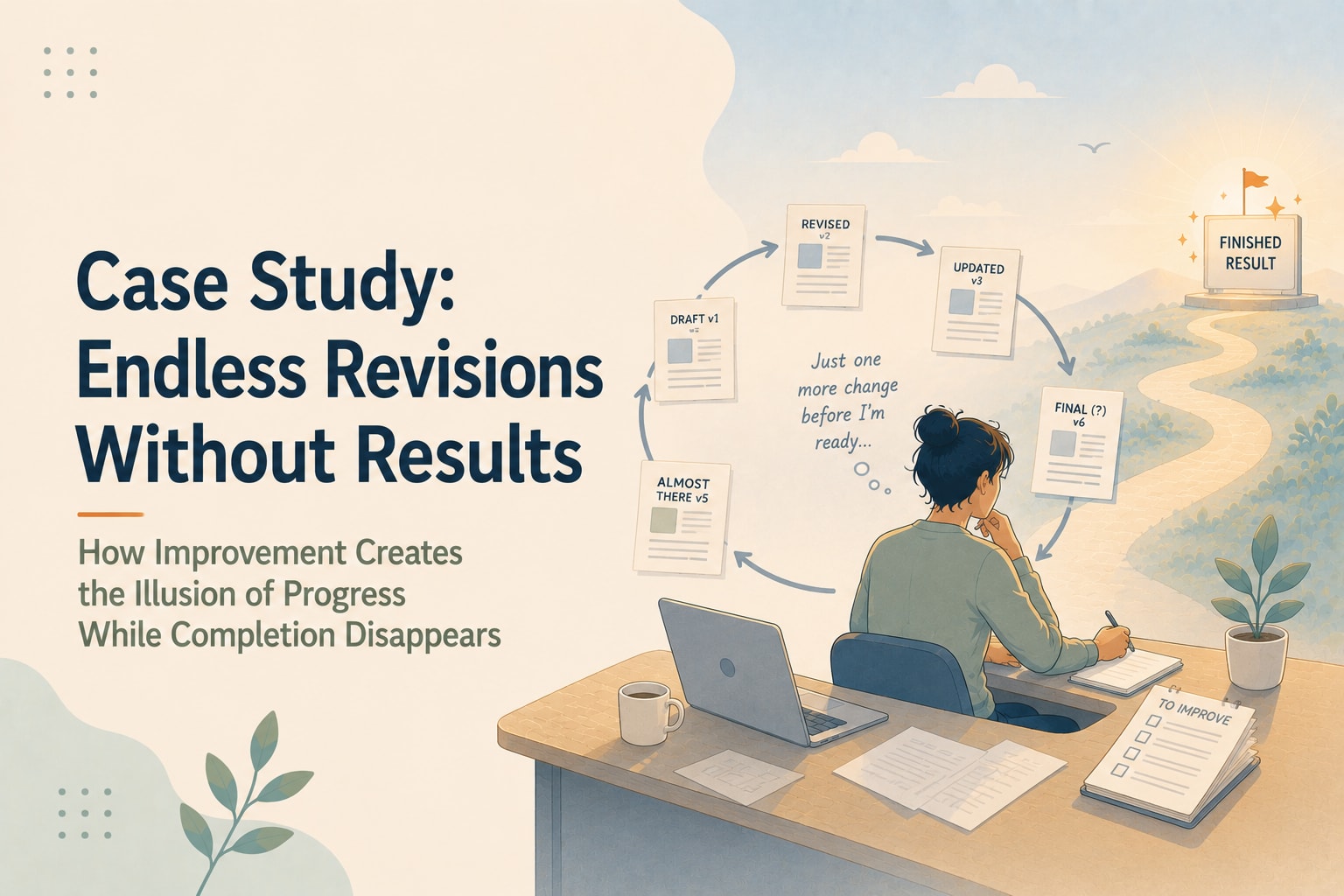
Case Study: Endless Revisions Without Results
Endless revisions without results often begin with a reasonable decision.
Something could be clearer.
A section could be stronger.
The design could look more consistent.
The wording could sound more precise.
The person returns to the work and improves it.
Nothing about the action appears unusual.
But the same thing happens again.
Another weakness becomes visible.
Another version is created.
Another deadline moves.
The work continues changing, yet the result remains absent.
You might not notice it at first.
The person is still active.
The project is still receiving attention.
But if you look closely, the sequence repeats.
The work improves in private while completion remains permanently ahead.
What Endless Revisions Without Results Describe
This pattern appears when revision stops serving completion and begins replacing it.
The person is not refusing to work.
They may be spending more time on the project than anyone else would.
The difficulty is that their effort no longer increases the amount of finished work.
It only increases the number of versions.
One document becomes seven documents.
One presentation receives repeated redesigns.
One video is edited for weeks.
One application is rewritten until the opportunity has passed.
Each revision appears connected to quality.
Together, they form a loop.
The loop usually begins after the work has already reached a functional standard.
The main idea is present.
The central problem has been solved.
The output can already perform its intended purpose.
What remains is not always essential improvement.
It is often an attempt to reduce the uncertainty attached to releasing the work.
This is one of the ways self-sabotage patterns can remain hidden inside discipline.
The person keeps moving.
The goal does not.
The Stages of the Endless Revision Loop
The pattern becomes easier to recognize when it is broken into stages.
Stage 1: The work becomes functional
The project reaches a point where it could be submitted, published, presented, or used.
It is not flawless.
But another person could understand it and receive value from it.
This is the first point where the work becomes exposed to response.
Stage 2: One imperfection becomes central
A small weakness attracts attention.
The introduction feels ordinary.
The design looks less polished than expected.
One sentence may be misunderstood.
The issue may be real, but its importance begins to expand.
The mind stops seeing the work as a whole.
It begins organizing attention around the flaw.
Stage 3: Revision creates relief
The person fixes the problem.
The revised version feels safer.
For a short time, confidence returns.
This relief matters.
It teaches the brain that discomfort can be reduced by returning to the work instead of releasing it.
Revision becomes more than a quality-control step.
It becomes a way to regulate uncertainty.
Stage 4: Increased attention reveals more flaws
The new version is reviewed again.
Because attention is now trained on weaknesses, another problem appears.
A sentence sounds repetitive.
The structure could be smoother.
The colour choice feels inconsistent.
The work is objectively more polished, yet the person feels less certain about it.
This is where overthinking loops often become part of the process.
Review creates questions.
Questions create revisions.
Revisions create more review.
Stage 5: Completion becomes emotionally defined
The person no longer asks whether the work is useful.
They ask whether it feels ready.
That change makes completion difficult to measure.
Usefulness can be evaluated.
Emotional certainty cannot.
The finish line begins moving according to confidence, fear, and imagined criticism.
Stage 6: Results disappear while effort continues
The deadline is delayed.
The application is not submitted.
The article remains unpublished.
The project never reaches the people it was created for.
The person continues refining, but there is no external result to show what mattered.
Limited results create more self-doubt.
Self-doubt creates more revisions.
The loop returns to its beginning.
Why the Mind Repeats This Loop
The brain repeats the revision loop because revision offers control.
Before release, almost everything can still be changed.
The person can alter the wording, replace the design, adjust the structure, or delay the decision.
Once the work is released, control becomes limited.
Other people can respond in ways that cannot be edited.
They may misunderstand the work.
Ignore it.
Question it.
Value something the creator considered unimportant.
The person cannot fully prepare for these outcomes.
Revision creates the impression that enough improvement might remove the uncertainty.
But the uncertainty does not come only from flaws in the work.
It comes from exposure itself.
This is why the pattern often overlaps with fear of judgment psychology.
A possible weakness becomes a possible criticism.
A possible criticism becomes a reason to revise.
The mind also learns from temporary relief.
Every postponed release reduces immediate tension.
The person feels more prepared because they are no longer required to act today.
That reduction in discomfort reinforces the delay.
The next time completion approaches, the brain offers the same strategy again.
Find another problem.
Create another version.
Postpone the result.
Where This Pattern Appears in Daily Life
Endless revisions without results can appear anywhere work remains editable.
A writer changes the introduction repeatedly while the article stays unpublished.
A job seeker rewrites a résumé for every possible concern but submits very few applications.
A student improves one section of an assignment while the deadline approaches.
A creator records the same video several times because each version reveals another minor weakness.
A business owner keeps changing a website instead of showing the offer to real customers.
Someone rewrites a message until the original reason for sending it becomes unclear.
The same pattern appears in planning.
A person repeatedly adjusts a schedule, budget, strategy, or routine without using any version long enough to produce evidence.
They remain busy designing a system that is never tested.
The specific activity changes.
The behavioral structure remains stable.
Functional work appears.
An imperfection gains attention.
Revision creates relief.
Another imperfection appears.
Completion moves further away.
You can see this sequence in The Project That Never Launched, where continuous improvement allows a project to remain active without ever becoming real.
What Keeps the Revision Cycle Going
Several psychological rewards keep the pattern in place.
Perfectionism
The standard gradually shifts from useful to difficult to criticize.
The person becomes more focused on preventing flaws than producing value.
This is closely connected to maladaptive perfectionism, where high standards begin interfering with completion.
Identity protection
Finished work creates evidence.
It can reveal strengths, limitations, and ordinary mistakes.
Unfinished work preserves possibility.
The person can continue believing the project will be exceptional once it is finally ready.
Completion resistance
Finishing changes the status of the work.
It is no longer private preparation.
It becomes something that can succeed, fail, or be ignored.
This is why completion resistance often appears near the end rather than the beginning.
Lack of external feedback
Unreleased work cannot show the person which concerns were meaningful.
Without real feedback, imagined problems remain powerful.
The person continues revising against possibilities rather than evidence.
The appearance of productivity
Revision produces visible activity.
Files are updated.
Changes are made.
Hours are recorded.
Because the effort is real, it can be difficult to notice that the result is not moving.
Final Reflection
Endless revisions without results do not usually look like avoidance.
They look like care.
The person appears committed to quality.
They continue working long after others would have stopped.
But the function of the work has changed.
Earlier revisions improve the output.
Later revisions reduce the discomfort of releasing it.
That difference is easy to miss because the actions look almost identical.
The sequence is quiet:
Create something functional.
Notice a flaw.
Revise it.
Feel temporary relief.
Review again.
Find another flaw.
Delay completion.
Lose real feedback.
Become less certain.
Revise again.
The project does not collapse.
It remains active.
That is what makes the loop difficult to recognize.
The work is never clearly abandoned.
It is kept in a permanent state of improvement.
Related Patterns
If this loop feels familiar, it often connects to other patterns.
- The Output Over Refinement Framework explains how improvement can quietly replace visible progress.
- The 80% Completion Rule maps why resistance often increases after the main work is already complete.
- Completion Resistance Definition explores why finishing can feel more threatening than continuing to prepare.
- The Project That Never Launched shows how repeated preparation can keep a functional project permanently private.
- The Complete Guide to Self-Sabotage Patterns connects this loop to the wider system of behaviors that preserve effort while interrupting results.
