import Image from "next/image";
export const metadata = { title: "Why You Keep Refining Small Details: The Psychology of Endless Fine-Tuning", description: "Why you keep refining small details explains how perfectionism, uncertainty, and the desire to avoid mistakes can turn healthy improvement into endless revision.", };
export const slug = "why-you-keep-refining-small-details";
export const tags = [ "why you keep refining small details", "perfectionism patterns", "self sabotage patterns", "overthinking loops", "fear of criticism", "attention to detail psychology", "decision fatigue", "human behavior psychology" ];
Why You Keep Refining Small Details
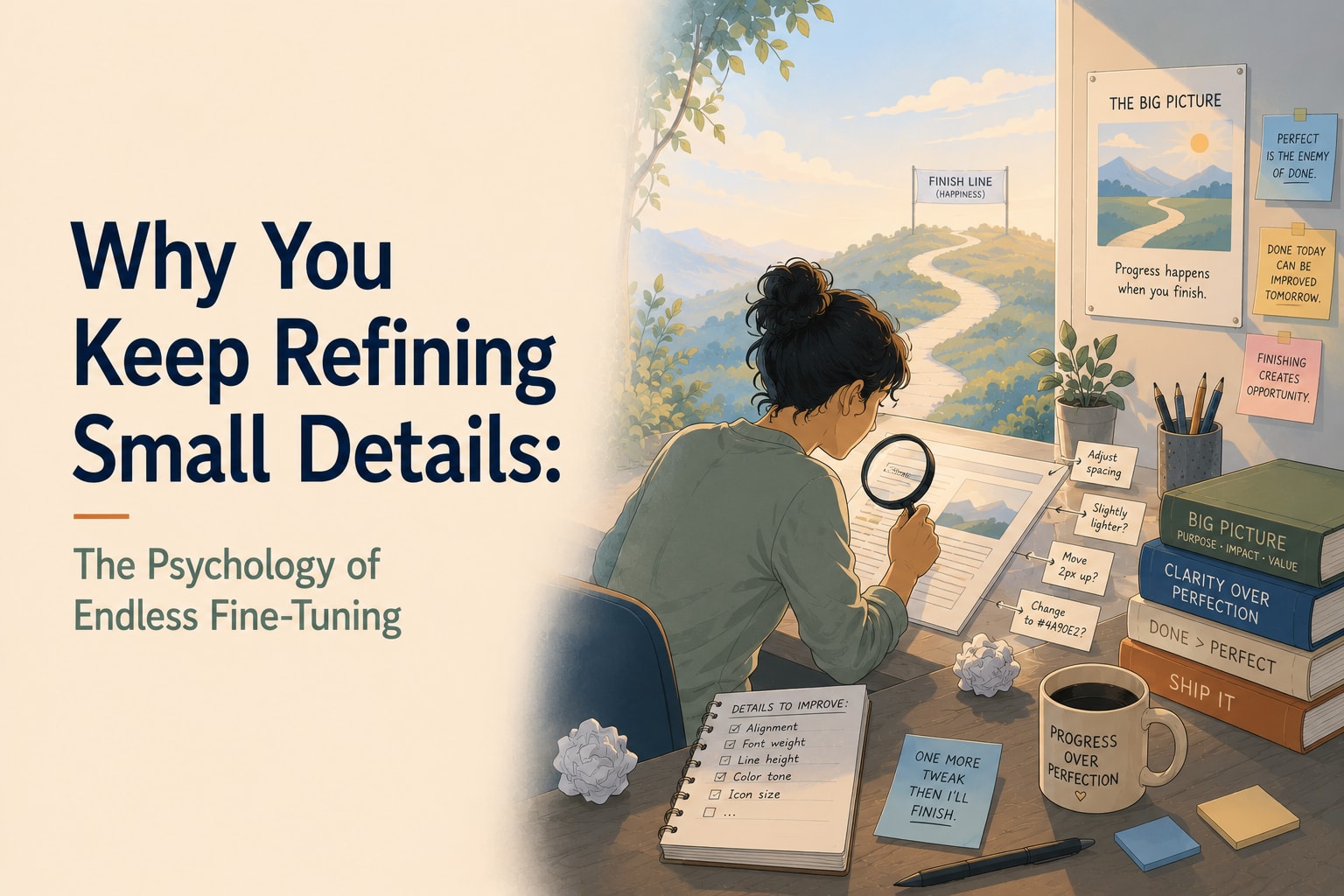
<Image src="/images/why-you-keep-refining-small-details-banner.jpg" alt="Minimal editorial illustration of a person using a magnifying glass to polish tiny details on a nearly finished project while the larger picture waits in the background." width={1600} height={900} priority style={{ width: "100%", height: "auto", borderRadius: "16px", marginTop: "1rem", marginBottom: "2rem", }} />
Have you ever spent thirty minutes changing a sentence that already made sense?
Or rearranged the layout of a document long after the important work was finished?
Maybe you've adjusted a presentation over and over, convinced that one more change would finally make it ready.
At first, this feels like being careful.
It feels responsible.
It feels like producing quality work.
But if you look closely, something interesting appears.
The more attention you give the smallest details, the harder it becomes to decide that the work is finished.
That is the hidden psychology behind why you keep refining small details.
What This Concept Means
Why you keep refining small details describes a psychological pattern where attention gradually shifts away from the overall purpose of a task and becomes increasingly focused on minor improvements.
Refining details is not a problem by itself.
In fact, it is often a sign that you care about doing good work.
The difficulty begins when every improvement creates another improvement.
A paragraph becomes a sentence.
A sentence becomes a word.
A word becomes a punctuation mark.
Eventually, the project stops moving forward.
It simply becomes more polished in increasingly smaller ways.
The interesting part is that these changes often produce very little difference to anyone else.
Yet to the person doing the work, they feel deeply important.
The project begins to feel unfinished, even when it already serves its purpose.
This pattern often overlaps with larger self-sabotage patterns, where progress quietly slows because the mind struggles to accept that something is complete.
Why the Brain Creates This Pattern
The brain dislikes uncertainty.
Finishing a project means accepting that it is no longer under your control.
Once you publish the article...
Send the email...
Launch the business...
Or submit the application...
Other people become part of the story.
They may praise your work.
They may criticize it.
They may ignore it completely.
The brain cannot predict those outcomes.
But it can control one thing.
The next revision.
Making another small improvement creates a brief feeling of certainty.
For a moment, it feels like you are reducing risk.
That emotional relief teaches the brain that refining details is helpful.
Over time, the habit becomes automatic.
Instead of asking,
"Does this project accomplish its purpose?"
The brain begins asking,
"Could this tiny part be slightly better?"
That question has no obvious ending.
It also feeds the kind of overthinking loops that make simple decisions feel increasingly difficult.
The project may already be complete.
Your mind simply has not accepted that it is safe to stop.
How This Pattern Appears in Daily Life
This behavior often hides inside ordinary routines.
A writer keeps rewriting the introduction after finishing the article.
A designer spends hours adjusting colors that most people would never notice.
A student keeps changing formatting instead of submitting the assignment.
Someone preparing for an interview keeps researching instead of applying.
A business owner delays launching because one page of the website still feels imperfect.
A content creator exports the same video several times because each version reveals another tiny flaw.
Notice what these examples have in common.
The biggest problems have already been solved.
The remaining work becomes smaller and smaller.
Yet emotionally, those tiny details begin feeling larger than the important work that came before them.
You might not notice it at first.
But the project slowly stops being about improvement.
It becomes about avoiding the discomfort of calling it finished.
Why People Often Miss It
One reason this pattern is difficult to recognize is because it looks productive.
You are still working.
You are still making changes.
You are still investing effort.
From the outside, it appears that you are committed to quality.
Inside your mind, however, something different may be happening.
The revisions are no longer creating meaningful value.
They are creating emotional comfort.
Each small adjustment postpones the moment when the work becomes visible to other people.
That makes the behavior feel justified.
After all, who could argue against making something better?
The problem is that "better" quietly becomes impossible to define.
Without realizing it, you begin measuring progress by how many details remain to improve instead of whether the project fulfills its purpose.
Over time, this changes your relationship with completion.
Finishing starts to feel irresponsible.
Stopping feels careless.
The smallest imperfections begin carrying far more emotional weight than they deserve.
Eventually, you trust endless refinement more than your own judgment.
Final Reflection
Why you keep refining small details is not really about details.
It is about certainty.
It is about the quiet hope that one more adjustment will remove every possible mistake before the world sees your work.
But that moment rarely arrives.
There will almost always be another sentence to improve.
Another image to replace.
Another paragraph to rewrite.
Another idea to reconsider.
The question is not whether the work could become slightly better.
Almost everything can.
The more useful question is whether another hour of refinement will meaningfully improve the outcome—or simply delay it.
That distinction changes everything.
Because good work is not created by polishing forever.
It is created by knowing when the details have served their purpose.
Sometimes the most difficult part of creating something meaningful is not beginning.
It is deciding that what you have created is ready to exist without you changing it one more time.
Q: Why do I keep changing small details after a project is finished?
A: This often happens because your brain is trying to reduce uncertainty. Small revisions create a temporary feeling of control, making it harder to decide that the work is complete.
Q: Is refining small details a sign of perfectionism?
A: It can be. Paying attention to details is healthy, but when endless refinement prevents completion, it often becomes part of perfectionism rather than quality improvement.
Q: Why do tiny mistakes bother me so much?
A: When a project feels personally important, the brain can treat small flaws as larger threats than they really are. This makes minor imperfections seem much more significant than they appear to others.
Q: How is refining details connected to overthinking?
A: Endless refinement often grows out of overthinking loops, where the mind repeatedly searches for improvements instead of deciding that the work is good enough to move forward.
