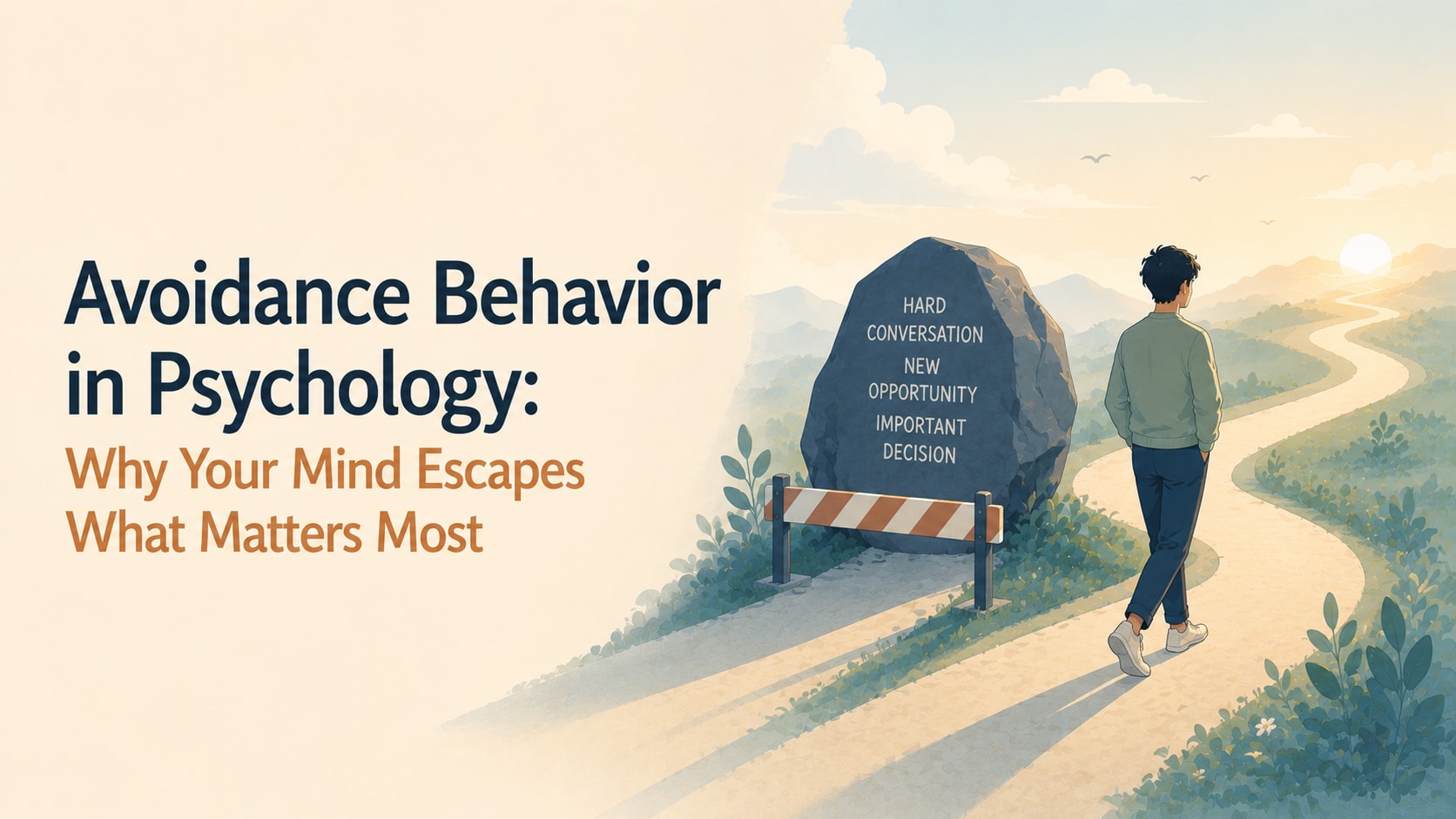
Avoidance Behavior in Psychology
Avoidance behavior in psychology often looks nothing like avoidance.
You don't always run away.
Sometimes you simply wait.
You postpone the conversation.
You leave the email unanswered.
You promise yourself you'll start tomorrow.
You decide you'll feel more prepared next week.
From the outside, it looks harmless.
Sometimes it even looks responsible.
But if you look closely, something interesting appears.
The task isn't disappearing.
You're simply staying far enough away from it that you don't have to feel uncomfortable.
That's where the pattern begins.
What avoidance behavior actually means
Avoidance behavior in psychology is a pattern where a person reduces emotional discomfort by avoiding situations, decisions, thoughts, or actions that feel threatening.
The important word isn't avoiding.
It's discomfort.
Most people aren't avoiding the task itself.
They're avoiding what the task might make them feel.
Embarrassment.
Rejection.
Failure.
Conflict.
Uncertainty.
Those emotions become the real obstacle.
The mind quietly learns that if it delays the situation, it also delays the uncomfortable feeling.
For a moment, that works.
Relief arrives.
But so does repetition.
This is why avoidance behavior often becomes part of larger self-sabotage patterns.
It protects you in the short term while quietly limiting you in the long term.
The behavior most people don't notice
Avoidance isn't always obvious.
Most people imagine avoidance as refusing to do something.
Real life is usually quieter.
Avoidance sounds like:
"I'll think about it later."
"Now isn't the best time."
"I need to prepare more first."
"I'll do it once I feel ready."
Each sentence sounds reasonable.
Sometimes it's even true.
The problem isn't saying those things once.
The pattern begins when they become your automatic response whenever something feels emotionally uncomfortable.
You might not notice it at first.
Because avoidance often disguises itself as planning.
Preparation.
Patience.
Careful thinking.
That disguise is what makes it difficult to recognize.
Why the mind does this
The brain naturally tries to reduce emotional pain.
It constantly predicts possible outcomes.
If it expects discomfort, it searches for a way to prevent it.
Avoidance becomes one of the fastest solutions.
Not because it solves the problem.
Because it immediately lowers emotional tension.
Imagine postponing a difficult phone call.
For a few minutes, you feel better.
Nothing changed.
The conversation still exists.
But the anxiety briefly disappears.
Your brain notices that relief.
Next time something similar appears, it remembers.
"Avoiding worked before."
Slowly, avoidance becomes a habit instead of a decision.
This is why avoidance behavior frequently overlaps with overthinking loops.
Thinking feels safer than acting.
Planning feels safer than beginning.
The mind mistakes temporary relief for permanent protection.
Where this pattern appears in daily life
Avoidance behavior is surprisingly ordinary.
It appears in moments most people never connect together.
You don't apply for the opportunity.
You avoid checking your bank account.
You postpone making a doctor's appointment.
You keep rewriting instead of publishing.
You scroll your phone before beginning an important task.
You stay busy with small jobs while avoiding the meaningful one.
You delay replying to someone because you're unsure what to say.
Each behavior looks different.
But underneath them sits the same pattern.
The mind is protecting itself from anticipated discomfort.
Not actual danger.
Just anticipated discomfort.
That's an important distinction.
The hidden effect of this pattern
Avoidance feels effective because it works immediately.
The uncomfortable emotion becomes quieter.
But only temporarily.
The situation remains.
Sometimes it even grows.
Deadlines get closer.
Conversations become harder.
Decisions become heavier.
Meanwhile, something else quietly changes.
Your confidence.
Every avoided experience becomes one less opportunity to discover that you could probably handle it.
Without realizing it, the brain starts collecting evidence that avoidance is necessary.
Not because you've failed.
Because you've never given yourself the chance to succeed.
That's why avoidance often strengthens itself over time.
Relief today creates hesitation tomorrow.
What this reveals about human behavior
Avoidance behavior reveals something deeply human.
People rarely organize their lives around what they want.
They often organize them around what they hope not to feel.
That changes everything.
It explains why intelligent people delay simple tasks.
Why capable people doubt themselves.
Why opportunities quietly pass by.
The goal isn't always success.
Sometimes the unconscious goal is simply avoiding emotional discomfort.
You might not notice it at first.
But if you look closely, something interesting appears.
Avoidance isn't really about the task.
It's about the feeling attached to the task.
Once you see that, many behaviors suddenly make sense.
Final reflection
Avoidance behavior isn't weakness.
It's protection.
The mind believes it's keeping you safe.
And sometimes it genuinely is.
But protection can quietly become limitation when it never allows you to discover what happens beyond the discomfort.
The next time you delay something important, pause for a moment.
Ask yourself a different question.
"Am I avoiding the task... or the feeling I expect the task to create?"
That single question won't eliminate the pattern.
But it often reveals it.
And awareness is where every hidden behavioral loop first becomes visible.
Q: What is avoidance behavior in psychology?
A: Avoidance behavior is a psychological pattern where people escape situations, thoughts, or actions that create emotional discomfort, even when avoidance creates bigger problems later.
Q: Why does avoidance behavior happen?
A: The brain naturally seeks relief from anxiety, uncertainty, rejection, or fear. Avoidance temporarily reduces those feelings, which reinforces the behavior.
Q: Is avoidance behavior related to overthinking?
A: Yes. Many people avoid action by entering overthinking loops, believing more thinking will remove uncertainty before they act.
Q: Is avoidance behavior a form of self-sabotage?
A: It often becomes one. When temporary emotional relief repeatedly replaces meaningful action, avoidance develops into larger self-sabotage patterns.
Related Patterns
If this pattern feels familiar, it often connects to other hidden behaviors.
