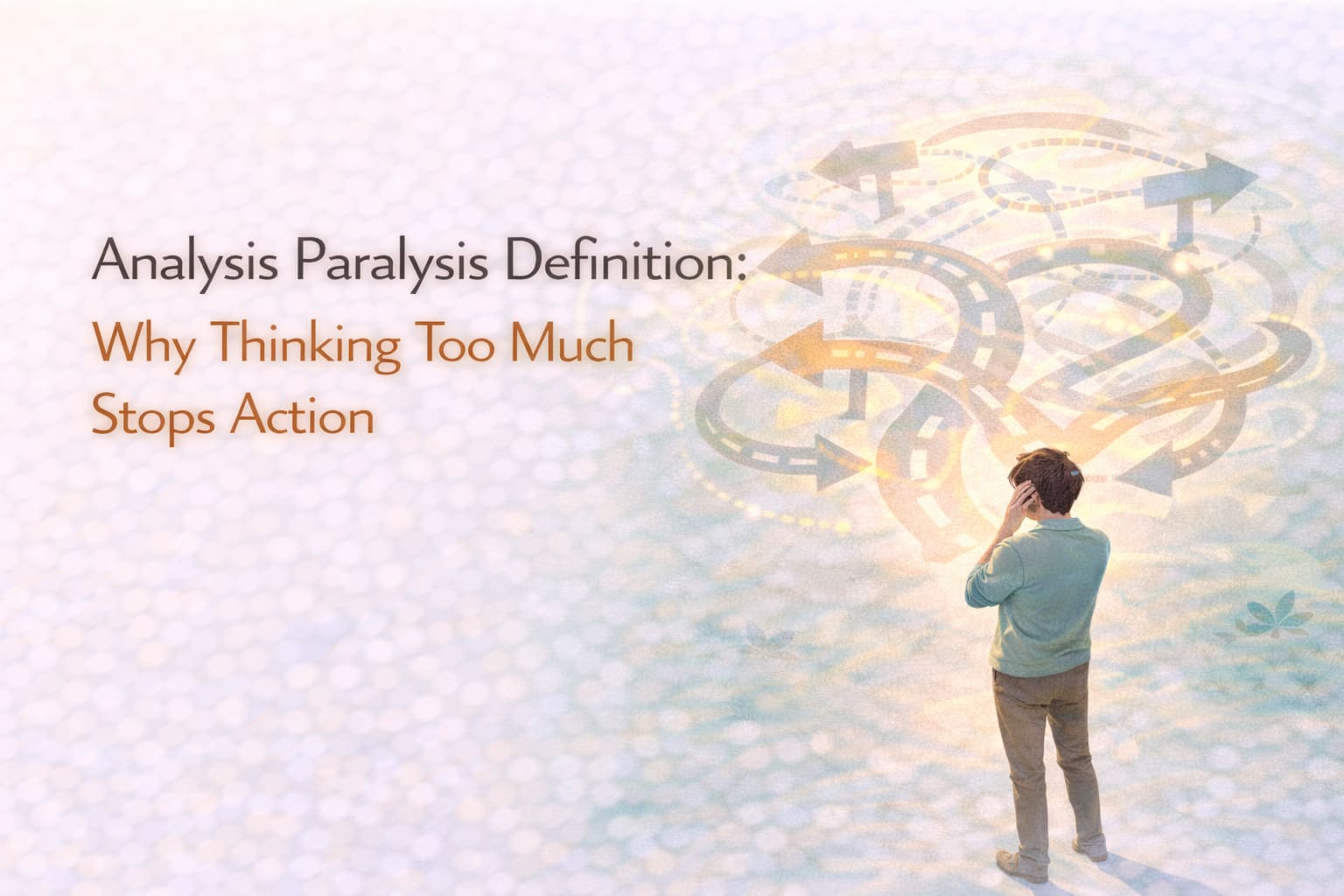
Analysis Paralysis Definition
Analysis paralysis definition often becomes clear in a moment you’ve experienced before.
You need to decide something.
The options are there.
The information is there.
The next step is known.
But instead of choosing…
You keep thinking.
You compare.
You re-evaluate.
You look at the same decision from different angles.
And at some point, something subtle happens.
You stop moving forward.
Not because you don’t understand.
But because you’re still analyzing.
You might not notice it at first.
But if you look closely, something interesting appears.
The thinking continues.
The decision doesn’t.
What this actually means
Analysis paralysis is a psychological pattern where excessive thinking prevents decision-making, even when enough information is already available.
It starts as normal analysis.
You gather details.
You weigh options.
You try to make the best choice.
But instead of reaching a point and acting, the mind continues.
It keeps searching.
It keeps comparing.
It keeps questioning.
At some point, the thinking stops being useful.
And starts repeating.
This is where analysis turns into paralysis.
It often connects directly to:
Where thinking continues past clarity.
The behavior most people don’t notice
Analysis paralysis doesn’t feel like being stuck.
It feels like being careful.
You tell yourself you need more clarity.
More certainty.
More confidence before acting.
So you keep thinking.
But something subtle changes.
The questions don’t lead anywhere new.
The answers don’t change.
The decision remains the same.
And yet, it still feels incomplete.
That’s where the pattern hides.
Inside what feels like responsible thinking.
Why the mind does this
The brain prefers certainty.
Especially when a decision feels important.
Uncertainty creates tension.
It creates the possibility of being wrong.
So the brain tries to eliminate that risk.
It does this through analysis.
More thinking.
More comparison.
More evaluation.
Several patterns drive this behavior.
Fear of failure
The mind tries to avoid making the wrong choice.
Self-doubt cycles
You question whether your judgment is reliable.
Perfectionism patterns
The decision must feel “right” before action.
Control illusion
Thinking creates the sense that you are managing the outcome.
But some decisions cannot be made with full certainty.
And when the brain cannot reach that certainty, it continues.
This is how analysis paralysis becomes part of:
Not through bad decisions.
But through delayed ones.
Where this pattern appears in daily life
Analysis paralysis shows up in ordinary moments.
You spend too long choosing between simple options.
You delay starting a task because you’re still planning it.
You research something repeatedly without acting.
You rethink a decision you already made.
You hesitate before taking a step you already understand.
Each moment feels small.
But the pattern repeats.
The thinking continues.
The action doesn’t.
That’s the key difference.
The hidden effect of this pattern
Analysis paralysis doesn’t just delay decisions.
It changes how you experience them.
Decisions begin to feel heavier.
More complicated.
More important than they actually are.
Over time, something shifts.
Confidence weakens slightly.
Not because you lack clarity.
But because you stop trusting it.
The brain begins expecting perfect certainty before action.
But that level of certainty rarely exists.
This creates a cycle.
The more you think, the harder it becomes to decide.
The harder it becomes to decide, the more you think.
And the loop continues.
What this reveals about human behavior
Analysis paralysis reveals something important about the mind.
The brain believes that more thinking will eventually remove uncertainty.
But some uncertainty cannot be removed through thinking alone.
It can only be experienced through action.
You might not notice it at first.
But if you look closely, something interesting appears.
The answer often arrives early.
The thinking continues anyway.
Not because the answer is missing.
But because the outcome feels uncertain.
That’s where the pattern begins.
Final reflection
Analysis paralysis doesn’t begin as a problem.
It begins as effort.
Care.
Attention.
But somewhere along the way, it changes.
The mind stops deciding.
And starts circling.
You might not notice it at first.
Because it feels like progress.
But if you look closely, something becomes clear.
The loop begins after the answer is already there.
And once you see that, something shifts.
You begin recognizing the difference between thinking…
And deciding.
Q: What is analysis paralysis in psychology?
A: Analysis paralysis is a pattern where overthinking prevents decision-making, even when enough information is already available.
Q: Why does analysis paralysis happen?
A: It happens because the brain tries to reduce uncertainty and avoid mistakes by continuing to analyze instead of acting.
Q: Is analysis paralysis related to overthinking?
A: Yes. It is a form of overthinking where analysis continues beyond usefulness and delays action.
Q: How can I recognize analysis paralysis?
A: When you keep thinking about a decision without making progress or taking action, you are likely experiencing it.
Related Patterns
If this pattern feels familiar, it often connects to other behaviors.
