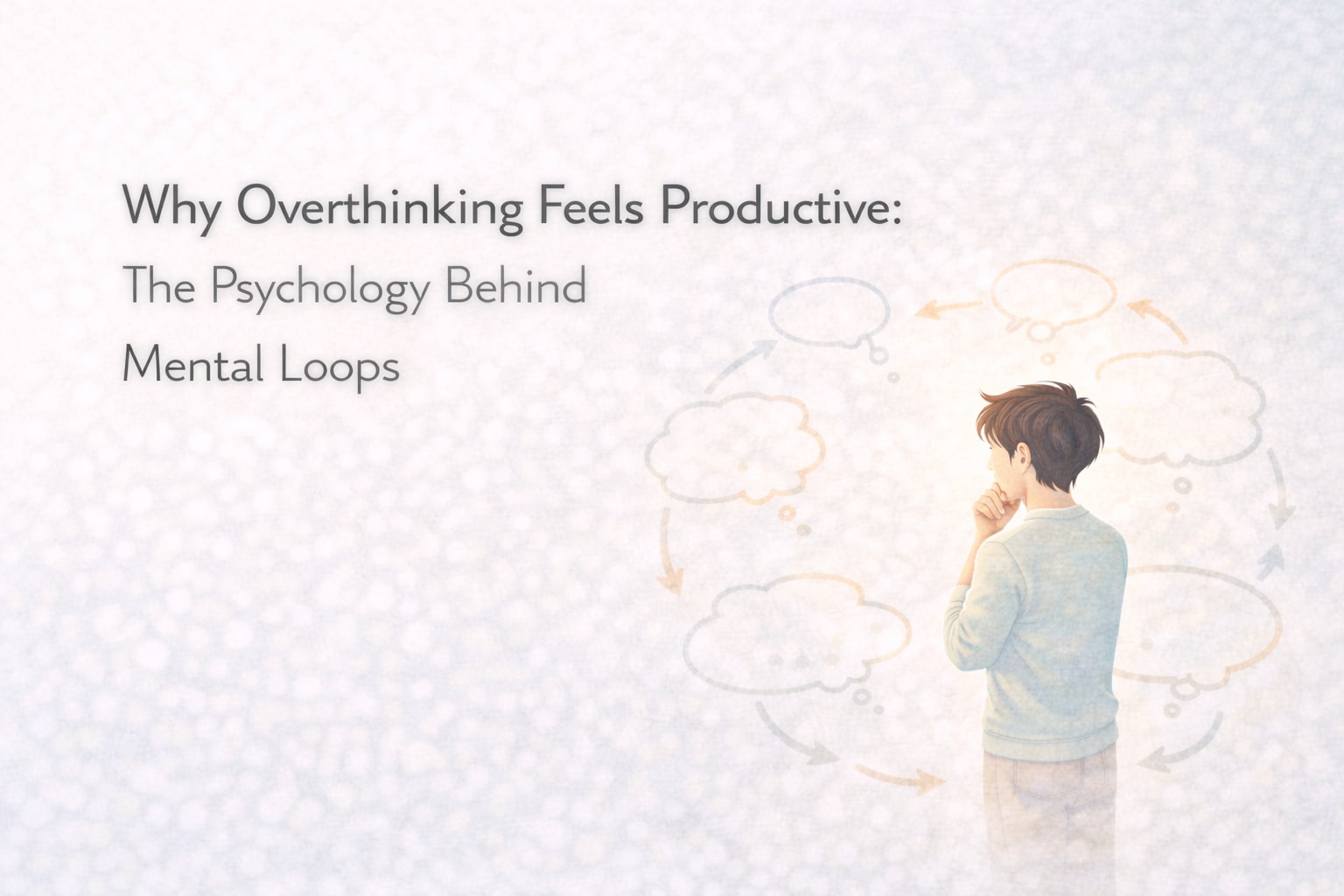
Why Overthinking Feels Productive
You sit with a decision for a while.
You think about it carefully.
You analyze the options.
You imagine different outcomes.
You replay possible conversations in your head.
At first, it feels responsible.
Thinking things through feels like progress.
But an hour passes.
Then another.
The decision still hasn't moved forward.
This is the quiet reason why overthinking feels productive.
The mind is active.
Thoughts are moving.
Ideas are being examined.
From the inside, it feels like work.
But sometimes the movement is only happening in your head.
And that difference matters.
Overthinking often appears thoughtful and responsible, but many times it becomes a subtle pattern connected to self-sabotage behavior.
If you want to understand how these mental loops fit into a bigger behavioral framework, you can explore the full guide here:
The Complete Guide to Self-Sabotage Patterns
What This Behavior Actually Is
When people ask why overthinking feels productive, the answer usually lies in how the brain interprets mental activity.
Thinking creates the sensation of effort.
The brain associates effort with progress.
So when you're analyzing something deeply, it feels like you're moving forward.
But thinking and progress are not always the same thing.
Overthinking happens when the mind continues analyzing a situation after useful thinking has already happened.
Instead of producing new clarity, the mind begins repeating similar thoughts.
Different versions of the same scenario.
Different interpretations of the same information.
The activity continues, but the result stays the same.
This is the core of overthinking loops.
The brain believes it is solving a problem.
In reality, it may just be revisiting it.
If you want to explore the full behavioral pattern behind this dynamic, this article explains it in detail:
Why the Brain Does This
The reason why overthinking feels productive is connected to how the brain manages uncertainty.
When something important appears — a decision, a risk, a conversation — the brain wants to reduce possible mistakes.
Thinking becomes the brain's tool for protection.
Several psychological mechanisms reinforce this behavior.
Control illusion
Thinking about a situation creates the feeling that you are managing it.
Even if no action happens yet, the mind feels involved.
Risk reduction
The brain searches for ways to prevent negative outcomes.
Analyzing scenarios feels like preparation.
Cognitive activity reward
Mental activity can feel satisfying.
Solving puzzles, evaluating possibilities, and imagining outcomes stimulate the brain.
Uncertainty discomfort
Humans dislike uncertainty.
Overthinking becomes an attempt to remove it.
The difficulty is that uncertainty rarely disappears through thinking alone.
Sometimes it disappears only after action.
But the brain doesn't always recognize that difference.
The Hidden Cost
If overthinking feels productive, the brain has little reason to stop doing it.
That’s where the hidden cost appears.
The longer thinking replaces action, the more progress slows down.
Several subtle consequences often appear.
Delayed decisions
Choices remain unresolved longer than necessary.
Mental fatigue
Repeated analysis drains attention and energy.
Reduced momentum
Opportunities often depend on timing.
Too much thinking can slow movement.
Increased anxiety
Ironically, overthinking often amplifies the very worries it tries to solve.
Thoughts repeat.
Possible problems multiply.
And the situation begins to feel heavier than it actually is.
Over time, this pattern can quietly become one of the most common forms of self-sabotage.
Not dramatic sabotage.
Quiet delay.
Small hesitation.
Repeated reconsideration.
A Small Shift That Changes the Pattern
Breaking the cycle doesn't require eliminating thoughtful thinking.
Thinking is valuable.
The shift is learning when thinking has already done its job.
A few small insights can change how the pattern works.
Notice the moment thinking becomes repetition
Useful thinking creates new information.
Overthinking repeats the same information.
Recognizing that moment is powerful.
Separate thinking time from action time
Give your mind time to analyze a situation.
But once that window ends, move toward action.
Even a small step changes the dynamic.
Accept that clarity often comes after movement
Many people wait for perfect clarity before acting.
In reality, clarity often appears because of action, not before it.
When the brain sees that progress continues even with uncertainty, the overthinking loop weakens.
Final Reflection
Overthinking rarely begins as a problem.
It begins as responsibility.
You care about the outcome.
You want to make the right choice.
So you think carefully.
But sometimes careful thinking slowly turns into a loop.
A loop that feels active.
A loop that feels productive.
Yet nothing moves forward.
Understanding why overthinking feels productive reveals something important about human behavior.
The brain often confuses mental activity with progress.
And once you notice that difference, something interesting happens.
The next time your thoughts start circling the same idea again and again, you'll recognize the pattern sooner.
Not as thinking.
But as a loop.
And loops become much easier to step out of once you can see them.
Q: Why does overthinking feel productive?
A: Overthinking feels productive because the brain interprets mental effort as progress. Thinking creates the sensation of activity, even when no real action occurs.
Q: Is overthinking the same as careful thinking?
A: No. Careful thinking produces new clarity and decisions. Overthinking repeats the same analysis without moving toward action.
Q: Why do intelligent people overthink more?
A: Analytical minds naturally evaluate more possibilities and risks, which can increase the likelihood of entering overthinking loops.
Q: How can someone stop overthinking loops?
A: Limiting thinking time, recognizing repetitive thoughts, and taking small actions can interrupt the pattern and restore forward momentum.
