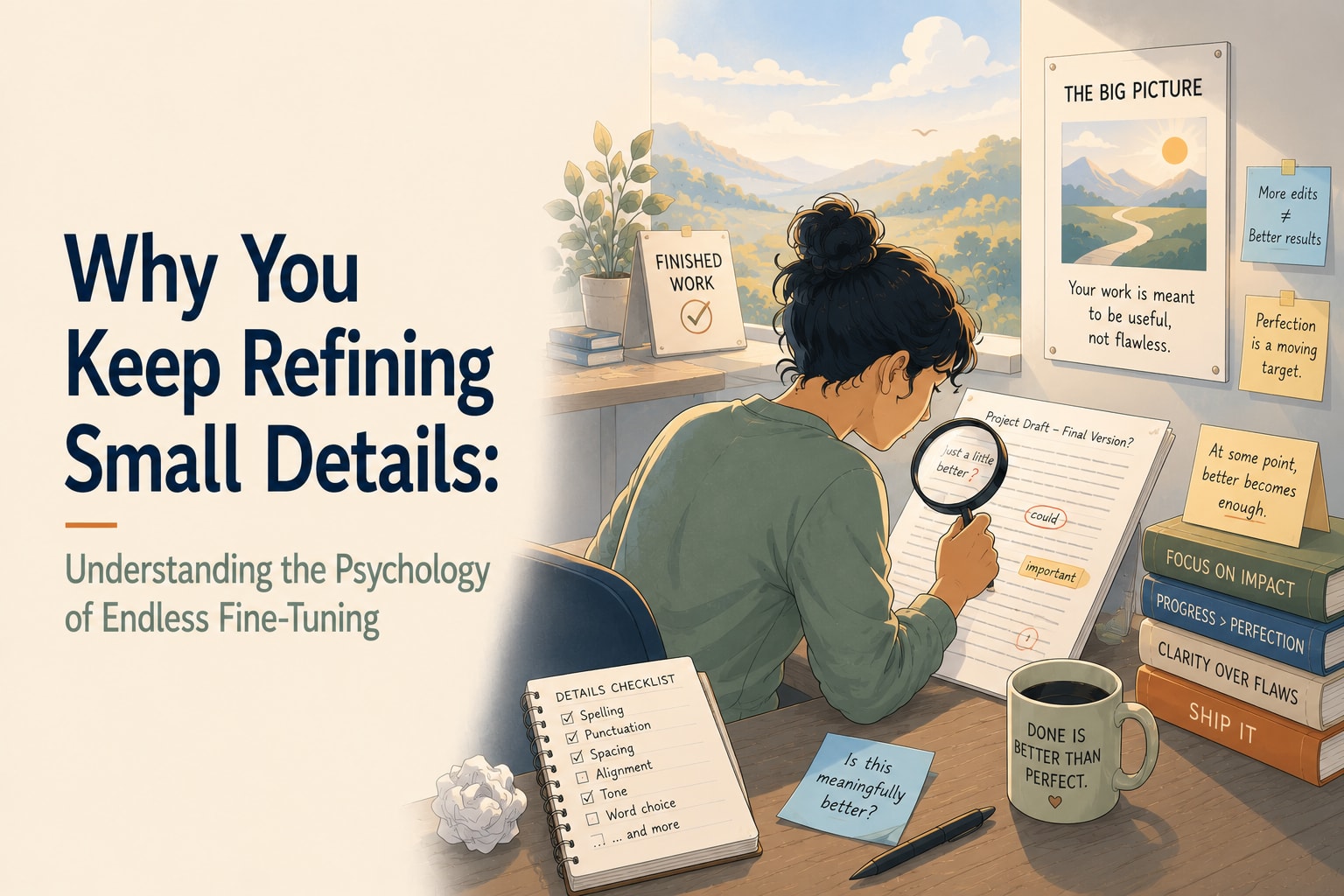
Why You Keep Refining Small Details
Have you ever spent more time adjusting the last five percent of a project than creating the first ninety-five?
Maybe you've rewritten the same paragraph ten times.
Changed the color of a button over and over.
Or spent an hour deciding between two words that mean almost the same thing.
At first, it feels like careful craftsmanship.
You simply want the work to be better.
But after a while, something changes.
The improvements become smaller.
The time spent becomes longer.
The project somehow feels less finished than it did an hour ago.
This is the psychology behind why you keep refining small details.
It is a surprisingly common mental pattern that often disguises itself as productivity.
What This Concept Means
Why you keep refining small details describes the tendency to continue making increasingly small improvements long after the important work has already been completed.
The goal is no longer to solve major problems.
Instead, attention becomes absorbed by tiny imperfections.
A sentence becomes a different sentence.
Then a different word.
Then different punctuation.
A presentation becomes a different font.
Then different spacing.
Then slightly different colors.
The project is still changing.
But the changes become harder and harder for anyone else to notice.
The interesting part is that the emotional importance of those tiny changes often grows larger as the practical importance becomes smaller.
In other words, the less the revisions actually matter, the more necessary they begin to feel.
That is why this pattern is often connected to larger self-sabotage patterns.
It does not stop progress by preventing work.
It stops progress by preventing completion.
Why the Brain Creates This Pattern
The brain likes certainty.
Finishing something removes certainty.
As long as a project remains unfinished, it still feels controllable.
You can improve it.
Correct it.
Protect it.
Once you release it into the world, that control disappears.
Other people form opinions.
Reality replaces imagination.
That transition creates emotional discomfort.
Without realizing it, the brain discovers a simple solution.
Keep improving.
Each small revision creates a brief sense of relief.
It feels like progress.
It feels responsible.
It feels safer than deciding the work is finished.
The brain begins rewarding refinement because refinement postpones uncertainty.
Eventually, the habit becomes automatic.
Instead of asking,
"Is this ready?"
You begin asking,
"Could this tiny detail still be slightly better?"
The problem is that this question has no natural ending.
There will almost always be another sentence to improve.
Another design choice to reconsider.
Another possibility to explore.
This is also why the pattern often becomes connected to overthinking loops.
Thinking continues long after useful decisions have already been made.
The mind mistakes continued activity for continued progress.
How This Pattern Appears in Daily Life
This behavior shows up in countless ordinary situations.
A writer finishes an article but spends another two hours rewriting the introduction.
A student spends more time adjusting formatting than reviewing ideas.
A business owner delays launching because the website still needs "one more improvement."
A photographer edits the same image repeatedly even though the differences are barely visible.
Someone writes an important email but keeps rereading it before pressing send.
A content creator exports multiple versions of the same video because each one contains a tiny flaw.
Notice something these situations have in common.
The project is rarely incomplete.
It simply feels incomplete.
The emotional experience becomes disconnected from reality.
Objectively, the work is ready.
Subjectively, the work still feels exposed.
The closer you get to finishing, the more your attention narrows.
Instead of seeing the entire project, your mind zooms in on details that once seemed insignificant.
You might not notice it at first.
But gradually, the details begin controlling the timeline instead of improving the outcome.
Why People Often Miss It
One reason this pattern is difficult to recognize is because it looks like dedication.
Nobody criticizes someone for caring about quality.
Attention to detail is usually considered a strength.
That makes the pattern easy to justify.
You tell yourself you're simply being thorough.
Professional.
Responsible.
But if you look closely, something interesting appears.
The revisions are no longer solving meaningful problems.
They are reducing emotional discomfort.
Every small improvement delays the moment when someone else can evaluate the work.
The project stays protected.
So does your confidence.
Unfortunately, protection comes with a hidden cost.
Every hour spent polishing tiny details is an hour not spent learning from real feedback.
The work cannot improve through experience because it never reaches experience.
Eventually, the mind begins trusting endless refinement more than completed action.
That is why people often feel busy while making surprisingly little progress.
Final Reflection
Why you keep refining small details is not really about details.
It is about the emotional meaning attached to completion.
Finishing something always involves uncertainty.
Someone might misunderstand your work.
Someone might dislike it.
Someone might ignore it altogether.
The brain naturally prefers another revision over another unknown.
But meaningful work rarely becomes meaningful because every tiny detail was perfect.
It becomes meaningful because it was completed.
The next time you find yourself adjusting something that already works, pause for a moment.
Ask yourself a different question.
Am I improving the work—or postponing the moment when I have to let it go?
The answer is often surprisingly revealing.
Because there comes a point where the greatest improvement is no longer another edit.
It is allowing the work to exist exactly as it is.
Q: Why do I keep changing small details after I've finished a project?
A: This usually happens because your brain is trying to reduce uncertainty. Small revisions create a temporary sense of control, making it emotionally difficult to decide the work is complete.
Q: Is refining small details a form of perfectionism?
A: It can be. Healthy attention to detail improves quality. Perfectionism continues refining long after meaningful improvements have stopped, making completion increasingly difficult.
Q: Why do tiny mistakes bother me more than they seem to bother other people?
A: When something feels personally important, your brain naturally magnifies imperfections. Small flaws begin to feel emotionally significant even when they have very little practical impact.
Q: How is refining small details connected to overthinking?
A: Endless refinement often grows from overthinking loops, where the mind repeatedly revisits finished decisions in search of certainty instead of accepting that the work is ready.
