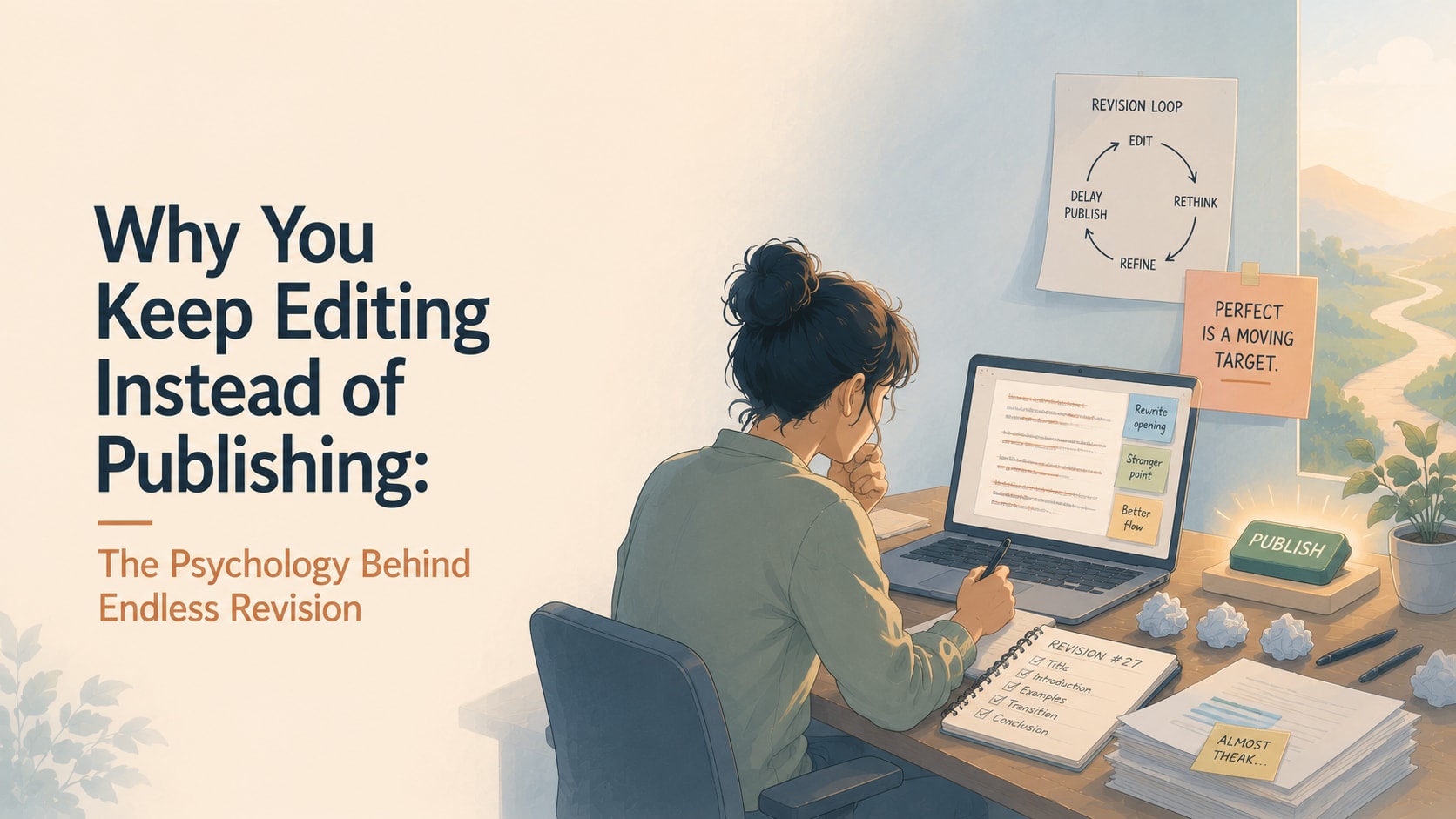
Why You Keep Editing Instead of Publishing
Why you keep editing instead of publishing becomes easier to understand when you notice what happens near the end of the work.
The article is mostly finished.
The video communicates the idea.
The post already says what you wanted it to say.
You could publish it.
Instead, you make another adjustment.
You replace one word.
You rewrite the opening.
You change the title.
You read everything again.
The work improves slightly.
But it still does not leave your hands.
You might not notice it at first.
Editing feels productive.
Publishing feels premature.
But if you look closely, something interesting appears.
The work is no longer being edited because it is unclear.
It is being edited because releasing it would make it visible.
That is where the pattern begins.
The Behavior Most People Don’t Notice
Editing is a necessary part of creating good work.
It helps you remove confusion.
Strengthen ideas.
Correct mistakes.
Make the final piece easier to understand.
The problem begins when editing stops serving the work and starts protecting you from publishing it.
That shift is subtle.
You do not decide to avoid publishing.
You simply notice another detail that could be improved.
Then another.
The sentence could flow better.
The design could look cleaner.
The argument could be stronger.
The work can always be changed, so the mind never runs out of reasons to delay.
This is why endless revision is difficult to recognize as avoidance.
You are still working.
You are still making decisions.
You may even be spending more time on the project than someone who has already published theirs.
From the inside, this feels like commitment.
From the outside, the result remains unfinished.
The work exists.
The release does not.
Why the Brain Does This
Before publishing, the work belongs entirely to you.
You control it.
You can change it.
You can imagine what it might become.
Once it is published, that control changes.
Other people can see it.
Interpret it.
Ignore it.
Criticize it.
The work becomes real in a way it was not while sitting privately in a draft.
That transition creates uncertainty.
Editing reduces that uncertainty temporarily.
Each revision gives the mind a reason to delay exposure while still feeling responsible.
Several psychological patterns often sit underneath this behavior.
Perfectionism
The work must feel flawless before it deserves to be seen.
Because flawless work does not exist, completion has no reliable endpoint.
Fear of criticism
Publishing creates the possibility that someone will notice a weakness you missed.
Another edit feels like protection against that possibility.
Self-doubt
You question whether the idea is valuable enough, clear enough, or original enough.
Editing becomes an attempt to make the work feel more legitimate.
Overthinking
You revisit decisions that have already been made.
This creates overthinking loops, where repeated thought feels useful even after it stops producing meaningful clarity.
The mind is not trying to prevent success.
It is trying to prevent discomfort.
Unfortunately, it often prevents both.
Where This Pattern Shows Up in Daily Life
This pattern is not limited to writers.
A content creator records the same video repeatedly without posting it.
A designer keeps changing a logo after the client’s needs have already been met.
A business owner delays launching a website because one section still feels unfinished.
A job seeker rewrites a résumé but never submits the application.
Someone drafts an important message, edits it for days, and leaves it unsent.
The surface behavior changes.
The structure remains the same:
Create → Review → Improve → Approach release → Feel exposed → Return to editing
The final stage is important.
The closer the work gets to being published, the more emotionally significant small flaws begin to feel.
A minor wording issue suddenly seems important.
A simple design choice becomes difficult.
The title needs another hour.
The ending needs another day.
This often creates a strange pattern where the most editing happens after the work is already good enough.
The revisions are no longer solving major problems.
They are helping the mind postpone the moment of exposure.
The Hidden Effect of This Pattern
The obvious effect is delayed publishing.
The deeper effect is delayed learning.
Private editing can only teach you so much.
Real feedback begins after the work enters the world.
You learn whether readers understand the point.
Whether the opening holds attention.
Whether the idea is useful.
Whether the imperfections you worried about matter to anyone else.
When publishing is delayed, that information is delayed too.
You continue improving the work based on imagined reactions rather than real ones.
This creates an illusion of progress.
The project changes.
Your understanding of the audience does not.
Confidence also becomes harder to build.
Confidence rarely comes from reaching a perfect standard.
It comes from surviving imperfect exposure.
You publish.
Nothing catastrophic happens.
You notice what worked.
You improve the next version.
Without that experience, publishing continues to feel unusually important.
The work becomes heavier because it has remained private for so long.
This is how endless editing can become one of the quieter self-sabotage patterns.
You are not destroying the work.
You are protecting it so carefully that it never gets the chance to do anything.
What This Reveals About Human Behavior
Why you keep editing instead of publishing reveals that people do not always pursue quality for the same reason.
Sometimes you improve the work because the work needs improvement.
Sometimes you improve it because you need protection.
Those two motivations can produce identical behavior.
Both may involve rewriting.
Rechecking.
Refining.
The difference appears in what happens afterward.
Useful editing moves the work toward release.
Protective editing moves the release further away.
One has a stopping point.
The other creates another condition.
You might not notice it at first.
But if you look closely, something becomes clear.
The question is no longer:
"Is this good enough to communicate what I mean?"
It becomes:
"Is this good enough to protect me from every possible reaction?"
No piece of work can meet that standard.
Publishing always includes some uncertainty.
That uncertainty is not evidence that the work is unfinished.
It is part of allowing the work to exist outside you.
Final Reflection
Editing gives you control.
Publishing asks you to release some of it.
That is why the final click can feel heavier than the hours of work that came before it.
You may think you are still improving the piece.
Sometimes you are.
But sometimes the work has already reached its natural ending.
The mind simply has not accepted that completion means exposure.
The next time you find yourself making one more revision, pause.
Ask yourself:
What specific problem is this edit solving?
If the answer is clear, make the change.
If the answer is vague, another question may be more useful:
Am I improving the work, or postponing the moment someone else can see it?
That distinction is quiet.
But once you recognize it, the pattern becomes difficult to ignore.
Publishing does not prove the work is perfect.
It simply allows the work to become real.
Q: Why do I keep editing instead of publishing?
A: You may be using editing to delay the uncertainty of being seen, judged, ignored, or criticized. The revisions feel productive, but they also keep the work protected.
Q: Is endless editing a form of perfectionism?
A: It often is. Perfectionism creates a standard with no clear endpoint, allowing the mind to find another improvement whenever publishing feels uncomfortable.
Q: How do I know when editing has become procrastination?
A: Editing becomes procrastination when repeated changes no longer improve clarity or usefulness and mainly delay release.
Q: Is fear of criticism connected to overediting?
A: Yes. Fear of criticism can make small flaws feel unusually important, leading you to revise repeatedly in an attempt to prevent every possible negative reaction.
Q: What should I read next?
A: Explore Overthinking Loops, Why Perfectionism Slows You Down, and The Complete Guide to Self-Sabotage Patterns to see how editing, fear, and avoidance connect.
