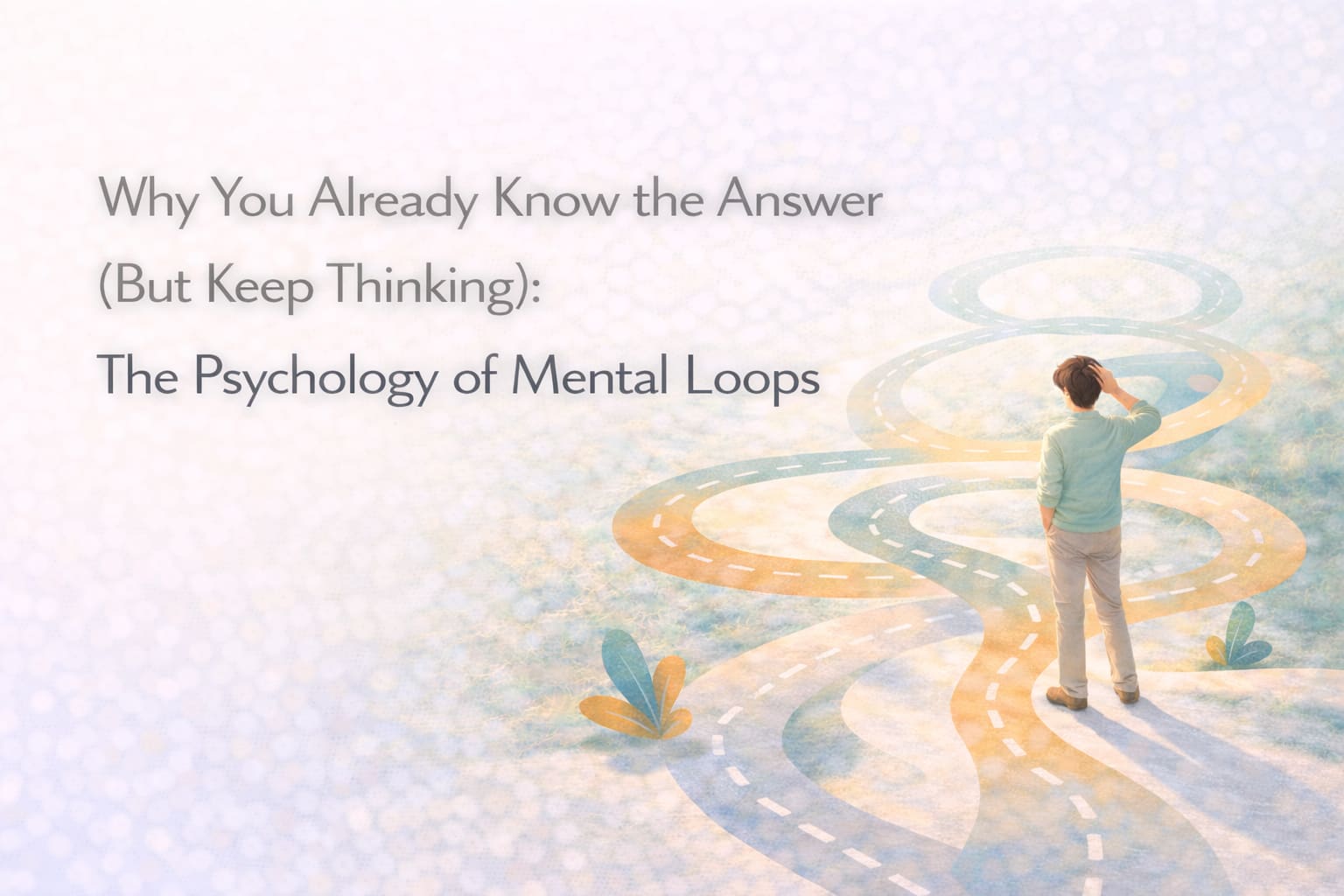
Why You Already Know the Answer (But Keep Thinking)
This one of those patterns you only notice after it repeats a few times.
You ask yourself a question.
Should I send the message?
Should I start the project?
Should I say what I’m thinking?
And almost immediately, an answer appears.
But instead of acting on it, you keep thinking.
You revisit the same idea.
You explore different angles.
You question the answer you already had.
You might not notice it at first.
But if you look closely, something interesting appears.
The thinking is not creating clarity anymore.
It’s delaying something.
That’s where the pattern begins.
What this actually means
Why you already know the answer but keep thinking describes a mental pattern where the brain continues analyzing a decision even after enough clarity already exists.
The answer is not missing.
It’s already there.
But the mind keeps searching anyway.
Not because it needs more information.
But because it’s trying to avoid something else.
Usually discomfort.
Usually uncertainty.
Usually the moment of action.
This is closely connected to what are often called overthinking loops, where thinking continues beyond usefulness.
You can explore that pattern more deeply here:
The behavior most people don’t notice
This pattern doesn’t feel like avoidance.
It feels like responsibility.
You tell yourself you’re being careful.
You want to be sure.
You want to think it through properly.
So you continue thinking.
But something subtle changes.
The thinking stops producing new insights.
Instead, it begins repeating.
Different versions of the same idea.
Different scenarios that lead to the same conclusion.
And yet, action still doesn’t happen.
You already know what to do.
But you’re still thinking.
That’s the part most people don’t notice.
Why the mind does this
The brain is not only designed to think.
It’s designed to protect you.
When a decision involves uncertainty, the mind begins scanning for possible outcomes.
What if this goes wrong?
What if this feels uncomfortable?
What if this leads somewhere uncertain?
Even if the answer is clear, the action attached to the answer may not feel safe.
So the brain does something subtle.
It stays in thinking mode.
Thinking feels safer than acting.
Because thinking has no consequences.
Action does.
This is why the pattern often connects to fear of failure, self-doubt cycles, and deeper self-sabotage patterns.
If you want to explore how these patterns connect, you can read more here:
The Complete Guide to Self-Sabotage Patterns
The mind is not trying to confuse you.
It’s trying to delay the moment where something real happens.
Where this pattern appears in daily life
Once you recognize this pattern, you start seeing it everywhere.
You hesitate before sending a message you’ve already written.
You rethink a decision you’ve already made.
You keep planning something you already know how to start.
You replay a conversation before having it.
You ask for advice, even though your instinct already answered the question.
Each moment feels small.
But if it repeats often enough, something becomes clear.
The delay is not about the answer.
It’s about what happens after the answer.
Action.
And action introduces uncertainty.
That’s where the mind slows down.
The hidden effect of this pattern
At first, this pattern seems harmless.
You’re just thinking.
But over time, something begins to change.
Decisions take longer.
Opportunities pass quietly.
Confidence weakens slightly.
Not because you don’t know what to do.
But because you stop trusting your own answers.
The brain learns something subtle.
That clarity is not enough.
That certainty must feel perfect.
And because perfect certainty rarely exists, action gets delayed again.
This is how the pattern becomes a form of quiet self-sabotage.
Not through wrong decisions.
Through delayed ones.
What this reveals about human behavior
This pattern reveals something interesting about the mind.
The brain often confuses thinking with solving.
It assumes that more thinking will eventually remove uncertainty completely.
But some uncertainty can only be resolved through action.
Not thought.
The answer often arrives earlier than expected.
But the mind keeps going because it’s not ready for what comes next.
Action means exposure.
Action means feedback.
Action means something real can happen.
So the brain stays where it feels safe.
Inside the loop.
Final reflection
You might not notice it at first.
The thinking feels useful.
It feels careful.
It feels like progress.
But if you look closely, something interesting begins to appear.
The answer often arrives before the thinking ends.
And the thinking continues not because the answer is unclear.
But because the action feels uncertain.
Once you see that pattern, something changes.
The next time your mind keeps circling the same question, you recognize it sooner.
Not as thinking.
But as a loop.
And once you see the loop, you realize something simple.
You already knew what to do.
Related Patterns
If this pattern feels familiar, it often connects to other behaviors.
These patterns tend to work together, not separately.
These deeper patterns explain why thinking sometimes replaces action.
Q: Why do I keep thinking even when I already know the answer?
A: This happens because the brain is trying to avoid the uncertainty or discomfort that comes with acting on the answer, not because the answer is unclear.
Q: Is this related to overthinking?
A: Yes. This is a form of overthinking where the mind continues analyzing even after clarity exists.
Q: Why does thinking feel productive even when it isn’t?
A: Thinking creates the feeling of progress, even when no action is taken. The brain interprets activity as movement.
Q: How can I stop this pattern?
A: Recognizing when thoughts begin repeating and shifting toward small actions can help break the loop.
