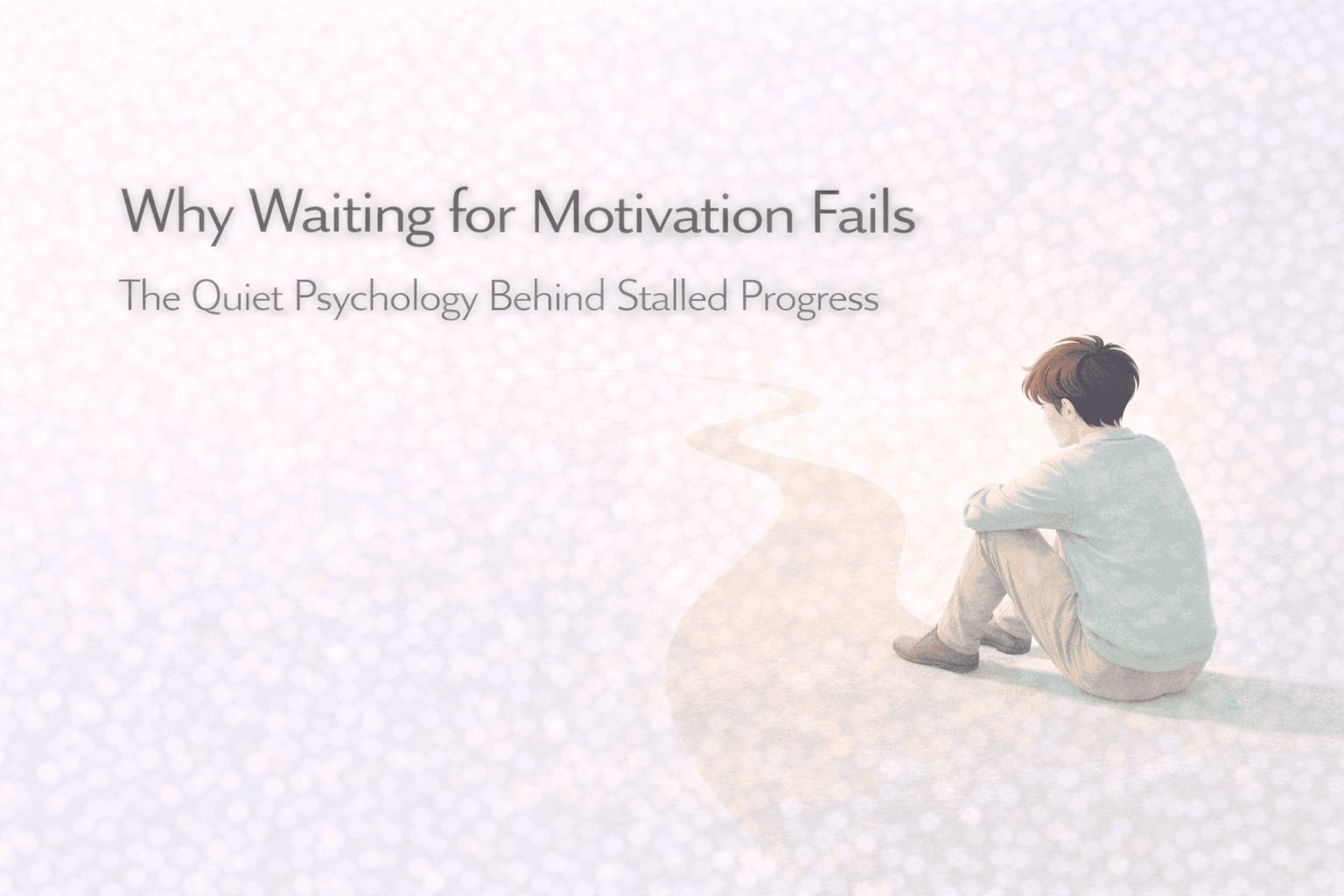
Why Waiting for Motivation Fails
You probably recognize this moment.
You want to start something.
A project.
A habit.
A task that you know matters.
But you pause.
You tell yourself you’ll start when you feel motivated.
When the energy arrives.
When the mood feels right.
When the timing feels clearer.
So you wait.
And strangely, the motivation rarely arrives the way you expect.
That’s the quiet reason why waiting for motivation fails.
At first, it seems reasonable.
Motivation feels like the fuel for action.
But if you look closely, something interesting appears.
The people who make progress rarely start with motivation.
They start with movement.
And motivation often appears afterward.
The Behavior Most People Don’t Notice
Waiting for motivation feels logical.
After all, motivation feels powerful.
When you feel motivated, action feels easier.
Effort feels lighter.
Progress feels natural.
But the mind slowly turns motivation into a requirement.
The brain begins believing something like this:
“I’ll start once I feel ready.”
The pattern sounds harmless.
But it creates a quiet delay loop.
You wait for the right mood.
You wait for the right energy.
You wait for the right moment.
But those conditions are unpredictable.
And sometimes they never arrive.
You might not notice it at first.
But if you look closely, something interesting appears.
People often treat motivation like a starting signal.
When in reality, it behaves more like a reaction.
Action comes first.
Motivation follows.
That small reversal changes everything.
Why the Brain Does This
The brain prefers comfort.
That’s its natural design.
When a task requires effort, the brain scans for resistance.
If something feels difficult, the mind searches for reasons to delay.
Waiting for motivation becomes a very convincing explanation.
The brain tells a simple story:
“You’re not ready yet.”
But readiness is rarely the real issue.
Several psychological mechanisms are operating beneath the surface.
Energy conservation
The brain evolved to conserve energy whenever possible.
Effort feels expensive.
Waiting feels efficient.
Uncertainty avoidance
Starting something new introduces uncertainty.
The mind prefers situations where outcomes feel predictable.
Emotional discomfort
Tasks that require focus, discipline, or risk often create mild tension.
Waiting for motivation becomes a way to postpone that tension.
Overthinking loops
Instead of starting, the brain may begin analyzing.
Planning.
Imagining.
Replaying possibilities.
If you’ve experienced this, you may recognize the pattern described here:
Thinking feels productive.
But sometimes thinking quietly replaces action.
That’s where the pattern begins.
Where This Pattern Shows Up in Daily Life
Once you recognize the pattern, you begin seeing it everywhere.
Not dramatically.
Quietly.
A person waits to begin exercising until they “feel motivated.”
A writer waits for inspiration before opening the document.
Someone delays sending an important message until the mood feels right.
A project sits untouched because the energy isn’t there yet.
Each moment feels small.
But repetition slowly turns these moments into patterns.
Motivation becomes the gatekeeper for action.
And when the gatekeeper doesn’t appear, progress pauses.
This is one reason the pattern connects closely with self-sabotage behaviors.
Not dramatic sabotage.
Just small delays repeated over time.
If you're exploring these deeper patterns, the full framework is explained here:
The Complete Guide to Self-Sabotage Patterns
The Hidden Effect of This Pattern
The most interesting effect of waiting for motivation is subtle.
The brain slowly learns the wrong lesson.
It begins associating action with emotional readiness.
But real progress often works the opposite way.
Action creates momentum.
Momentum creates motivation.
When action is delayed, momentum never begins.
Without momentum, motivation remains distant.
This creates a quiet psychological trap.
You wait for motivation to start.
But motivation is waiting for you to move.
Over time, the pattern can create several hidden effects.
Tasks begin feeling larger than they actually are.
Confidence slowly decreases.
Starting becomes harder.
And the brain starts believing that motivation is rare.
In reality, motivation simply arrives after movement, not before.
What This Reveals About Human Behavior
If you look closely at human behavior, you’ll notice something interesting.
The brain often misinterprets cause and effect.
It believes motivation causes action.
But in many situations, the opposite is true.
Action generates motivation.
The first step often feels uncomfortable.
The second step feels easier.
The third step begins building momentum.
But the brain rarely sees this pattern until it experiences it.
That’s why waiting for motivation feels logical.
The mind assumes motivation must appear first.
But if you observe people who consistently move forward, you’ll notice something different.
They don’t wait for motivation.
They start small.
And motivation appears while they’re already moving.
Final Reflection
You might not notice it at first.
The mind is very good at disguising delay.
Waiting can feel responsible.
Waiting can feel thoughtful.
Waiting can even feel productive.
But if you look closely, something subtle begins to appear.
The longer the brain waits for motivation, the more distant motivation feels.
Not because motivation disappeared.
But because momentum never began.
Once you notice this pattern, the relationship between motivation and action becomes clearer.
Motivation is rarely the starting point.
It’s usually the result of movement.
And the mind begins learning that lesson the moment action starts.
Q: Why does waiting for motivation fail?
A: Waiting for motivation fails because motivation often appears after action begins. The brain generates energy and engagement through movement, not before it.
Q: Is motivation necessary to start something?
A: Not always. Many tasks begin without strong motivation. Small actions often create the momentum that produces motivation later.
Q: Why do people wait for motivation before acting?
A: The brain prefers comfort and energy conservation. Waiting for motivation becomes a way to delay effort or uncertainty.
Q: How can someone start when they feel unmotivated?
A: Reducing the size of the first step helps. Small actions create momentum, which gradually generates motivation.
