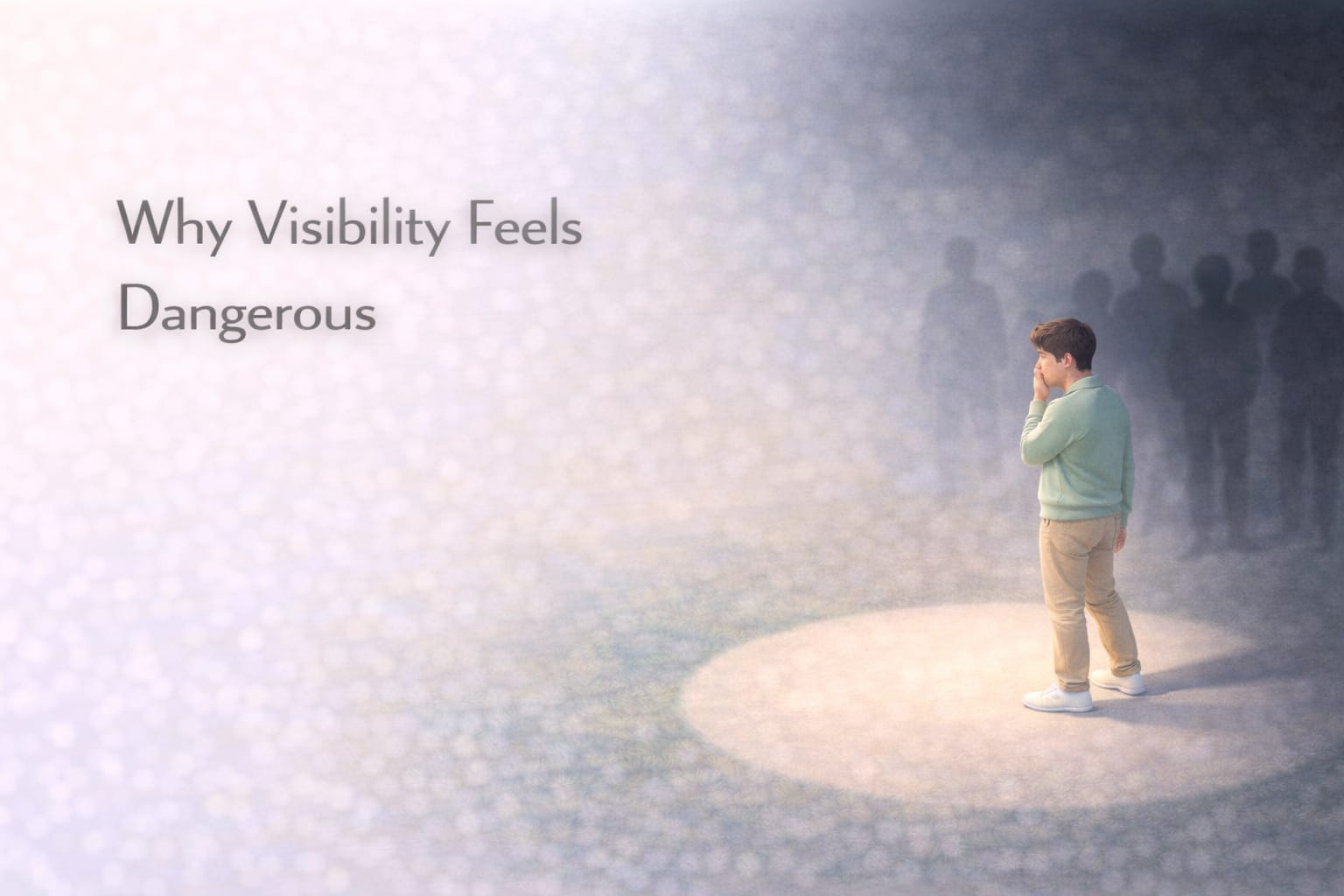
Why Visibility Feels Dangerous
Why visibility feels dangerous is a pattern many people experience without fully realizing it.
You want to share your ideas.
You want to publish the work.
You want to speak up in the room.
And yet something slows you down.
You hesitate before pressing publish.
You rewrite the message one more time.
You wait for a slightly better moment.
You might not notice it at first.
But if you look closely, something interesting appears.
The hesitation is rarely about the work itself.
It is about being seen.
That’s where the pattern begins.
Quiet Patterns Guide
If these patterns feel familiar, you may enjoy the deeper framework behind them.
Explore the full guide to Self-Sabotage Patterns and how small mental loops quietly shape behavior.
The Behavior Most People Don’t Notice
The mind does something subtle when visibility enters the picture.
It delays.
Not dramatically.
Just slightly.
You polish the idea longer than necessary.
You wait until it feels perfect.
You tell yourself you'll share it tomorrow.
From the inside, it feels like responsibility.
Preparation.
Quality control.
But if you observe the pattern carefully, something interesting appears.
The delay often happens right before the moment of visibility.
The moment when your work becomes public.
The moment when other people can respond.
That is when hesitation appears.
Not because the work is unfinished.
But because attention introduces psychological exposure.
Why the Mind Creates This Pattern
The mind is extremely sensitive to social signals.
For most of human history, visibility meant evaluation.
And evaluation carried consequences.
Approval.
Rejection.
Status.
Belonging.
Because of this, the brain still treats attention as something important.
And sometimes something risky.
Visibility means people can see you.
Which also means people can judge you.
So the brain quietly begins protecting itself.
It introduces hesitation.
Maybe this needs more work.
Maybe the timing isn’t right.
Maybe you should think about it longer.
At first this thinking feels logical.
But often it becomes another version of the mental cycles described in
/overthinking-loops.
The mind keeps reviewing the same idea.
Not improving it.
Just delaying the moment of exposure.
Where This Shows Up in Everyday Life
Visibility patterns appear in many ordinary moments.
Sharing ideas publicly
Writing online.
Posting content.
Presenting work.
The closer the moment of publishing gets, the stronger the hesitation can become.
Speaking in groups
You have a thought during a meeting.
But you wait.
Then the conversation moves on.
Creative work
Artists, writers, and creators often delay finishing projects.
Not because they lack ideas.
But because finishing means showing the work.
Career opportunities
Sometimes people hesitate to apply for roles or opportunities that increase their visibility.
Because visibility also increases evaluation.
In each situation, the pattern looks similar.
The opportunity to be seen appears.
And the mind quietly steps backward.
The Hidden Effect
Avoiding visibility rarely feels like avoidance.
It often feels like caution.
But the long-term effects are subtle.
Ideas stay private.
Work remains unseen.
Opportunities quietly pass by.
Over time the brain learns something interesting.
It becomes comfortable with preparation but uncomfortable with exposure.
Which slowly creates distance between ability and recognition.
This is why visibility avoidance often overlaps with patterns explored in
/self-sabotage-patterns.
Not because someone lacks talent.
But because the mind is trying to avoid the emotional risk of being seen.
The risk of judgment.
The risk of misunderstanding.
The risk of being visible.
Ironically, these risks rarely become as severe as the mind predicts.
But the brain acts cautiously anyway.
Final Reflection
Once you notice why visibility feels dangerous, the pattern becomes easier to see.
An idea appears.
The mind becomes curious.
Then visibility enters the picture.
And something subtle happens.
The brain begins negotiating.
Maybe later.
Maybe after more work.
Maybe when it feels clearer.
But if you watch the pattern closely, something interesting appears.
The hesitation rarely comes from the idea itself.
It comes from the moment when the idea becomes visible.
And visibility changes the rules.
Because once something is visible, it becomes real.
And real things invite attention.
But attention is not always danger.
Sometimes it is simply how ideas move into the world.
Q: Why does being visible feel uncomfortable?
A: Visibility can trigger fear of judgment or evaluation. The brain interprets attention as a social risk, which can create hesitation.
Q: Why do people delay publishing or sharing their work?
A: Many people delay sharing work because visibility introduces the possibility of criticism or misunderstanding.
Q: Is fear of visibility related to imposter syndrome?
A: Yes. Both involve discomfort with being seen or evaluated, especially when someone feels uncertain about their abilities.
Q: How can someone become more comfortable with visibility?
A: Gradual exposure and repeated sharing often reduce the brain’s perception of risk around being visible.
Related Patterns
If this pattern feels familiar, you might also recognize these:
