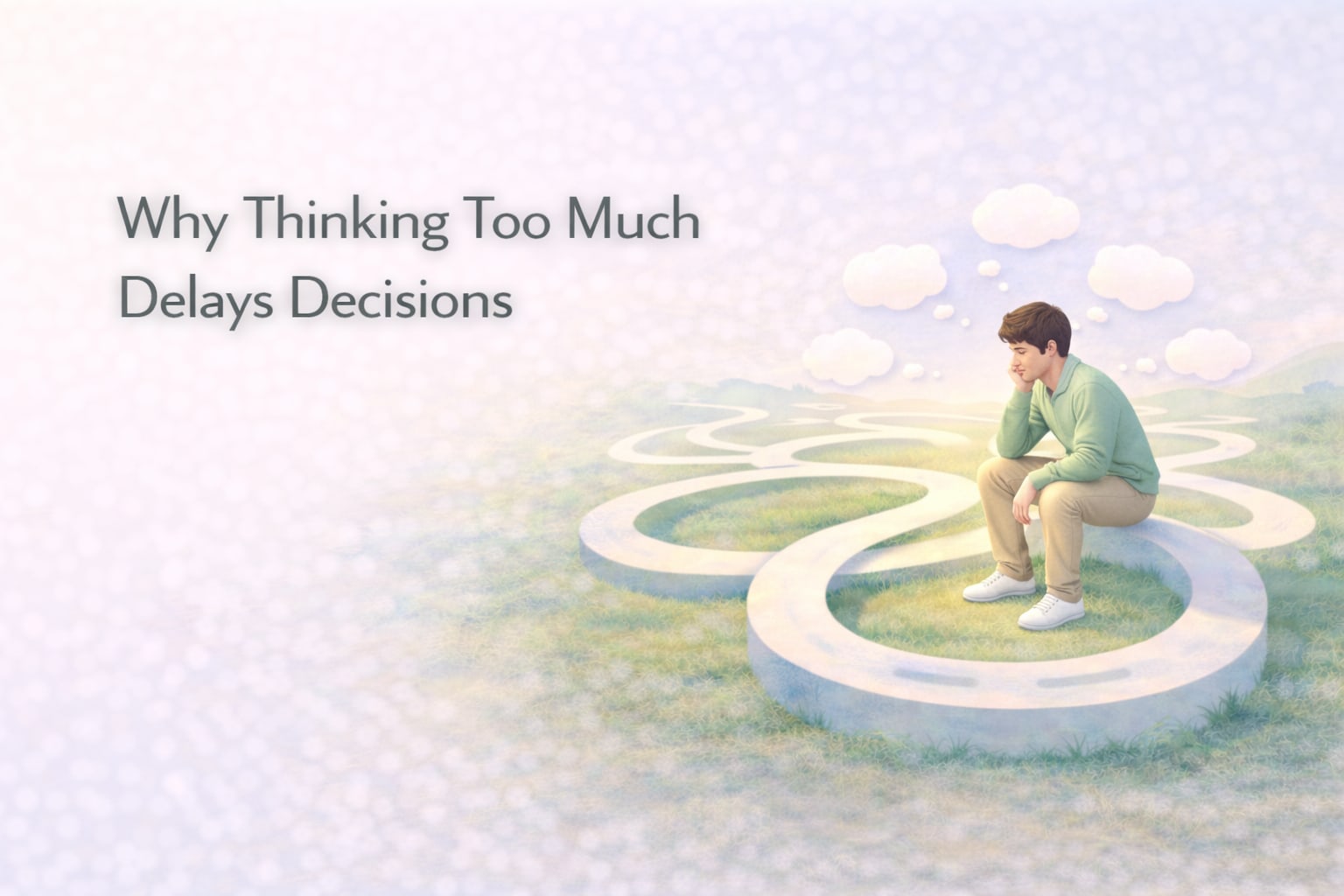
Why Thinking Too Much Delays Decisions
This is something most people notice in themselves at some point.
A decision appears.
At first, it seems simple.
You consider the options.
You imagine the outcomes.
But then the mind keeps going.
Another possibility appears.
Another question.
Another potential consequence.
You might not notice it immediately.
But if you look closely, something interesting begins to happen.
The thinking does not bring clarity.
Instead, the decision begins to feel heavier.
And the mind keeps circling the same possibilities.
What This Behavior Actually Is
Thinking too much delaying decisions is often a form of analysis paralysis.
The brain continues evaluating options long after enough information already exists.
At first, the thinking feels useful.
The mind wants to choose carefully.
It compares outcomes.
Predicts risks.
Searches for the best possible option.
But decisions rarely provide complete certainty.
So the brain keeps analyzing.
One more scenario.
One more comparison.
Over time, the thinking turns into repetition.
The same questions return.
The same possibilities are evaluated again.
This pattern often becomes the mental cycle described in overthinking loops.
The brain keeps reopening the decision instead of moving forward.
Why the Brain Does This
The brain thinks too much about decisions because it is trying to avoid mistakes.
Every choice closes other possibilities.
Once a path is chosen, the other options disappear.
The mind becomes aware of that loss.
So it tries to prevent regret.
It analyzes the decision from multiple angles.
What if this option leads somewhere better?
What if the other path would have worked out more successfully?
What if I realize later that I made the wrong choice?
The brain treats the decision like a problem that must be solved perfectly.
But many decisions do not work like puzzles.
They unfold over time.
And when the mind tries to predict everything in advance, it often enters the patterns described in self-sabotage patterns.
Not intentionally.
But because avoiding mistakes begins to feel more important than making progress.
The Hidden Cost
At first, thinking deeply about a decision feels responsible.
Careful thinking can prevent careless mistakes.
But when thinking continues for too long, something subtle begins to happen.
Momentum disappears.
Time passes.
Opportunities quietly move forward without you.
The mind becomes comfortable with analysis.
But uncomfortable with commitment.
Choosing a path requires accepting uncertainty.
And uncertainty is exactly what the brain has been trying to eliminate.
So the thinking continues.
But nothing changes.
The situation remains exactly where it started.
Ironically, the attempt to make the perfect decision can prevent any decision at all.
A Small Shift That Changes the Pattern
The pattern of thinking too much delaying decisions does not disappear through force.
But small shifts in awareness can change the experience.
Notice when thinking becomes repetition
If the same comparisons appear again and again, the mind may already have enough information.
Set a natural boundary for analysis
Careful thinking is helpful.
Endless thinking rarely adds new clarity.
Treat decisions as experiments
Many outcomes cannot be predicted perfectly.
They become clear only after action begins.
These shifts do not remove uncertainty.
But they change how the brain responds to it.
Instead of searching for the perfect answer, the mind begins allowing progress to reveal the answer over time.
Final Reflection
Once you understand why thinking too much delays decisions, the pattern becomes easier to recognize.
A choice appears.
The mind begins analyzing.
At first, the thinking feels productive.
But if you watch carefully, something subtle begins to happen.
The brain stops searching for the best option.
Instead, it begins trying to avoid the wrong one.
That small shift changes everything.
Because avoiding mistakes often leads to hesitation.
While progress usually requires accepting a small amount of uncertainty.
And once that uncertainty is accepted, the decision often becomes much lighter.
Q: Why does thinking too much make decisions harder?
A: Thinking too much increases the number of possible outcomes the brain tries to evaluate. This creates mental overload and makes it difficult to commit to one option.
Q: Is overthinking the same as analysis paralysis?
A: They are closely related. Overthinking often leads to analysis paralysis, where the brain keeps analyzing options but struggles to make a final decision.
Q: Why do smart people overthink decisions?
A: Analytical thinkers tend to see more variables and possible consequences, which can lead the brain to continue evaluating options long after enough information is available.
Q: How can someone stop overthinking decisions?
A: Setting limits on analysis time, accepting uncertainty, and treating decisions as experiments can help reduce overthinking and encourage action.
