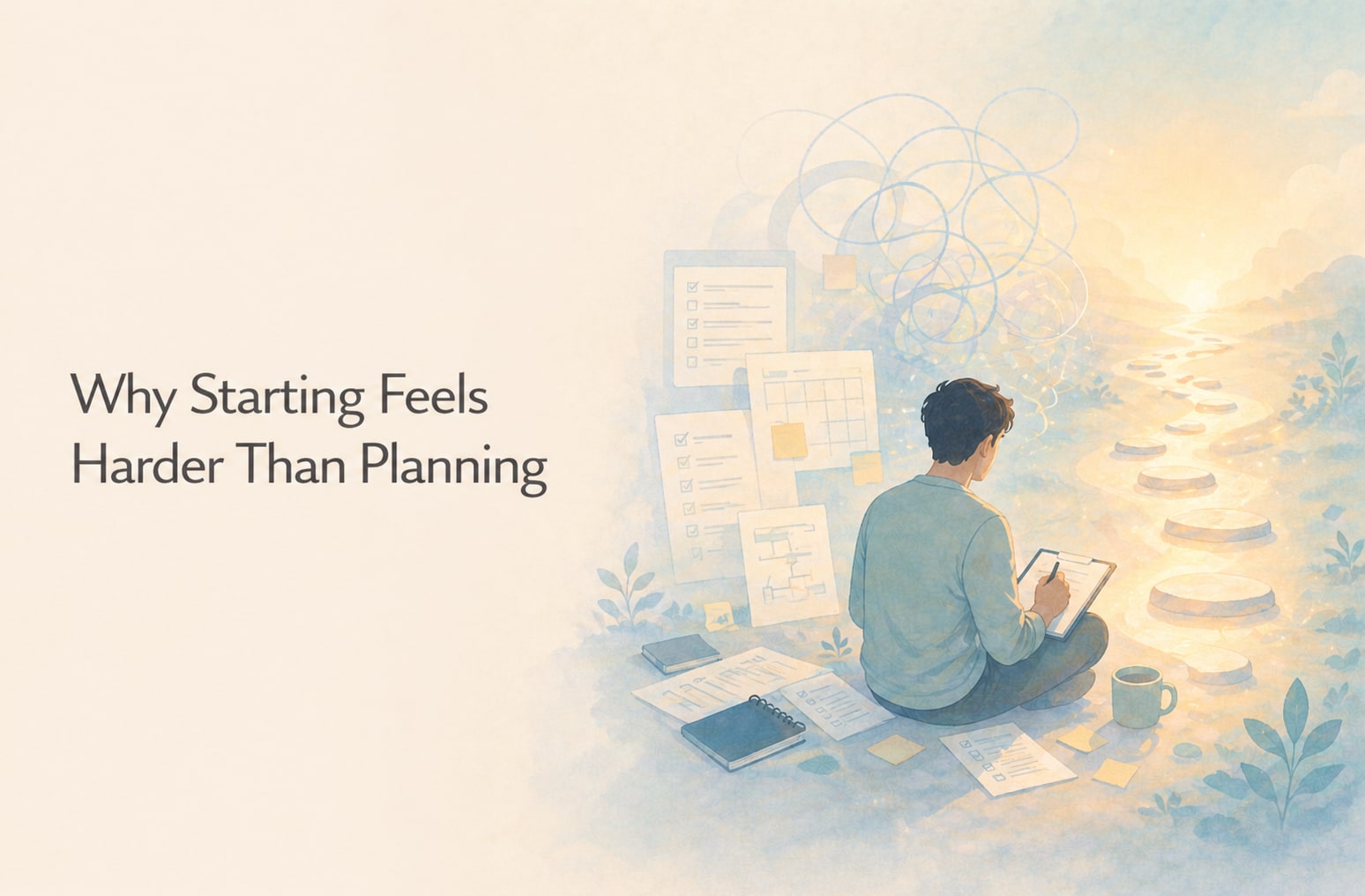
Why Starting Feels Harder Than Planning
Why starting feels harder than planning is something most people experience but rarely question.
You can sit with an idea for hours.
Refining it.
Expanding it.
Organizing it.
Planning feels productive.
It feels like movement.
But when it’s time to begin…
Something changes.
There’s a pause.
A hesitation.
And the start keeps getting delayed.
You might not notice it at first.
But if you look closely, something interesting appears.
Planning feels safe.
Starting does not.
That’s where the pattern begins.
What this actually means
When starting feels harder than planning, it usually means thinking has become a substitute for action.
Planning allows you to engage with the task without exposing yourself to outcome.
You can imagine progress without risking failure.
You can design the perfect approach without testing it.
So the mind naturally leans toward planning.
Not because it’s more effective.
But because it’s less risky.
This often sits inside larger self-sabotage patterns.
You stay close to the task.
But never fully enter it.
The behavior most people don’t notice
The shift from planning to avoidance is subtle.
You start by outlining what needs to be done.
Then you refine the outline.
Then you adjust the sequence.
Then you research better methods.
Then you reconsider your original idea.
Each step feels useful.
But none of them move the task forward.
The plan becomes more detailed.
But the task remains untouched.
This is where overthinking loops quietly take over.
The mind keeps working.
But the body doesn’t act.
It feels like effort.
But it produces no result.
Why the mind does this
The mind prefers control.
Planning offers control.
You can predict.
Adjust.
Optimize.
Nothing is uncertain because nothing is happening yet.
Starting removes that control.
Once you begin, reality takes over.
The outcome is no longer imagined.
It becomes real.
And real outcomes carry risk.
This is where fear of failure becomes relevant.
Because starting creates the possibility of being wrong.
Of not performing well.
Of producing something imperfect.
Planning avoids all of that.
It keeps everything theoretical.
Safe.
Contained.
There’s also a connection to perfectionism patterns.
Because the more you plan, the more you try to eliminate mistakes before they happen.
But in doing so, you delay the only thing that actually creates progress—action.
Where this pattern appears in daily life
You see this pattern in small, familiar ways.
You plan a business idea.
You outline the steps.
You research the market.
But you never launch anything.
You plan a piece of content.
You think about structure.
Tone.
Delivery.
But you don’t publish.
You plan to start learning something new.
You organize resources.
You choose the best method.
But you don’t begin the first lesson.
You plan a conversation.
You rehearse what to say.
You refine your words.
But you never actually have it.
In each case, planning continues.
Starting doesn’t.
The hidden effect of this pattern
At first, planning feels like progress.
It gives you a sense of involvement.
It keeps the idea alive.
But over time, something shifts.
The gap between planning and starting begins to grow.
The plan becomes more complex.
The expectations become higher.
Now starting feels heavier than before.
Not because the task changed.
But because the plan raised the standard.
This creates a quiet pressure.
And pressure increases hesitation.
Which leads to more planning.
Which leads to more delay.
This loop eventually feeds into self-doubt cycles.
Because you start noticing the pattern.
You see yourself planning.
But not starting.
And that begins to affect how you see your own consistency and discipline.
What this reveals about human behavior
This pattern reveals something simple.
People don’t avoid action randomly.
They avoid exposure.
Planning keeps you close to the idea.
But protected from the result.
Starting removes that protection.
It introduces uncertainty.
And uncertainty is uncomfortable.
So the mind creates a compromise.
Stay in the planning phase.
Feel productive.
Avoid risk.
But this comes at a cost.
Because nothing changes until something is done.
There are simple ways to interrupt this pattern once it’s recognized.
Not by abandoning planning.
But by limiting it.
And moving into action earlier than feels comfortable.
Because action corrects plans faster than thinking ever can.
Final reflection
Planning feels easier because nothing is at stake.
You can adjust endlessly.
Refine endlessly.
Improve endlessly.
But starting is different.
Starting forces reality to respond.
And that response cannot be controlled.
So the mind delays it.
Not because you are unmotivated.
But because you are protecting yourself from something you haven’t even experienced yet.
And sometimes…
The hardest part is not doing the work.
It’s stepping out of the plan.
Q: Why does starting feel harder than planning?
A: Because planning feels safe and controlled, while starting introduces uncertainty, risk, and real outcomes.
Q: Is this procrastination or overthinking?
A: It is both. Overthinking keeps you in planning mode, while procrastination delays the transition into action.
Q: How is this related to fear of failure?
A: Starting creates the possibility of failure, so the mind delays action to avoid confronting that outcome.
Q: How can I move from planning to starting?
A: By limiting planning time and taking small, immediate actions before the plan feels complete.
Related Patterns
If this pattern feels familiar, it often connects to other behaviors:
