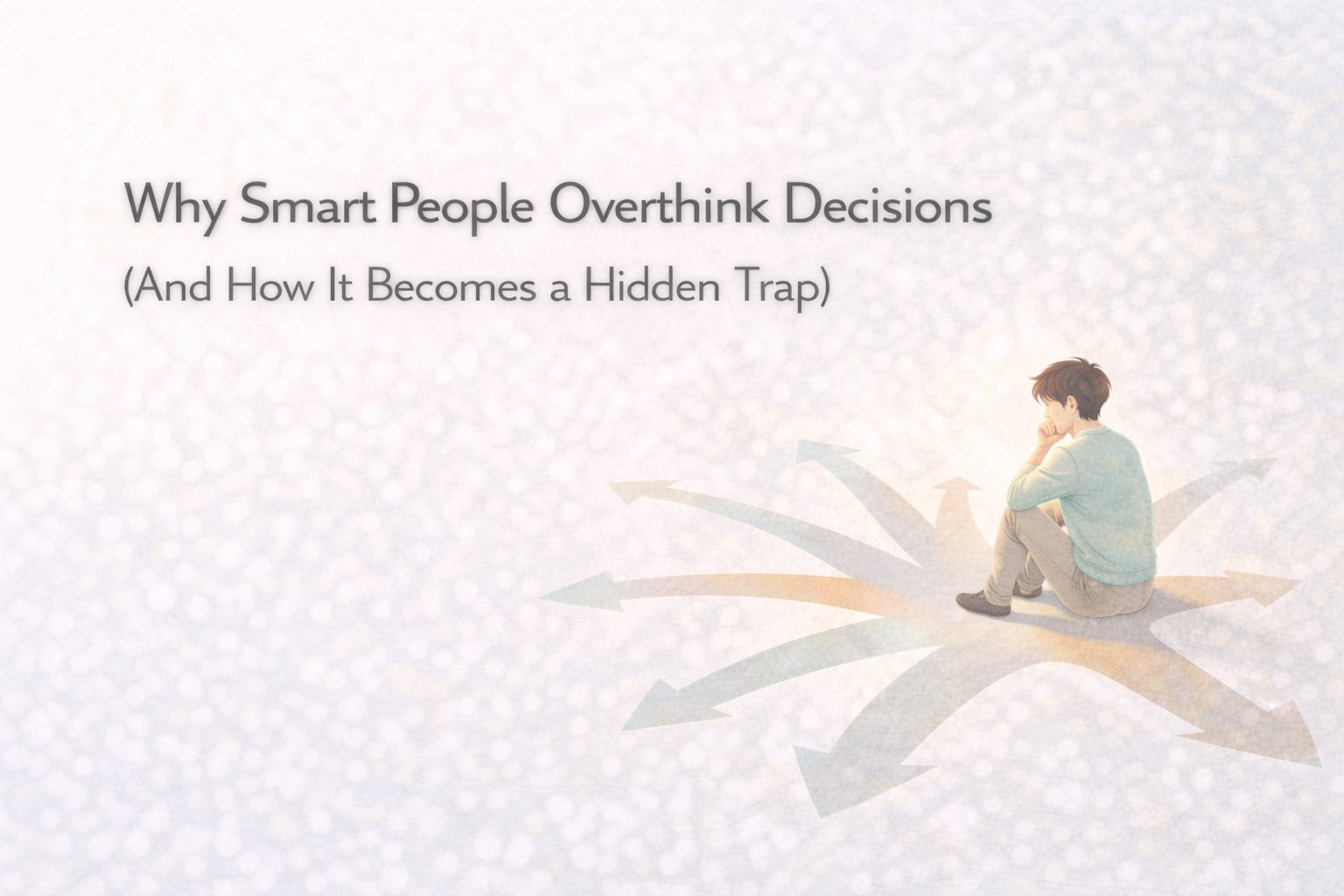
Why smart people overthink decisions is something many people quietly recognize in themselves.
You sit with a simple choice — which project to start, whether to send the message, whether the opportunity is right.
Your mind begins mapping outcomes.
Possible mistakes.
Future consequences.
Alternative paths.
Ten minutes later, nothing has happened.
The decision is still sitting there.
The strange part is that this pattern often appears most strongly in intelligent, thoughtful people. The same mental ability that helps them see patterns and possibilities also makes it harder to move forward.
Over time, the mind begins to loop.
This is where intelligence slowly turns into hesitation.
And many of the patterns described in self-sabotage psychology quietly begin.
What This Behavior Actually Is
At the surface, overthinking looks like careful decision-making.
But most of the time, it is not really about making better choices.
It is about trying to eliminate uncertainty.
The mind starts simulating every possible outcome:
What if this fails?
What if there’s a better option?
What if I regret it later?
So the brain keeps collecting more information.
More scenarios.
More variables.
But decisions rarely become clearer through endless analysis.
Instead, the mind enters what psychologists often describe as analysis paralysis — a loop where thinking replaces action.
If this pattern feels familiar, it often overlaps with the cognitive loops described in overthinking loops.
The brain is not solving the decision.
It is circling it.
Why Smart People Overthink Decisions
The reason smart people overthink decisions has less to do with intelligence itself and more to do with how intelligent minds process uncertainty.
People who think deeply tend to notice more possibilities.
They can imagine:
• more outcomes
• more risks
• more long-term consequences
That ability is powerful.
But it also creates a problem.
The brain starts treating every possibility as equally important.
A simple decision begins to feel like a complex strategic puzzle.
At that point, the brain switches into prediction mode.
It tries to calculate the safest path forward.
But human life does not work like a math equation.
Too many variables exist.
So the brain keeps searching for certainty that does not exist.
And the loop continues.
The Hidden Cost of Overthinking Decisions
On the surface, overthinking can feel responsible.
You are being careful.
Thoughtful.
Deliberate.
But slowly, something else begins to happen.
Momentum disappears.
Opportunities pass quietly.
The brain begins to associate action with risk and thinking with safety.
So it keeps thinking.
Many people don’t realize this pattern is actually a subtle form of the dynamics explained in self-sabotage patterns.
Not because the person wants to fail.
But because avoiding mistakes becomes more important than making progress.
And ironically, progress almost always requires imperfect decisions.
Small actions.
Experiments.
Movement.
Without movement, the mind stays trapped inside possibility instead of reality.
A Small Shift That Changes the Pattern
Breaking the cycle of overthinking decisions does not require becoming impulsive.
The shift is quieter than that.
It begins with noticing how the mind approaches uncertainty.
A few small adjustments can change the pattern.
Treat decisions as experiments
Instead of trying to make the perfect choice, treat decisions as small tests. Most choices are not permanent.
Limit the thinking window
Give the brain time to consider options — but not unlimited time. After that window closes, action begins.
Separate thinking from doing
Thinking feels productive, but real clarity often appears after action, not before it.
When people start experimenting with this shift, the mental loops described in overthinking loops slowly lose their grip.
The brain learns that uncertainty is not dangerous.
It is simply part of moving forward.
The Quiet Pattern Beneath It All
The reason smart people overthink decisions is not because they lack discipline or courage.
It is usually because their mind is trying to protect them.
It wants to avoid mistakes.
Avoid embarrassment.
Avoid regret.
So it keeps searching for the safest answer.
But human growth rarely happens inside perfectly calculated decisions.
It happens through motion.
Trial.
Adjustment.
And slowly, many people begin to realize something subtle.
The real trap was never the decision itself.
It was the belief that thinking longer would eventually remove the uncertainty.
But uncertainty is not a problem to solve.
It is part of being human.
Q: Why do intelligent people overthink decisions?
A: Intelligent people often see more possibilities and potential outcomes. This increases mental simulations and risk analysis, which can turn decision-making into a loop of endless evaluation instead of action.
Q: Is overthinking the same as analysis paralysis?
A: Overthinking often leads to analysis paralysis. The brain keeps analyzing possibilities without committing to a decision, which creates mental loops that delay action.
Q: How can I stop overthinking my decisions?
A: Limiting decision time, treating choices as experiments, and focusing on small actions instead of perfect outcomes can help interrupt the cycle of overthinking.
Q: Is overthinking a form of self-sabotage?
A: In some cases, yes. Overthinking can become a subtle self-sabotage pattern when the mind prioritizes avoiding mistakes over making progress.
