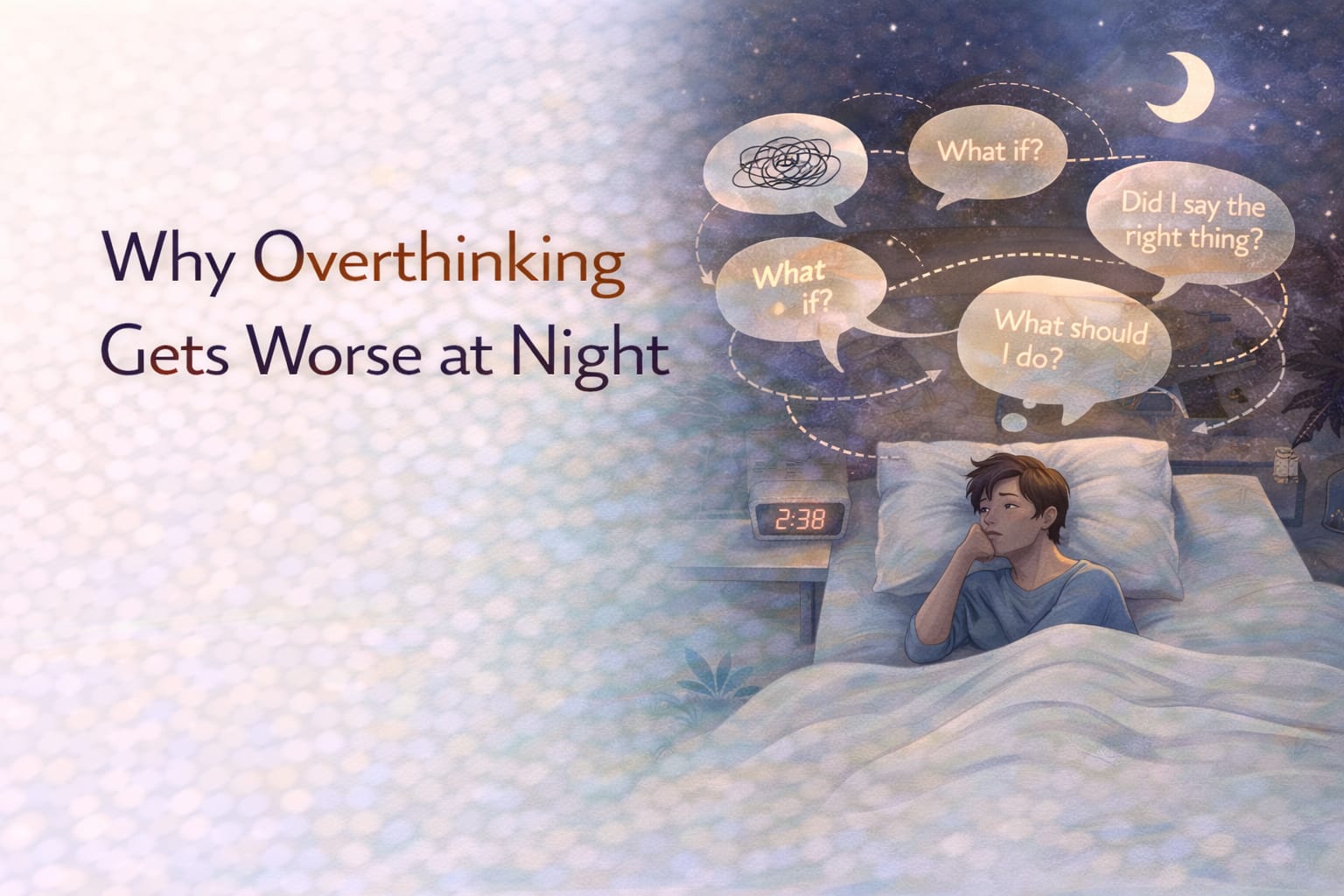
Why Overthinking Gets Worse at Night
Why overthinking gets worse at night is something most people recognize, even if they’ve never explained it.
During the day, your mind feels manageable.
You think about things.
You move through tasks.
You stay occupied.
But at night, something shifts.
The same thoughts feel heavier.
The same questions feel louder.
The same situations feel more complicated than they did hours earlier.
You lie down.
And your mind becomes active.
You might not notice it at first.
But if you look closely, something interesting appears.
The thoughts didn’t change.
The environment did.
If this pattern feels familiar, you may be noticing more than one loop at once.
Download The Self-Sabotage Pattern Recognition Guide: Identify the 7 Hidden Behavioral Loops Holding You Back.
What this behavior actually is
Why overthinking gets worse at night is not just about thinking more.
It is about the mind losing interruption.
During the day, your attention is divided.
Conversations.
Tasks.
Noise.
Movement.
These things interrupt your thoughts.
They prevent loops from forming fully.
At night, those interruptions disappear.
The environment becomes quiet.
Still.
Unoccupied.
That’s when overthinking loops become more visible.
Not because they started at night.
But because nothing is stopping them.
You can explore this pattern more deeply here:
The loop was already there.
Night simply removes everything that was distracting you from it.
Why the brain does this
The brain does not shut down at night.
In many ways, it becomes more active internally.
Without external input, attention turns inward.
And when attention turns inward, unresolved thoughts surface.
Several psychological shifts happen at night.
Reduced distraction
There are fewer things pulling your focus away from your thoughts.
Increased emotional sensitivity
At night, the mind often processes emotions more intensely.
Small concerns can feel larger.
Unresolved loops resurface
Thoughts that were postponed during the day return.
Not because they are urgent.
But because they were incomplete.
Search for closure
The brain tries to “finish” thoughts before rest.
But some thoughts don’t have clear endings.
So the mind continues.
This is where thinking becomes looping.
Not solving.
Where it appears in everyday life
This pattern shows up in very familiar ways.
You replay a conversation you had earlier.
You rethink something you said.
You imagine future scenarios that haven’t happened yet.
You question decisions that felt clear during the day.
You mentally rewrite past moments.
Everything feels manageable earlier.
But at night, it feels different.
The same thoughts take on more weight.
They feel more important.
More urgent.
Even when nothing has actually changed.
This is not because the situation is different.
It’s because your mind is no longer competing with the outside world.
So it turns fully inward.
And stays there.
The hidden cost
At first, this pattern seems harmless.
It feels like thinking.
Reflection.
Processing.
But over time, something subtle begins to shift.
Sleep becomes harder.
The mind becomes harder to quiet.
Small concerns become larger patterns.
Several effects begin to appear.
Mental fatigue increases
Because the brain is active when it should be resting.
Confidence weakens slightly
Because thoughts are repeatedly questioned.
Emotional weight increases
Because situations are processed more intensely.
Decision clarity decreases
Because night thinking often amplifies doubt.
This is how overthinking at night connects to broader:
Not through obvious mistakes.
But through repeated mental loops that never fully close.
The pattern most people miss
Most people assume overthinking gets worse at night because something is wrong.
But something else is happening.
The mind is not becoming more complicated.
It is becoming more visible.
During the day, distractions hide the loop.
At night, the loop becomes clear.
This leads to a common misunderstanding.
People try to “solve” their thoughts at night.
They try to think harder.
Find better answers.
Reach certainty.
But if you look closely, something interesting appears.
The thinking is not creating clarity.
It is repeating.
The brain is not solving the problem.
It is staying inside it.
That’s the difference.
Night doesn’t create overthinking.
It reveals it.
Final reflection
You might not notice it at first.
Overthinking at night feels like something new.
Like something that appears only in the dark.
But if you look closely, something becomes clear.
The thoughts were already there.
The loops were already running.
The day simply kept them hidden.
Night removes the noise.
And what remains is the mind itself.
Uninterrupted.
Unfiltered.
Repeating what it never fully resolved.
And once you begin to see that clearly, something changes.
You stop trying to solve every thought that appears at night.
And you start recognizing something simpler.
Not every thought needs to be finished.
Some just need to be seen… and left alone.
Q: Why does overthinking get worse at night?
A: Because distractions disappear, allowing existing thought loops to become more noticeable and uninterrupted.
Q: Is overthinking at night a sign of anxiety?
A: It can be related, but often it’s simply unresolved thoughts becoming more visible without daytime distractions.
Q: Why do small problems feel bigger at night?
A: The brain processes emotions more intensely in quiet environments, making thoughts feel heavier than they are.
Q: How can I stop overthinking at night?
A: Recognizing when thoughts are repeating instead of resolving can help reduce the need to engage with them.
