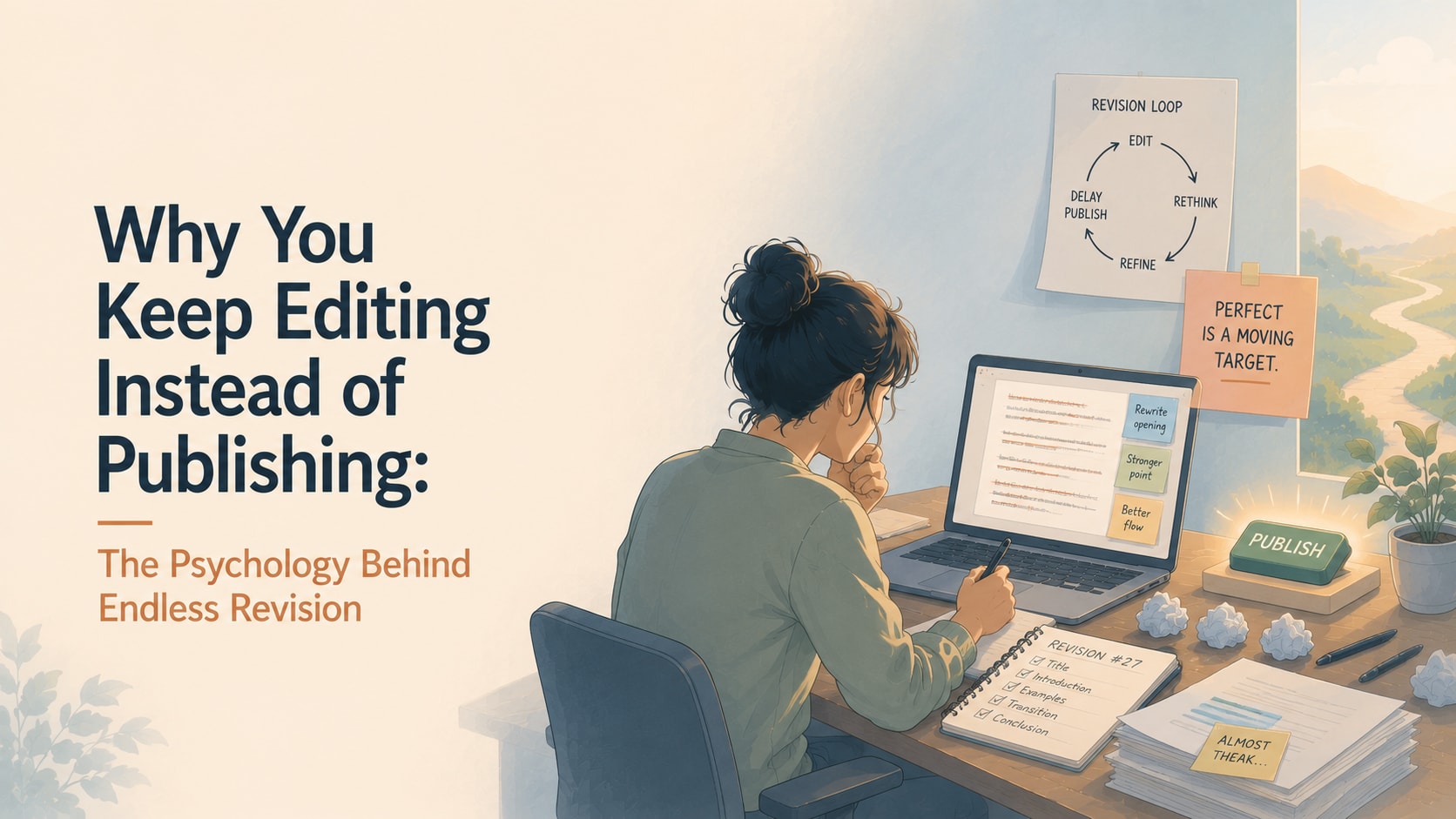
Why High Standards Turn Into Delay
Why high standards turn into delay is not always obvious.
You begin with a reasonable intention.
You want to do the work properly.
You want the final result to reflect your ability.
You do not want to be careless.
So you give the task more attention.
You improve the details.
You correct the weak areas.
You raise the quality.
But somewhere along the way, the standard stops guiding the work and starts preventing its completion.
You might not notice it at first.
You are still making an effort.
You are still thinking seriously about the outcome.
From the outside, it looks like discipline.
From the inside, however, the task keeps becoming harder to finish.
That is where the pattern begins.
The Behavior Most People Don't Notice
High standards are not automatically a problem.
They can help you create thoughtful work, make better decisions, and notice details other people overlook.
The difficulty begins when the standard has no clear endpoint.
You finish the first version, but it does not feel strong enough.
You improve it.
The new version is better, but now you can see more possibilities.
You make another adjustment.
Then another.
The work keeps moving forward, but completion keeps moving away.
This is the hidden difference between healthy standards and perfectionistic standards.
Healthy standards help you decide what "good enough" looks like before you begin.
Perfectionistic standards change as you work.
Every improvement reveals another improvement that could be made.
Because the standard keeps rising, the feeling of completion never arrives.
You are not delaying because you do not care.
You are delaying because the work matters so much that finishing it begins to feel risky.
This often appears within larger self-sabotage patterns.
The goal is not rejected.
It is held back until it can meet a standard that may never stop changing.
Why the Brain Does This
The mind often uses high standards as a form of protection.
If the work is excellent enough, perhaps no one will criticize it.
If the plan is detailed enough, perhaps nothing will go wrong.
If you prepare thoroughly enough, perhaps you will not feel embarrassed, rejected, or disappointed.
The standard becomes more than a measure of quality.
It becomes an attempt to control the future.
But the future cannot be fully controlled.
There will always be something you did not predict.
Someone may misunderstand the work.
A mistake may remain.
The response may be quieter than expected.
The result may not match the effort.
When the mind senses this uncertainty, it often responds by asking for more preparation.
One more revision.
One more check.
One more improvement.
Each extra step briefly reduces anxiety.
That relief teaches the brain that delay is useful.
Over time, the pattern becomes automatic.
Uncertainty appears.
The standard rises.
Action is postponed.
This is also how overthinking loops become attached to high standards.
You stop asking whether the work meets its purpose.
You begin asking whether every possible flaw has been removed.
That question has no final answer.
Where This Pattern Shows Up in Daily Life
High standards turn into delay in ordinary situations.
A writer spends hours adjusting an article that already communicates the idea clearly.
A job seeker keeps improving a résumé but avoids sending applications.
A business owner delays launching because the website still looks incomplete.
A student researches far beyond what the assignment requires but struggles to submit it.
Someone plans an important conversation repeatedly, waiting until they can say everything perfectly.
A content creator records the same message several times because each version contains a small flaw.
The details are different.
The structure is usually the same:
The task matters → expectations rise → mistakes feel dangerous → preparation expands → action is delayed
You may tell yourself you are waiting for better quality.
But sometimes you are waiting for a feeling.
You want the work to feel certain.
You want the decision to feel safe.
You want the moment of release to feel comfortable.
That feeling rarely arrives.
Instead, the longer you wait, the more important the task becomes.
A simple first attempt begins to feel like a test of your ability.
The pressure increases.
Then the high standard feels even more necessary.
The Hidden Effect of This Pattern
The obvious effect is that things take longer.
The hidden effect is that you receive less real-world feedback.
You keep improving based on what you imagine might happen.
But until the work is shared, submitted, tested, or discussed, you do not know which concerns actually matter.
You may spend hours fixing details no one would notice.
You may solve problems that would never have appeared.
You may delay learning because you are trying to avoid looking inexperienced.
High standards can also weaken your trust in yourself.
Each time you decide something is ready and then reopen it, you send yourself a quiet message:
My judgment cannot be trusted yet.
The next decision becomes harder.
You check more.
You compare more.
You need more reassurance.
Eventually, even small tasks begin to feel mentally heavy.
There is another cost.
The work that stays unfinished cannot create value.
The article cannot help a reader.
The application cannot reach an employer.
The idea cannot meet a customer.
The conversation cannot resolve anything.
The desire to protect the outcome quietly prevents the outcome from existing.
What This Reveals About Human Behavior
Why high standards turn into delay reveals that quality is not always the real issue.
Sometimes the deeper issue is exposure.
A completed task can be evaluated.
An unfinished task remains full of potential.
As long as the work is still being improved, you can imagine that it will eventually become exceptional.
Once it is released, imagination is replaced by reality.
Reality may be encouraging.
It may also be ordinary.
That is difficult for the mind when identity has become attached to the result.
You are no longer simply completing a task.
You are trying to prove that you are capable, intelligent, careful, or worthy.
A small flaw then feels larger than it is.
It does not merely affect the work.
It seems to say something about you.
But if you look closely, something interesting appears.
People who produce consistently are not always people with lower standards.
They are often people who know where the standard should stop.
They understand that quality improves through completed cycles.
Create.
Release.
Observe.
Adjust.
Begin again.
This is the principle behind the Start Before Ready Model.
Some clarity comes before action.
The rest only becomes available after the work meets reality.
Final Reflection
High standards can help you create something meaningful.
But they become a trap when they are used to remove every possibility of discomfort.
There will always be another adjustment available.
Another detail to improve.
Another reason to wait.
The question is not whether the work could be better.
Almost everything could be better.
The more useful question is:
Has another improvement become more valuable than completing the task?
Sometimes the answer will be yes.
The work genuinely needs more attention.
But sometimes the standard has already done its job.
The remaining delay is not protecting the quality.
It is protecting you from the uncertainty that follows completion.
That distinction can be difficult to see.
Once you see it, however, you begin to understand why doing your best and refusing to finish are not always the same thing.
Q: Why do high standards cause procrastination?
A: High standards cause procrastination when the mind treats mistakes as threats. Preparation and revision then expand because delaying action temporarily reduces the fear of producing an imperfect result.
Q: How can I tell if my standards are too high?
A: Your standards may be too high when they keep changing, prevent you from defining "good enough," or cause you to spend significant time making changes that do not improve the task's purpose.
Q: Are high standards the same as perfectionism?
A: No. High standards can support focused, thoughtful work. They become perfectionism when mistakes feel unacceptable and completion is repeatedly delayed in pursuit of a flawless result.
Q: Is overthinking connected to high standards?
A: Yes. High standards can create overthinking when you repeatedly reconsider decisions, search for hidden flaws, or imagine every possible reaction instead of completing the next practical step.
