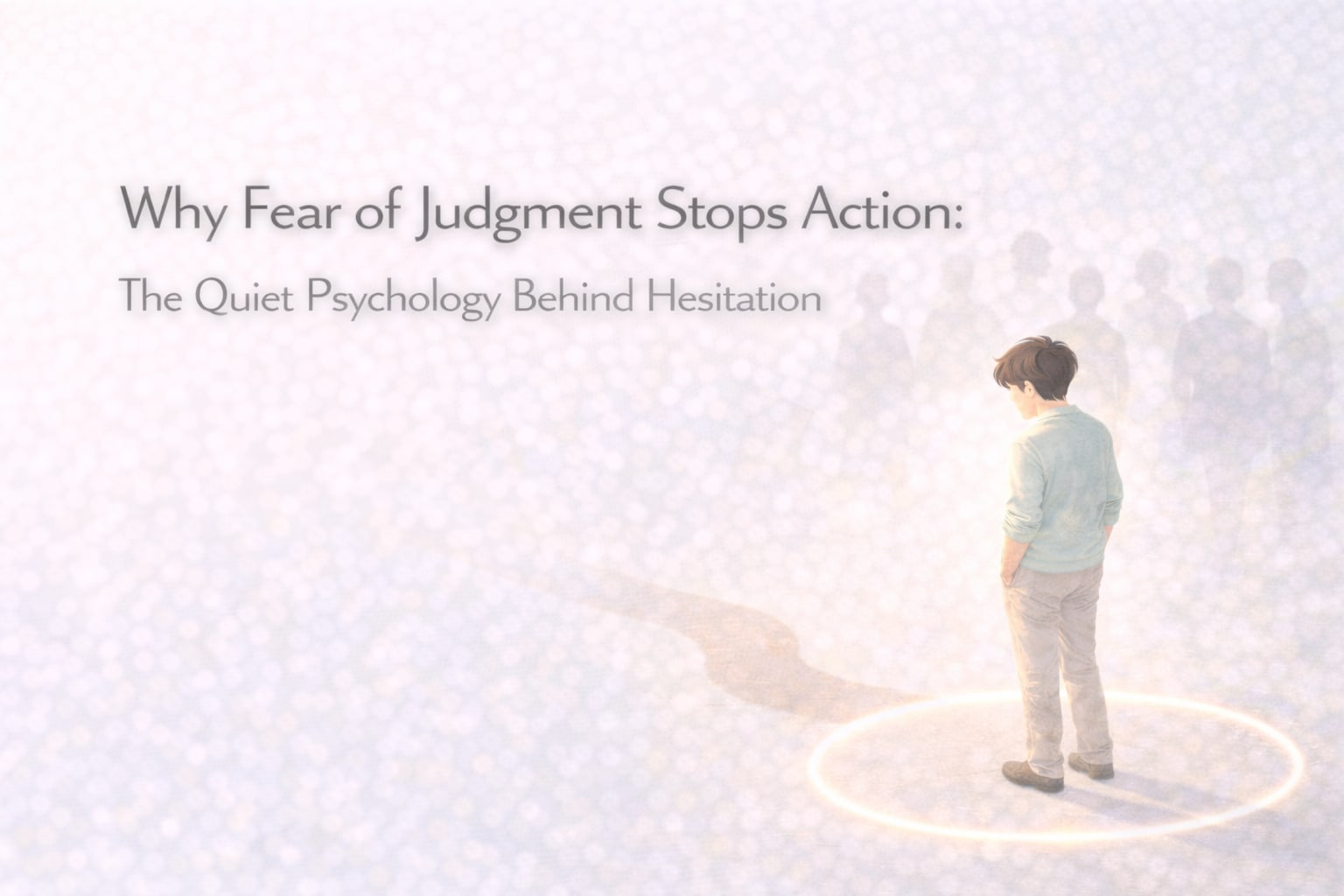
Why Fear of Judgment Stops Action
Why fear of judgment stops action becomes easier to understand when you notice a small moment most people experience.
You have an idea.
Maybe something you want to say.
Something you want to share.
Something you want to try.
But before you act, a quiet thought appears.
What will people think?
You pause.
You replay the situation in your mind.
You imagine how others might react.
Suddenly the action feels heavier than it did before.
So you wait.
This is how fear of judgment quietly stops action.
Not through dramatic fear.
Through small hesitation repeated over time.
What This Behavior Actually Is
Why fear of judgment stops action comes down to a simple psychological pattern.
The brain begins imagining how other people might evaluate you.
Your ideas.
Your performance.
Your decisions.
This mental simulation can happen quickly.
You picture possible criticism.
You picture someone misunderstanding you.
You picture mistakes becoming visible.
Once those possibilities appear, the brain slows down action.
The goal is protection.
If you don’t act, you can’t be judged.
From the brain’s perspective, hesitation becomes a form of safety.
But over time, repeated hesitation can quietly evolve into deeper self-sabotage patterns.
If you want to understand the larger framework behind these behaviors, the full guide explains it here:
The Complete Guide to Self-Sabotage Patterns
Why the Brain Does This
Understanding why fear of judgment stops action requires looking at human social psychology.
For most of human history, survival depended on belonging to a group.
Reputation mattered.
Acceptance mattered.
Rejection could carry serious consequences.
Because of this history, the brain developed strong sensitivity to social evaluation.
Several psychological mechanisms reinforce this behavior.
Social awareness
The brain constantly monitors how others might interpret your behavior.
Reputation protection
Avoiding criticism feels safer than risking negative reactions.
Emotional discomfort
Judgment can trigger embarrassment or self-doubt.
The brain tries to avoid that experience.
Overthinking loops
When the mind imagines multiple reactions from others, thinking begins repeating.
You replay conversations.
You imagine responses.
You analyze possibilities.
These loops are closely connected to the patterns explored here:
Thinking feels safer than acting.
But the situation remains unchanged.
The Hidden Cost
Fear of judgment feels protective in the moment.
But over time, the hidden cost becomes visible.
Actions that could create growth remain postponed.
Ideas remain unspoken.
Opportunities remain unexplored.
Several subtle effects appear.
Creative expression decreases
People hold back ideas that might be valuable.
Decisions take longer
The brain keeps imagining reactions before acting.
Confidence weakens
Repeated hesitation can slowly reduce self-trust.
Progress slows
Momentum depends on action.
Fear interrupts that movement.
This is how fear of judgment can quietly become a form of self-sabotage behavior.
Not through failure.
Through hesitation.
A Small Shift That Changes the Pattern
Breaking the pattern does not require eliminating fear entirely.
Fear is a normal part of social behavior.
The shift comes from changing how the mind interprets judgment.
A few small insights can interrupt the loop.
Notice imagined judgment
Most judgment exists only in the mind’s prediction.
Reality is often less dramatic than imagined reactions.
Focus on expression instead of evaluation
The purpose of sharing an idea is expression, not universal approval.
Not every response will be positive.
And that is normal.
Take smaller visible steps
Instead of large public actions, begin with smaller expressions.
The brain gradually learns that judgment rarely has the consequences it fears.
Over time, the pattern weakens.
Action becomes easier.
Final Reflection
Fear of judgment is deeply human.
The mind wants to belong.
It wants approval.
It wants to avoid embarrassment.
Because of this, the brain sometimes slows action before anyone else even reacts.
You might not notice it at first.
The hesitation feels reasonable.
The pause feels careful.
But if you watch closely, patterns begin to appear.
Moments where the mind protects you from imagined judgment.
Moments where progress quietly waits.
And once you recognize those moments, something interesting happens.
The hesitation becomes easier to see.
Not as danger.
But as a familiar pattern the mind has learned to follow.
Q: Why does fear of judgment stop action?
A: Fear of judgment stops action because the brain tries to protect social reputation. Imagining criticism or rejection can create hesitation before action happens.
Q: Is fear of judgment related to overthinking?
A: Yes. When the mind repeatedly imagines how others might react, it can create overthinking loops that delay decisions or expression.
Q: Can fear of judgment lead to self-sabotage?
A: It can. When hesitation repeatedly prevents someone from acting or sharing ideas, opportunities and progress may be delayed.
Q: How can someone overcome fear of judgment?
A: Recognizing imagined reactions, taking smaller actions, and focusing on expression rather than approval can gradually reduce the pattern.
