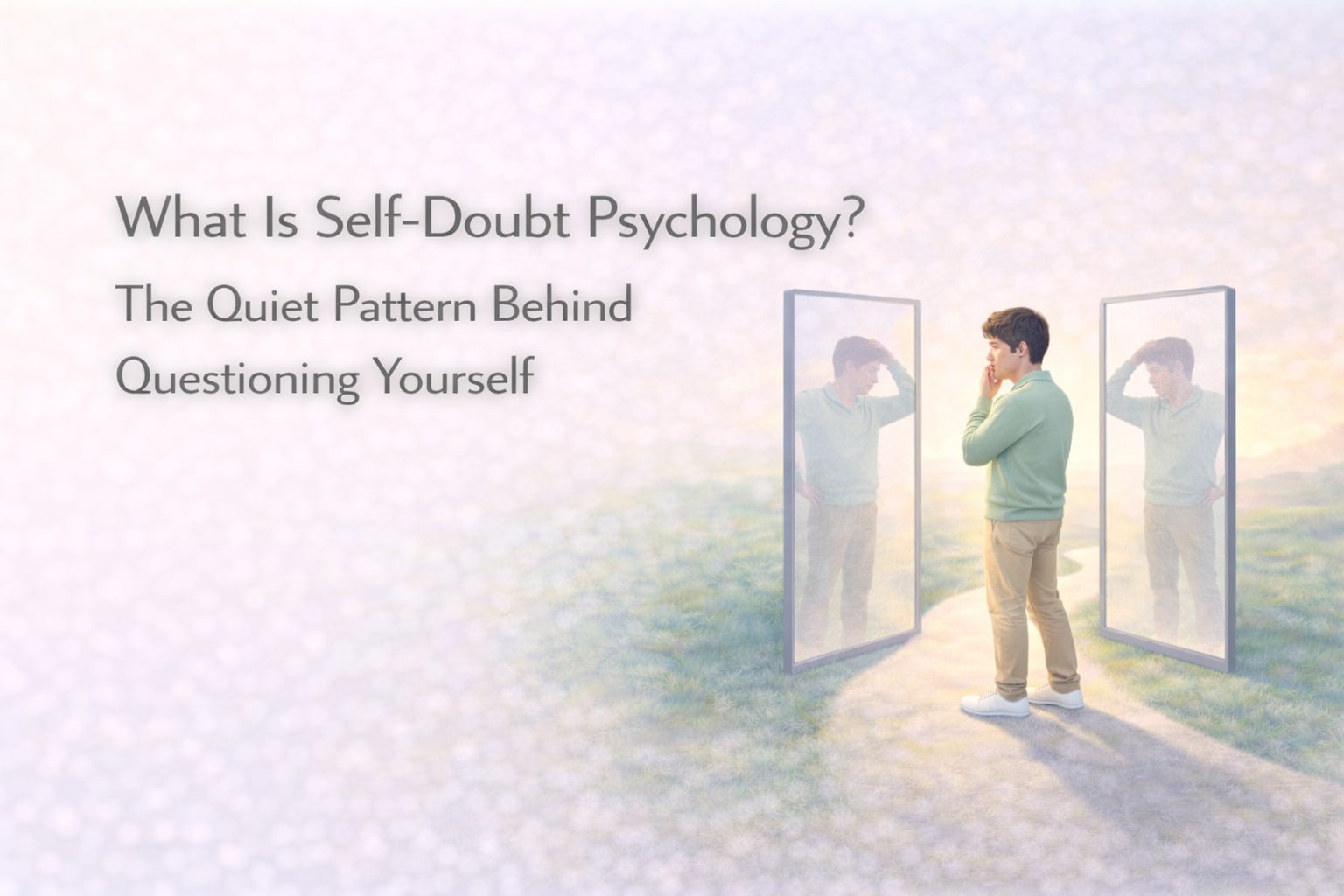
What Is Self-Doubt Psychology?
Most people encounter it long before they ever have a name for it.
You make a decision.
At the time, it feels reasonable.
Clear enough.
But later, a quiet question appears.
“Was that actually the right choice?”
You replay the moment.
You reconsider what you said.
You imagine what might have happened if you chose differently.
You might not notice it at first.
But if you look closely, something interesting appears.
The doubt often arrives after the decision, not before it.
And that’s where the psychological pattern of self-doubt often begins.
The Behavior Most People Don’t Notice
Self-doubt psychology is not simply about lacking confidence.
It is about how the mind responds to uncertainty.
The brain prefers clear outcomes.
Clear feedback.
Clear signals that a decision worked.
But many real-life situations do not provide that kind of clarity.
Conversations end without knowing exactly what someone thought.
Decisions unfold slowly over time.
Opportunities reveal their outcomes much later.
So the mind begins filling the gaps.
It replays situations.
Analyzes possible interpretations.
Imagines alternative outcomes.
What if I handled that differently?
What if they meant something else?
What if I misunderstood the situation?
At first, this thinking feels like careful reflection.
But slowly, it can shift into something else.
The mind begins repeating the same analysis.
That’s where patterns similar to overthinking loops begin to form.
The brain keeps revisiting the same moment without finding a final answer.
Why the Brain Creates Self-Doubt
To understand self-doubt psychology, it helps to understand the brain’s deeper priority.
The brain’s primary goal is not confidence.
It is safety.
Confidence sometimes comes later.
When the mind senses uncertainty, it activates its evaluation system.
It scans the situation for potential mistakes.
Possible risks.
Missed signals.
This process is helpful in moderation.
It allows us to learn from experience.
But when the brain continues evaluating long after the situation has passed, something changes.
The analysis becomes speculation.
The mind begins imagining problems that may never have existed.
Instead of reviewing reality, it begins constructing possibilities.
And each new possibility introduces uncertainty.
That uncertainty slowly grows into doubt.
This is also why self-doubt sometimes connects with the deeper patterns explored in self-sabotage patterns.
The mind tries so hard to prevent mistakes that it begins questioning its own judgment.
Where This Pattern Shows Up in Daily Life
Self-doubt psychology rarely appears as a dramatic moment.
More often, it hides inside small everyday experiences.
After conversations
You replay something you said.
You wonder how the other person interpreted it.
The mind examines the tone, the wording, the timing.
And slowly the memory becomes less clear.
Before new opportunities
A chance appears.
Something exciting.
But the mind immediately starts evaluating readiness.
Am I actually prepared for this?
After success
Even achievements can trigger self-doubt.
You accomplish something meaningful.
Then the mind quietly questions it.
Was that really skill, or just luck?
In each of these moments, the pattern is the same.
The brain is not simply remembering.
It is analyzing.
And analysis can slowly transform clarity into uncertainty.
The Hidden Effect of This Pattern
Self-doubt often looks harmless.
It can even appear thoughtful.
After all, questioning yourself can prevent arrogance.
But when the pattern becomes constant, something subtle begins to happen.
Confidence becomes fragile.
Decisions take longer.
Opportunities feel heavier.
The mind becomes cautious about action.
It begins protecting against mistakes.
Instead of trusting its own judgment, the brain searches for reassurance.
But reassurance rarely lasts.
Each new situation introduces fresh uncertainty.
And the mind returns to analysis again.
Over time, the brain begins to confuse thinking with control.
If the situation is examined thoroughly enough, maybe mistakes can be prevented.
But life rarely works that way.
Many answers appear only after action happens.
Not before.
What This Reveals About Human Behavior
Self-doubt psychology reveals something interesting about how the mind works.
We often assume confidence comes from having fewer questions.
But thoughtful people usually experience the opposite.
The more someone reflects on a situation, the more possibilities they can see.
More interpretations.
More alternative outcomes.
More things that might have gone differently.
That awareness can create intelligence.
But it can also create hesitation.
Because the brain begins measuring itself against every possibility it can imagine.
And imagination has no natural limit.
The mind can always find one more scenario to question.
That is why self-doubt is rarely solved through thinking alone.
Sometimes the mind simply needs new experience to replace speculation.
Final Reflection
Once you understand what self-doubt psychology is, the pattern becomes easier to notice.
A situation ends.
Then the mind returns to it.
Examining.
Replaying.
Questioning.
At first, the thinking feels helpful.
But if you observe carefully, something interesting appears.
The brain is not always searching for truth.
Sometimes it is searching for certainty.
And certainty is something the future rarely provides.
But experience does.
Which is why progress often happens not when the mind finally stops questioning itself…
…but when it decides to move forward anyway.
Q: What is self-doubt psychology?
A: Self-doubt psychology explores how the mind questions its own decisions, abilities, or interpretations, often due to uncertainty and repeated mental analysis.
Q: Why do people experience self-doubt even when they succeed?
A: Success can raise expectations and awareness of potential mistakes. The brain begins analyzing performance more deeply, which can trigger doubt.
Q: Is self-doubt connected to overthinking?
A: Yes. Self-doubt often grows when the mind repeatedly analyzes a situation, creating cycles similar to overthinking loops.
Q: Can self-doubt affect decision-making?
A: It can. When the mind questions its own judgment repeatedly, decisions may feel riskier and take longer to make.
