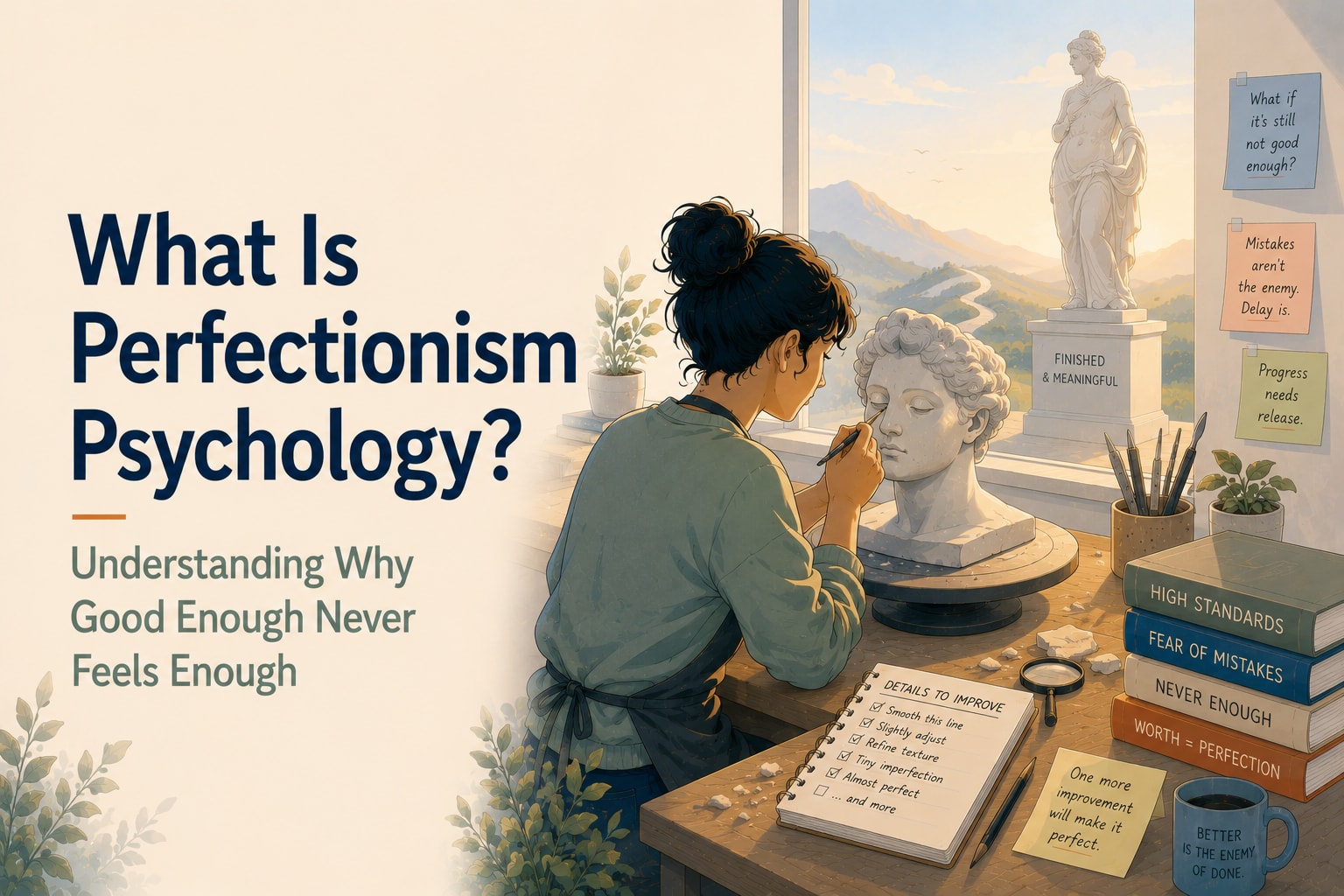
What Is Perfectionism Psychology?
Have you ever delayed sharing something because it still didn't feel quite right?
Maybe you rewrote an email several times.
Kept editing a document that was already clear.
Or postponed an important decision because you wanted to be completely certain.
At first, it feels like you simply care about quality.
You want to do things well.
You want to avoid mistakes.
There is nothing unusual about that.
But if you look closely, something interesting appears.
The standard slowly becomes impossible to reach.
No matter how much effort you invest, the work never quite feels finished.
That is often the quiet beginning of perfectionism psychology.
What This Concept Means
Perfectionism psychology is the study of a mental pattern where a person believes that mistakes are far more significant than they really are and that only exceptionally high standards are acceptable.
People often think perfectionism means wanting everything to be perfect.
In reality, it is more about how the mind reacts to imperfection.
A small mistake begins to feel much larger than it is.
An average outcome feels like failure.
"Good enough" starts to feel irresponsible.
Because of this, perfectionism is not always about producing excellent work.
Sometimes it prevents work from being completed at all.
You spend more time preparing.
More time checking.
More time improving.
Yet somehow, you feel less ready than when you began.
That is why perfectionism frequently appears alongside larger self-sabotage patterns.
The goal is not abandoned.
It simply becomes increasingly difficult to finish.
Why the Brain Creates This Pattern
The brain naturally tries to protect us from emotional discomfort.
Making mistakes can lead to embarrassment.
Criticism.
Rejection.
Disappointment.
The mind remembers those experiences.
Over time, it quietly develops a strategy.
Avoid mistakes before they happen.
At first, that strategy seems helpful.
You prepare carefully.
You think ahead.
You improve your work.
But eventually the brain begins treating every possible mistake as equally important.
A typo feels emotionally similar to a major failure.
An ordinary presentation begins to feel like a test of your worth.
The brain starts believing that perfection creates safety.
If the work is flawless...
Nobody can criticize it.
If every possibility is considered...
Nothing can go wrong.
Unfortunately, reality never works that way.
There is always another improvement.
Another possibility.
Another uncertainty.
That is why perfectionism often creates overthinking loops.
Instead of reducing uncertainty, the mind keeps searching for certainty that does not exist.
How This Pattern Appears in Daily Life
Perfectionism is often quieter than people expect.
A student spends hours rewriting notes instead of studying.
A writer edits the introduction repeatedly but never publishes the article.
Someone delays applying for jobs because the résumé still feels incomplete.
A business owner keeps redesigning a website that customers already find useful.
A content creator records the same video over and over because one sentence sounded slightly awkward.
Someone cleans the house before beginning an important task because everything needs to feel "just right."
Different situations.
The same pattern.
Progress slowly becomes secondary.
Avoiding mistakes becomes the real objective.
You might not notice it at first.
The work still looks productive.
You are busy.
Focused.
Responsible.
But the finish line quietly keeps moving farther away.
Why People Often Miss It
Perfectionism hides behind qualities that society usually praises.
Being careful.
Being ambitious.
Paying attention to detail.
Working hard.
These are all valuable traits.
That is why perfectionism can continue for years without being recognized.
People may compliment your dedication while never seeing the anxiety driving it.
You may even believe your high standards are the reason for your success.
Sometimes they are.
But if you look closely, something else often appears.
How much of your effort is improving the work?
And how much is trying to avoid the discomfort of being imperfect?
Those are not the same thing.
Healthy standards help you finish meaningful work.
Perfectionism often makes finishing feel emotionally dangerous.
Over time, you begin trusting endless preparation more than completed action.
The work stays private.
The opportunities stay delayed.
The confidence you hoped perfection would create never fully arrives.
Final Reflection
Perfectionism psychology is not really about perfection.
It is about protection.
The mind believes that flawless work will protect you from criticism, disappointment, or regret.
But life rarely asks for flawless work.
It asks for finished work.
Useful work.
Honest work.
The next time you find yourself making one more tiny adjustment before calling something complete, pause for a moment.
Ask yourself:
Am I improving the quality... or trying to remove every possibility of discomfort?
The answer often reveals more than the project itself.
Because perfectionism is not measured by how good your work becomes.
It is measured by how difficult your mind makes it to believe that good is finally enough.
Q: What is perfectionism psychology?
A: Perfectionism psychology refers to the mental pattern of believing that mistakes are unacceptable and that only extremely high standards are good enough. This often leads to overthinking, self-criticism, and delayed action.
Q: Is perfectionism a form of self-sabotage?
A: It can be. When perfectionism repeatedly delays decisions, prevents completion, or keeps you from sharing your work, it often becomes part of broader self-sabotage patterns.
Q: Why does perfectionism cause procrastination?
A: Perfectionism makes mistakes feel emotionally expensive. To avoid making them, the brain often delays action through extra preparation, endless revision, or waiting until everything feels perfect.
Q: How is perfectionism connected to overthinking?
A: Perfectionism frequently creates overthinking loops because the mind keeps searching for certainty and flaws long after useful decisions have already been made.
