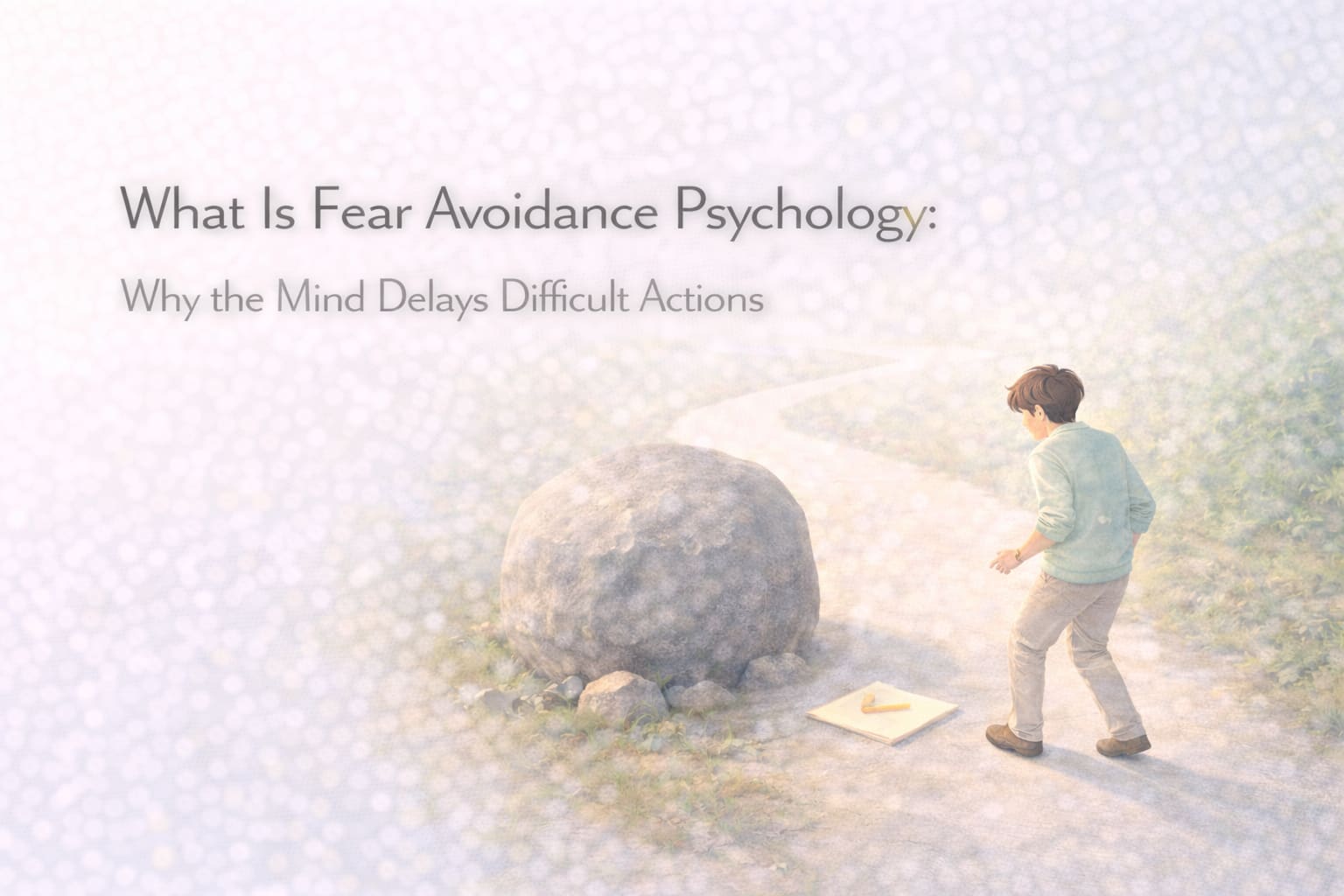
What Is Fear Avoidance Psychology
What is fear avoidance psychology?
You might have experienced it without realizing it.
There’s something you know you should probably do.
A conversation that needs to happen.
A decision waiting for attention.
A project that could move your life forward.
You think about it.
You plan to do it soon.
But somehow, the moment passes.
You tell yourself you’ll handle it tomorrow.
Tomorrow becomes next week.
You might not notice it at first.
But if you look closely, something interesting appears.
The mind isn’t just delaying the task.
It’s avoiding the feeling attached to the task.
That’s where fear avoidance psychology begins.
The Behavior Most People Don’t Notice
Fear avoidance psychology doesn’t always look like fear.
Most of the time it looks like ordinary hesitation.
You check something else first.
You tell yourself you need more information.
You decide the timing isn’t right yet.
On the surface, these behaviors seem reasonable.
But if the same pattern repeats often enough, something subtle becomes visible.
The brain quietly redirects attention away from situations that might create discomfort.
Not dramatic danger.
Just emotional tension.
The possibility of failure.
The possibility of judgment.
The possibility of uncertainty.
So the mind does something clever.
It stays busy.
Thinking.
Planning.
Analyzing.
But the one action that would actually resolve the situation remains untouched.
That’s the quiet nature of avoidance.
The mind keeps moving.
But the situation stays the same.
Why the Brain Does This
Fear avoidance psychology exists because the brain is designed to protect you.
Thousands of years ago, avoiding danger was essential for survival.
The brain developed systems that quickly detect threats and move away from them.
Today, most threats are no longer physical.
They’re psychological.
Embarrassment.
Criticism.
Failure.
Rejection.
Even though these experiences are not life-threatening, the brain reacts strongly.
It interprets emotional discomfort as something to avoid.
So the mind begins searching for ways to reduce the tension.
Sometimes that means distraction.
Sometimes that means delay.
And sometimes it means thinking about the problem endlessly without actually touching it.
That’s when avoidance quietly merges with overthinking loops.
If you’ve ever replayed the same situation in your mind repeatedly, you may recognize this pattern.
You can explore that behavior more deeply here:
Thinking feels productive.
But sometimes it becomes a safe substitute for action.
Where This Pattern Shows Up in Daily Life
Once you recognize fear avoidance psychology, you begin seeing it everywhere.
It appears in moments that feel completely ordinary.
Someone delays sending an important email because they worry about the response.
A person postpones starting a project because they’re unsure how well it will go.
Someone avoids sharing their ideas because they imagine criticism.
Another person keeps researching a decision instead of making it.
Each moment feels small.
But patterns are built from repetition.
The brain slowly learns that avoiding discomfort reduces stress.
So the behavior repeats.
That’s why fear avoidance psychology often connects with deeper behavioral loops.
Patterns where hesitation slowly turns into self-sabotage.
If you'd like to explore the broader framework behind these patterns, you can read it here:
The Complete Guide to Self-Sabotage Patterns
Not all self-sabotage is dramatic.
Sometimes it’s simply avoidance repeated over time.
The Hidden Effect of This Pattern
Fear avoidance rarely creates immediate problems.
That’s why it’s difficult to notice.
Each delay feels temporary.
Each hesitation feels small.
But over time, something subtle begins happening.
Tasks become heavier the longer they’re avoided.
Decisions create more stress the longer they remain unresolved.
Confidence slowly weakens when important actions remain unfinished.
And the brain begins believing something untrue.
That the task itself is the source of discomfort.
In reality, the discomfort often comes from the avoidance, not the task.
Once the situation is faced, the tension frequently fades faster than expected.
But the mind rarely learns that lesson while avoidance continues.
What This Reveals About Human Behavior
Fear avoidance psychology reveals something fascinating about how the mind works.
The brain is not primarily designed for progress.
It is designed for protection.
It scans the environment for potential threats.
It reacts quickly to reduce discomfort.
And it prefers predictable situations over uncertain ones.
These instincts are useful.
They protect you in many situations.
But in moments of growth, the same instincts can quietly slow you down.
Progress often requires stepping into uncertainty.
Trying something that might not work.
Speaking before you know how others will react.
The brain doesn’t naturally enjoy these situations.
So it tries to guide you somewhere safer.
That’s where the pattern begins.
Final Reflection
You might not notice it at first.
Fear avoidance rarely appears as obvious fear.
It shows up as hesitation.
As preparation.
As careful thinking.
But if you look closely, something interesting begins to appear.
The mind is not always avoiding the task.
It’s avoiding the feeling attached to the task.
The uncertainty.
The possibility of criticism.
The chance that things might not go perfectly.
Once you see this pattern clearly, something changes.
The hesitation becomes easier to recognize.
And in that moment, the mind reveals something important.
The feeling you’re avoiding is usually temporary.
But the opportunities you delay can last much longer.
Q: What is fear avoidance psychology?
A: Fear avoidance psychology describes a mental pattern where people avoid situations that might cause emotional discomfort, uncertainty, or perceived failure.
Q: Why do people avoid tasks they know are important?
A: The brain tries to reduce emotional tension. Avoiding the task temporarily lowers stress, which reinforces the avoidance behavior.
Q: Is fear avoidance related to procrastination?
A: Yes. Many forms of procrastination happen because the brain avoids tasks that feel uncertain or emotionally uncomfortable.
Q: How can someone break fear avoidance patterns?
A: Recognizing the moment avoidance begins and taking small actions toward the task can help the brain learn that the discomfort is manageable.
