The Doubt Interruption Method begins with a familiar moment.
You've made a decision.
You thought about it carefully.
You considered the options.
You finally chose.
Then, a few minutes later, a question appears.
"But what if I made the wrong choice?"
You think about it again.
You remember something you hadn't considered.
You check one more detail.
You ask someone what they think.
For a moment, you feel better.
Then another question appears.
"But what if they're wrong too?"
And suddenly, you're back where you started.
The strange part?
You haven't necessarily discovered anything new.
You've simply become less comfortable with the uncertainty that was already there.
This is the pattern the Doubt Interruption Method is designed to make visible.
Not every doubt needs to be eliminated.
Sometimes what needs interrupting is the repeated response to doubt.
What the Doubt Interruption Method Describes
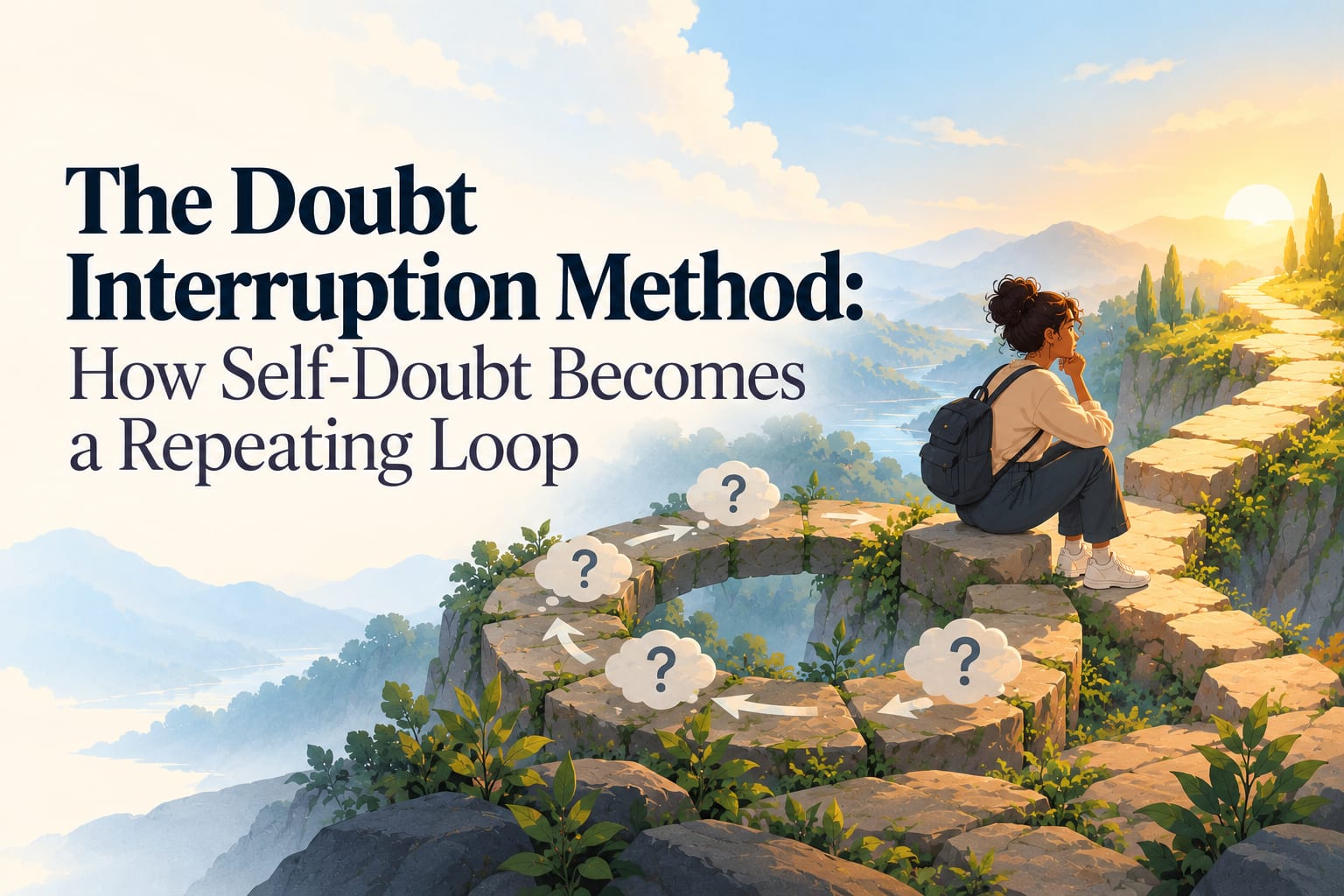
The framework describes a recurring sequence in which uncertainty triggers doubt, doubt triggers checking, and checking produces relief that doesn't last.
The sequence looks like this:
Uncertainty → Doubt → Rechecking → Temporary Relief → Renewed Doubt
At first, the behaviour appears reasonable.
You're being careful.
You want to avoid mistakes.
You want to make sure you've understood everything.
But if you look closely, something changes.
The purpose of thinking gradually shifts.
You stop looking for information that could improve your decision.
You start looking for a feeling that will make the decision seem completely safe.
And those are not the same thing.
Information can help you make a reasonable choice.
But no amount of thinking can guarantee that every future outcome will be comfortable.
This distinction matters because many self-sabotage patterns begin when a useful behaviour continues long after it has stopped being useful.
Careful thinking becomes repeated checking.
Reflection becomes rumination.
Seeking advice becomes seeking permission.
The method identifies the moment when this change happens.
The Stages of the Doubt Interruption Loop
The loop can be understood through six stages.
Stage 1: A decision creates uncertainty
You send an important email.
Accept an opportunity.
Choose a direction for your business.
Tell someone how you feel.
The decision is made, but the outcome is still unknown.
There is nothing unusual about this.
Most meaningful decisions contain some uncertainty.
Stage 2: The mind introduces a threatening possibility
A thought appears.
"What if I overlooked something?"
"What if they misunderstand me?"
"What if this doesn't work?"
The possibility may be realistic.
But the mind begins treating its existence as a reason to question the entire decision.
Stage 3: The feeling becomes evidence
Uncertainty creates discomfort.
You feel uneasy.
Then the mind makes a subtle connection.
"If I feel this unsure, maybe something really is wrong."
This resembles the pattern explained in the Evidence vs Feeling Model.
The emotional reaction begins carrying more authority than the available facts.
Stage 4: Rechecking begins
You review the message.
Revisit the options.
Search for another opinion.
Replay the conversation.
Imagine alternative outcomes.
Some checking may reveal useful information.
But when the same questions return without new evidence, the process can become repetitive.
Stage 5: Relief temporarily rewards the checking
You find an explanation.
Someone reassures you.
You convince yourself that the decision was reasonable.
The discomfort decreases.
For a moment, everything feels settled.
But the mind may learn that checking is what made the uncertainty tolerable.
The next time doubt appears, it asks for the same response.
Stage 6: Doubt returns and the cycle restarts
Another possibility appears.
Another detail feels important.
Another opinion seems necessary.
The previous reassurance loses its effect.
That's where the loop becomes visible.
The Doubt Interruption Method focuses on recognising this return and separating genuinely new information from another attempt to feel certain.
Why the Mind Repeats This Loop
The brain naturally pays attention to uncertainty.
When something matters, the possibility of getting it wrong can feel threatening.
Thinking ahead helps us anticipate problems.
Reviewing decisions helps us learn.
Seeking advice helps us notice things we may have missed.
These processes are useful.
The difficulty begins when the mind starts expecting them to remove uncertainty completely.
A person may believe:
"If I think about this long enough, I'll finally feel sure."
But certainty is not always available.
You cannot know exactly how another person will respond.
You cannot predict every consequence of a decision.
You cannot guarantee that a good choice will produce a good outcome.
When the mind treats uncertainty as a problem that must be solved immediately, thinking can become repetitive.
This is one reason overthinking loops are so persistent.
Each new round of analysis promises an answer.
Each temporary answer creates relief.
And when the relief fades, the mind assumes more analysis is required.
Fear of failure can intensify the process.
If making a mistake feels like proof of personal inadequacy, every decision carries an additional burden.
You're no longer evaluating only the choice.
You're evaluating what a bad outcome might say about you.
That is a much harder question to settle.
Where This Pattern Appears in Daily Life
The Doubt Interruption Method becomes especially useful when the same sequence appears across unrelated situations.
After sending a message
You write something carefully.
You send it.
Then you reread it repeatedly, searching for a tone that might be misunderstood.
The words haven't changed.
Your interpretation keeps changing.
When making purchases
You compare several options.
You choose one.
Then you continue researching alternatives.
Every new comparison makes the original decision feel less secure.
During creative work
You finish an article, design, or video.
Instead of publishing, you make another adjustment.
Then another.
The work improves at first.
Eventually, the revisions mainly postpone the discomfort of letting other people see it.
A similar sequence appears in the case study The Project That Never Launched.
When setting boundaries
You say no.
The other person seems disappointed.
You begin wondering whether your boundary was unreasonable.
You replay the conversation, even though no new information has appeared.
After receiving reassurance
Someone tells you that your decision makes sense.
You feel relieved.
Hours later, you need to hear it again.
The reassurance worked emotionally, but it did not settle your relationship with uncertainty.
What Keeps the Loop Going
The most important reinforcement is temporary relief.
When checking reduces discomfort, the behaviour becomes easier to repeat.
The mind begins associating reassurance with safety.
But the relief may also prevent you from discovering something important.
You might have been able to tolerate the uncertainty without another round of checking.
Because you always check, that possibility remains untested.
Perfectionism can strengthen the cycle.
A person may believe that every decision should be fully researched, every message perfectly worded, and every possible mistake anticipated.
Under that standard, ordinary uncertainty begins to look like inadequate preparation.
Self-doubt adds another layer.
You may have made good decisions before.
You may have handled similar situations successfully.
Yet the next decision still feels like an entirely new test of your judgment.
This is the contradiction explored in The You've Done This Before Loop.
The past provides evidence.
The present feeling refuses to accept it.
The interruption point
The method does not require suppressing doubt or refusing to reconsider decisions.
Sometimes reconsideration is necessary.
New evidence may appear.
Circumstances may change.
A mistake may genuinely need correction.
The useful distinction is between reviewing because something has changed and reviewing because uncertainty still feels uncomfortable.
One can improve judgment.
The other can keep the same question alive indefinitely.
The interruption begins when you recognise which process is happening.
Final Reflection
The Doubt Interruption Method reveals something easy to miss.
Sometimes the problem is not the original decision.
It is the relationship that develops with the decision afterward.
You choose.
You doubt.
You check.
You feel relieved.
Then you doubt again.
The sequence becomes so familiar that it starts to feel like responsible thinking.
But if you look closely, the question may no longer be changing.
Only the discomfort is returning.
And each time it returns, the mind asks you to begin the investigation again.
That is the quiet difference between useful reflection and a self-doubt loop.
Useful reflection can produce new understanding.
A repeating loop often produces the same uncertainty in a different form.
The interruption is not the moment you become completely certain.
It is the moment you recognise that another round of thinking may not give you anything you don't already know.
Related Patterns
If this loop feels familiar, it often connects to other patterns within the wider psychology of self-sabotage.
