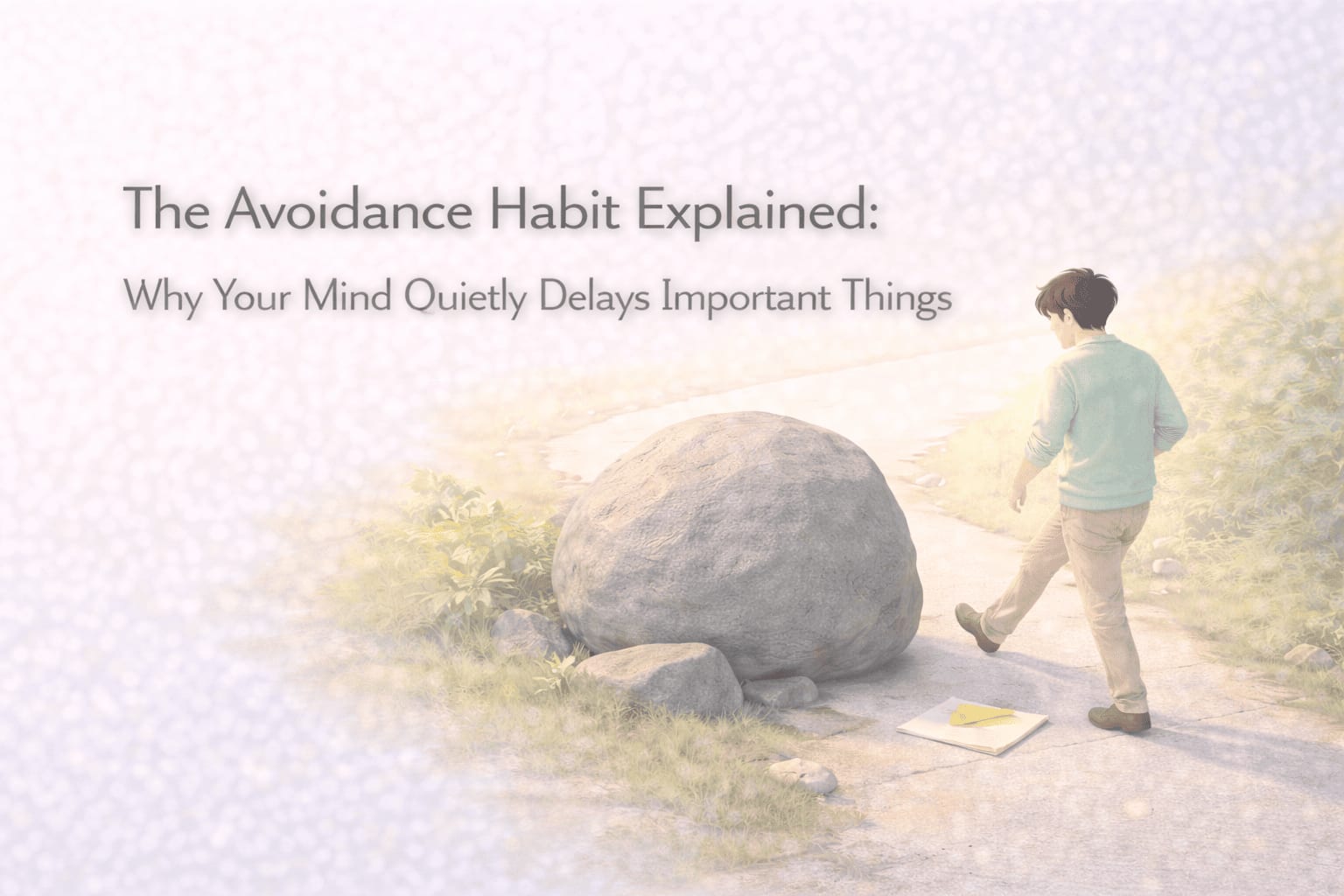
The Avoidance Habit Explained
The avoidance habit explained is easier to recognize when you notice a small moment most people experience.
You know something needs attention.
A task.
A message.
A decision that has been waiting.
You think about doing it.
But instead, you do something else.
You check something quick.
You organize something small.
You tell yourself you’ll return to it later.
Later feels safer.
Later feels easier.
At first, it seems harmless.
But if you look closely, this is how the avoidance habit begins.
Not with dramatic refusal.
With small delays that quietly repeat.
What This Behavior Actually Is
The avoidance habit explained in simple terms is a repeated tendency to delay or redirect attention away from tasks that feel uncomfortable, uncertain, or mentally demanding.
Avoidance doesn’t always look like doing nothing.
Often it looks like doing something else.
You clean instead of writing.
You scroll instead of deciding.
You research instead of starting.
From the outside, activity continues.
But the important action remains untouched.
This is why avoidance can be difficult to notice.
The mind stays busy.
But the original task quietly moves further away.
Psychologists often describe this pattern as a behavioral protection mechanism.
The brain is not trying to sabotage you.
It is trying to reduce discomfort.
However, repeated avoidance can slowly connect with deeper self-sabotage patterns, which are explored in the larger framework here:
The Complete Guide to Self-Sabotage Patterns
Why the Brain Does This
Understanding the avoidance habit explained requires looking at how the brain handles discomfort.
When a task triggers stress, uncertainty, or emotional tension, the brain immediately searches for relief.
Avoidance is one of the easiest ways to create that relief.
Several psychological processes contribute to this pattern.
Discomfort avoidance
The brain prefers emotional stability.
If something feels tense or uncertain, the mind redirects attention elsewhere.
Short-term relief
Avoiding a task instantly reduces stress.
That relief reinforces the behavior.
The brain remembers that avoidance works.
Uncertainty protection
Difficult tasks often involve unknown outcomes.
The brain prefers predictable situations.
Overthinking substitution
Sometimes avoidance doesn't look like distraction.
It looks like thinking.
You analyze the situation instead of acting.
If this pattern feels familiar, it often connects to the mental dynamics explored here:
Thinking can feel productive.
But sometimes it becomes another way of postponing action.
The Hidden Cost
The avoidance habit feels small in the moment.
But repetition slowly changes the outcome.
A delayed task becomes heavier.
A postponed decision becomes more stressful.
Over time, several quiet effects appear.
Tasks grow larger
The longer something is avoided, the more difficult it begins to feel.
Mental pressure increases
Unfinished responsibilities remain active in the mind.
Confidence weakens
When tasks remain unresolved, trust in your own follow-through decreases.
Momentum disappears
Progress often depends on small consistent actions.
Avoidance interrupts that rhythm.
This is why avoidance often becomes one of the most common forms of self-sabotage behavior.
Not intentional sabotage.
Just repeated delay.
A Small Shift That Changes the Pattern
Breaking the avoidance habit does not require dramatic willpower.
Often the shift begins with awareness.
Once the pattern becomes visible, small changes can interrupt it.
Recognize the moment avoidance begins
Avoidance usually starts with a tiny hesitation.
Noticing that moment makes the pattern easier to interrupt.
Shrink the first step
Large tasks create resistance.
Small actions lower the barrier to movement.
Even five minutes of action can break avoidance.
Separate discomfort from danger
The brain often treats discomfort like a threat.
But most difficult tasks are simply uncomfortable, not dangerous.
Recognizing this difference changes how the mind responds.
Over time, the brain begins learning a new pattern.
Action reduces tension more effectively than avoidance.
Final Reflection
The avoidance habit explained reveals something interesting about human behavior.
The mind often believes it is protecting you.
Avoiding discomfort.
Avoiding mistakes.
Avoiding uncertainty.
In the short term, it works.
The tension fades.
But in the long term, the pattern slowly shapes outcomes.
Not through dramatic choices.
Through small repeated delays.
You might not notice it at first.
But once you begin observing your own avoidance patterns, something changes.
The moment where the mind tries to step away becomes easier to see.
And once that moment becomes visible, a small choice appears.
You can follow the habit.
Or you can step forward anyway.
Q: What is the avoidance habit in psychology?
A: The avoidance habit refers to a pattern where people repeatedly delay tasks or decisions that create discomfort, uncertainty, or emotional tension.
Q: Why do people avoid important tasks?
A: The brain tries to reduce stress and uncertainty. Avoiding a difficult task provides immediate emotional relief, which reinforces the behavior.
Q: Is avoidance connected to procrastination?
A: Yes. Many forms of procrastination are actually avoidance behaviors where the brain redirects attention away from uncomfortable tasks.
Q: How can someone break the avoidance habit?
A: Recognizing the moment avoidance begins, taking small actions, and reducing the size of tasks can gradually interrupt the pattern.
