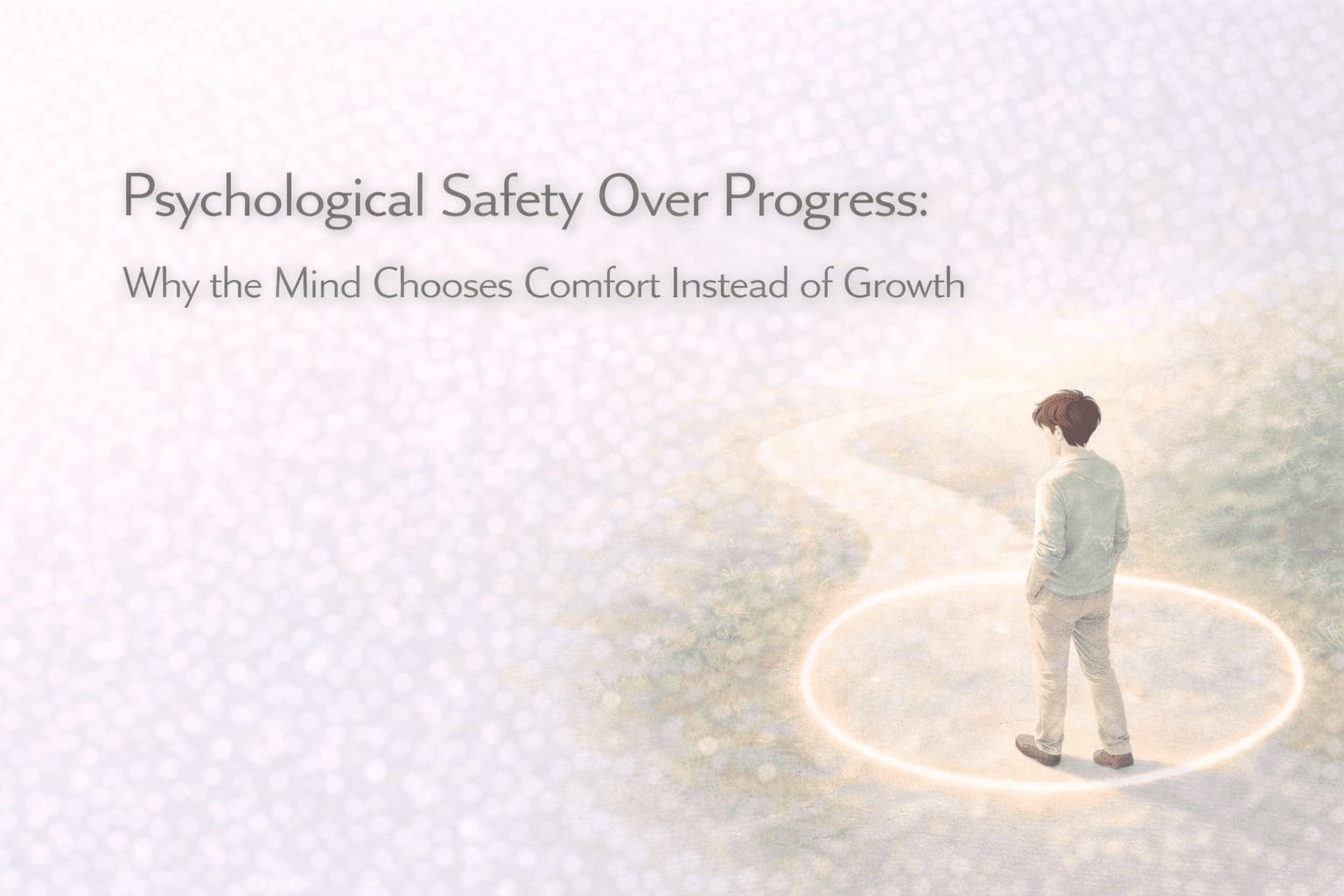
Psychological Safety Over Progress
Psychological safety over progress is a pattern many people experience without realizing it.
You know something would move your life forward.
A decision.
A conversation.
A project you’ve been thinking about.
But something inside you hesitates.
You tell yourself you’ll start when things feel clearer.
When you feel more prepared.
When the moment feels right.
So you wait.
And slowly, the opportunity sits untouched.
This is one way the mind chooses psychological safety over progress.
Not intentionally.
But quietly.
The brain protects you from discomfort first.
Progress becomes secondary.
What This Behavior Actually Is
Psychological safety over progress describes a mental pattern where the brain prioritizes emotional comfort instead of taking actions that involve uncertainty or risk.
This doesn’t mean people avoid progress entirely.
Most people genuinely want growth.
But when progress requires discomfort, the brain begins negotiating.
You may think longer before acting.
You may delay a decision until it feels easier.
You may prepare more than necessary before starting.
Each moment feels reasonable.
But when the pattern repeats, something subtle happens.
Comfort slowly becomes the default choice.
Progress becomes conditional.
The brain waits for the situation to feel emotionally safe before moving forward.
And many situations never feel completely safe.
Why the Brain Chooses Psychological Safety Over Progress
The human brain evolved to prioritize survival.
In earlier environments, avoiding danger was essential.
Today, most threats are not physical.
They are psychological.
Embarrassment.
Judgment.
Failure.
Uncertainty.
Even though these are not life-threatening, the brain still reacts strongly.
Several mechanisms reinforce this behavior.
Emotional protection
The brain tries to prevent experiences that could cause stress or discomfort.
Uncertainty avoidance
Unknown outcomes create tension.
The mind prefers situations where results feel predictable.
Short-term relief
Avoiding difficult actions reduces emotional pressure immediately.
That relief teaches the brain that hesitation works.
Cognitive loops
Sometimes the brain replaces action with thinking.
You analyze possibilities instead of moving forward.
This often connects with patterns described here:
Thinking feels safer than acting.
But thinking does not always change outcomes.
The Hidden Cost
Choosing psychological safety over progress rarely creates immediate problems.
That’s why the pattern is difficult to notice.
Each moment feels small.
But repetition slowly changes the direction of progress.
Several subtle effects appear.
Opportunities remain unexplored
Actions that could create growth remain postponed.
Momentum disappears
Progress usually depends on small consistent steps.
Hesitation interrupts that movement.
Confidence weakens
When actions are delayed repeatedly, self-trust gradually decreases.
Mental pressure increases
Unfinished intentions stay active in the mind.
This is how the pattern can quietly connect to self-sabotage behaviors.
Not through dramatic decisions.
But through repeated hesitation.
If you want to explore this broader framework, the full guide explains these patterns in detail:
The Complete Guide to Self-Sabotage Patterns
A Small Shift That Changes the Pattern
Breaking the habit of choosing psychological safety over progress often begins with awareness.
Once the pattern becomes visible, small adjustments can interrupt it.
Recognize discomfort without interpreting it as danger
Many growth moments include emotional tension.
Discomfort does not mean something is wrong.
Lower the size of the first step
Large changes create resistance.
Small actions make movement easier.
Even a small step shifts the brain from hesitation to progress.
Notice when thinking becomes delay
Thinking is useful when it produces clarity.
But repeated analysis may simply protect the mind from acting.
Action often creates clarity faster than thinking.
Over time, the brain begins learning something important.
Progress rarely feels completely safe at the beginning.
But movement makes uncertainty easier to handle.
Final Reflection
Psychological safety over progress reveals something fascinating about human behavior.
The mind wants stability.
Predictability.
Comfort.
In many situations, that instinct protects you.
But in moments of growth, the same instinct can quietly slow you down.
The brain tries to remove discomfort before acting.
Yet growth usually requires stepping into uncertainty.
You might not notice it at first.
The hesitation feels small.
The delay feels temporary.
But if you watch closely, patterns begin to appear.
Moments where comfort wins.
Moments where progress waits.
And once you start recognizing these moments, something subtle changes.
The next time hesitation appears, you begin to see it more clearly.
Not as a signal to stop.
But as a familiar pattern the mind has learned to follow.
Q: What does psychological safety over progress mean?
A: It describes a pattern where the brain prioritizes emotional comfort instead of taking actions that involve uncertainty or risk.
Q: Why does the brain choose psychological safety?
A: The brain evolved to protect against threats. Even psychological discomfort can trigger hesitation or avoidance.
Q: Is choosing safety over progress a form of self-sabotage?
A: It can become one. When hesitation repeatedly delays important actions, progress slows and opportunities may be missed.
Q: How can someone stop choosing safety over progress?
A: Recognizing hesitation, taking smaller steps, and accepting some uncertainty can gradually interrupt the pattern.
