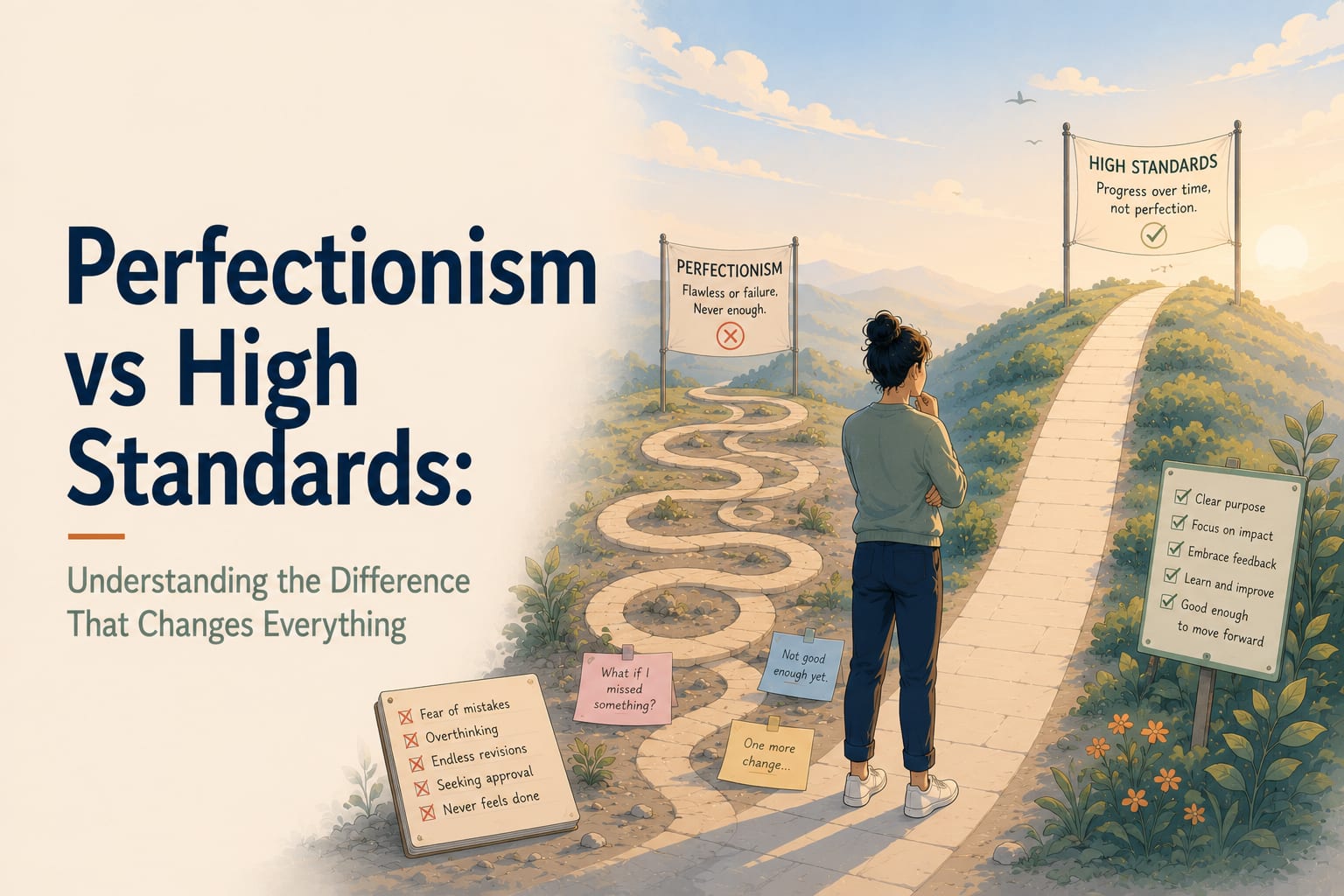
Perfectionism vs High Standards
Many people use the words perfectionism and high standards as though they mean the same thing.
They don't.
From the outside, both can look remarkably similar.
Both involve careful work.
Both involve ambition.
Both involve paying attention to quality.
But if you look closely, something interesting appears.
One pattern helps you move forward.
The other quietly makes it harder to finish.
Understanding the difference changes the way you see your own behavior.
It explains why two people can care equally about doing excellent work while having completely different experiences along the way.
What This Concept Means
High standards and perfectionism both begin with the desire to do something well.
That is where their similarities end.
High standards focus on creating meaningful work.
Perfectionism focuses on avoiding imperfect work.
That difference may sound small.
Psychologically, it changes everything.
Someone with healthy standards asks:
"Does this accomplish what I intended?"
Someone caught in perfectionism asks:
"Have I removed every possible mistake?"
The first question has an answer.
The second rarely does.
High standards allow room for learning.
Perfectionism often treats mistakes as evidence that something has gone wrong.
High standards encourage completion.
Perfectionism often delays it.
One measures progress by improvement.
The other measures progress by the absence of flaws.
This is why perfectionism frequently becomes part of broader self-sabotage patterns.
The goal remains important.
The path toward finishing becomes increasingly difficult.
Why the Brain Creates This Pattern
The brain naturally prefers certainty.
Mistakes create uncertainty.
Criticism creates uncertainty.
Failure creates uncertainty.
Perfectionism develops when the mind begins believing that perfect work can eliminate those uncomfortable experiences.
It quietly forms a simple equation.
Less error equals less emotional pain.
At first, this belief seems reasonable.
You check your work more carefully.
You prepare more thoroughly.
You improve your skills.
Those habits can genuinely be useful.
The problem begins when the brain no longer knows where to stop.
Every improvement creates another possible improvement.
Every completed task reveals another detail to reconsider.
Instead of feeling relieved, you feel responsible for fixing one more thing.
That is how the mind gradually enters overthinking loops.
Thinking no longer supports action.
It replaces it.
Healthy standards use thinking to improve the work.
Perfectionism uses thinking to delay uncertainty.
How This Pattern Appears in Daily Life
Imagine two writers finishing the same article.
Both notice a few sentences they could improve.
The writer with healthy standards makes the important changes and publishes it.
The writer driven by perfectionism rewrites the introduction.
Then the conclusion.
Then the title.
Tomorrow, they read it again and discover new problems.
The article remains unpublished.
The same difference appears in countless situations.
A student submits an assignment after checking it carefully.
Another keeps revising until the deadline arrives.
A business owner launches a website knowing it can improve over time.
Another postpones launching because one page still feels incomplete.
One person prepares for an interview and applies.
Another spends weeks researching because they never feel ready enough.
The behaviors initially look similar.
Both people work hard.
Both care about quality.
The difference is not visible in the work.
It is visible in what happens afterward.
One person moves to the next step.
The other remains trapped in the current one.
Why People Often Miss It
Perfectionism is difficult to recognize because society often rewards the behaviors that surround it.
People admire dedication.
Carefulness.
Precision.
Strong work ethic.
Those qualities genuinely matter.
That makes perfectionism easy to hide behind them.
You may even describe yourself as someone with "high standards."
Sometimes that is true.
But there is one question worth asking.
Do your standards help you finish your work... or make finishing feel increasingly difficult?
That question reveals the difference more clearly than almost anything else.
Healthy standards create confidence through experience.
Perfectionism often waits for confidence before allowing experience.
Over time, this changes the way you see yourself.
You begin believing you need more preparation before taking action.
More certainty before making decisions.
More improvement before sharing your work.
Without realizing it, the standard quietly becomes impossible to satisfy.
Final Reflection
Perfectionism vs high standards is not really about how much you care.
It is about what your mind believes will keep you safe.
Healthy standards say:
"Let's do this well."
Perfectionism says:
"Let's make sure nothing can go wrong."
One goal is achievable.
The other asks for something life cannot provide.
Mistakes will always exist.
Feedback will always be uncertain.
Growth will always involve moments of discomfort.
The next time you find yourself making one more revision before moving forward, pause for a moment.
Ask yourself:
Am I trying to improve the work... or trying to eliminate every possibility of imperfection?
The answer often reveals which side of the line you are standing on.
Because excellence is not the absence of mistakes.
More often, it is the willingness to finish meaningful work while accepting that being human has never required being flawless.
Q: What is the difference between perfectionism and high standards?
A: High standards encourage quality while still allowing work to be completed. Perfectionism makes flaws feel unacceptable, often leading to endless revisions, overthinking, and delayed action.
Q: Can high standards become perfectionism?
A: Yes. Healthy standards can gradually become perfectionism when the focus shifts from doing meaningful work to avoiding every possible mistake or criticism.
Q: Is perfectionism always unhealthy?
A: Caring about quality is healthy. Perfectionism becomes problematic when it repeatedly delays decisions, increases self-criticism, or prevents you from finishing important work.
Q: Why does perfectionism create overthinking?
A: Perfectionism often fuels overthinking loops because the brain keeps searching for certainty and hidden flaws instead of accepting that the work is ready to move forward.
