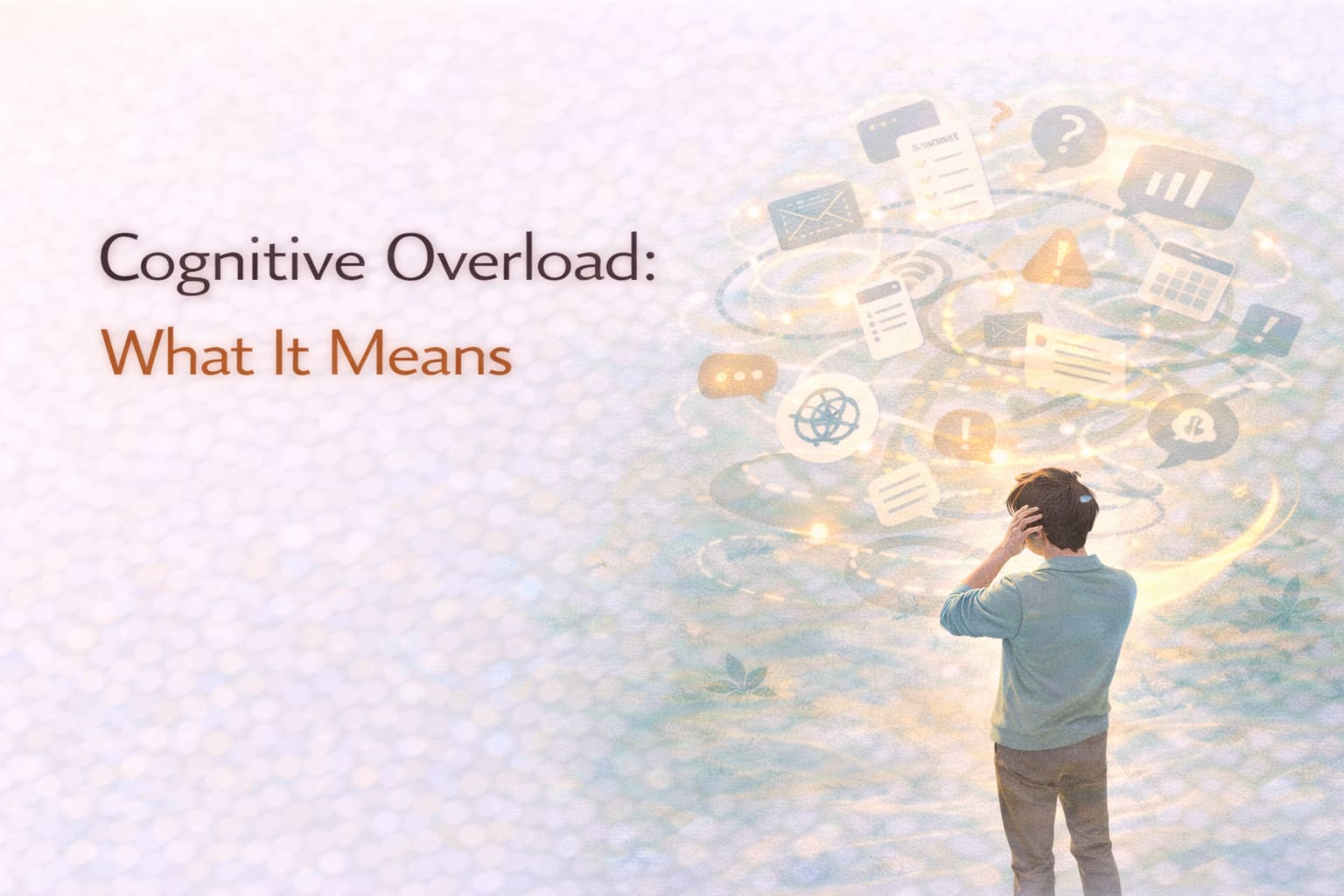
Cognitive Overload: What It Means
Cognitive overload: what it means often becomes clear in a moment you’ve experienced many times.
You’re trying to think.
But your mind feels crowded.
Too many options.
Too many thoughts.
Too many things to process at once.
You start something…
Then pause.
Not because you don’t understand.
But because everything feels like it’s happening at the same time.
You might not notice it at first.
But if you look closely, something interesting appears.
The problem is not the situation.
It’s the amount of mental input you’re trying to handle.
What this actually means
Cognitive overload is a mental state where the brain is handling more information than it can process effectively at one time.
The mind has a limit.
Not a fixed number.
But a threshold.
When too many inputs enter at once, something changes.
Clarity drops.
Thinking slows.
Decisions become harder.
This is not because you lack intelligence.
It’s because your brain is working beyond its capacity.
Instead of organizing information, it begins to stall.
Or loop.
This is where cognitive overload often connects to:
The mind doesn’t stop thinking.
It just stops moving forward.
The behavior most people don’t notice
Cognitive overload doesn’t always feel obvious.
It doesn’t always feel like “too much.”
Sometimes it feels like confusion.
Or hesitation.
Or indecision.
You might notice it in small ways.
You open something… then close it.
You switch between tasks without finishing them.
You reread the same thing multiple times.
You delay decisions you could normally make easily.
It doesn’t feel like overload.
It feels like something is off.
But something subtle is happening.
The brain is not lacking effort.
It is exceeding its processing limit.
Why the mind does this
The brain is constantly receiving input.
Information.
Choices.
Possibilities.
In today’s environment, that input rarely stops.
Messages.
Decisions.
Options.
Expectations.
The brain tries to process everything.
But it cannot prioritize effectively when too much is present at once.
Several mechanisms contribute to this.
Information overload
Too many inputs compete for attention.
Decision pressure
Multiple choices require evaluation at the same time.
Perfectionism patterns
The mind tries to find the best option instead of a good one.
Self-doubt cycles
You question whether you’re processing things correctly.
Instead of simplifying, the brain expands the process.
More thinking.
More comparison.
More analysis.
This is where overload quietly turns into a form of:
Not through failure.
But through mental congestion.
Where this pattern appears in daily life
Cognitive overload appears in ordinary moments.
You open multiple tabs and don’t know where to start.
You receive several messages and delay responding to all of them.
You have many tasks but feel unable to begin any.
You think about several decisions at once and avoid choosing.
You feel mentally tired even without physical effort.
Nothing is individually overwhelming.
But together, they become too much.
The brain doesn’t stop.
It slows.
Then stalls.
Then loops.
The hidden effect of this pattern
Cognitive overload doesn’t just affect thinking.
It affects behavior.
Decisions become slower.
Actions become delayed.
Focus becomes fragmented.
Confidence weakens slightly.
Not because you don’t know what to do.
But because you can’t process everything clearly at once.
This leads to something subtle.
Avoidance.
You delay tasks.
You postpone decisions.
You disengage slightly.
Not intentionally.
But because your mind is overloaded.
This is how cognitive overload contributes to patterns like:
procrastination behavior
self-doubt cycles
overthinking loops
All of which feed into a larger system of mental delay.
What this reveals about human behavior
Cognitive overload reveals something important.
The brain is not designed for constant input.
It is designed for focused processing.
When too much enters at once, the system becomes inefficient.
The mind doesn’t fail.
It adapts.
It slows things down.
It avoids decisions.
It repeats thoughts.
Because it cannot process everything at once.
You might not notice it at first.
But if you look closely, something interesting appears.
The problem is not that you’re thinking too little.
It’s that you’re handling too much at the same time.
And once you see that clearly, something shifts.
You stop trying to think harder.
And start recognizing when your mind is full.
Final reflection
Cognitive overload doesn’t feel dramatic.
It feels subtle.
A slight delay.
A small hesitation.
A quiet mental fatigue.
But if you look closely, something becomes clear.
Your mind is not struggling to think.
It is trying to manage too much at once.
And when that happens, thinking doesn’t stop.
It fragments.
It loops.
It slows.
You might not notice it at first.
But once you see it, you begin recognizing it sooner.
Not as confusion.
But as capacity.
And in that moment, something simple becomes visible.
Not every problem needs more thinking.
Some just need less input.
Q: What is cognitive overload in psychology?
A: Cognitive overload is when the brain is processing more information than it can handle effectively, leading to confusion, slow thinking, and decision difficulty.
Q: Why does cognitive overload happen?
A: It happens when too many inputs, decisions, or tasks compete for attention at the same time.
Q: Is cognitive overload related to overthinking?
A: Yes. When overloaded, the brain may enter overthinking loops instead of making clear decisions.
Q: How can I recognize cognitive overload?
A: When you feel mentally stuck, unable to decide, or repeatedly switching between tasks, your mind may be overloaded.
Related Patterns
If this pattern feels familiar, it often connects to other behaviors.
- Overthinking Loops
- Decision Paralysis Psychology (coming soon)
- Procrastination Patterns (coming soon)
- The Complete Guide to Self-Sabotage Patterns
