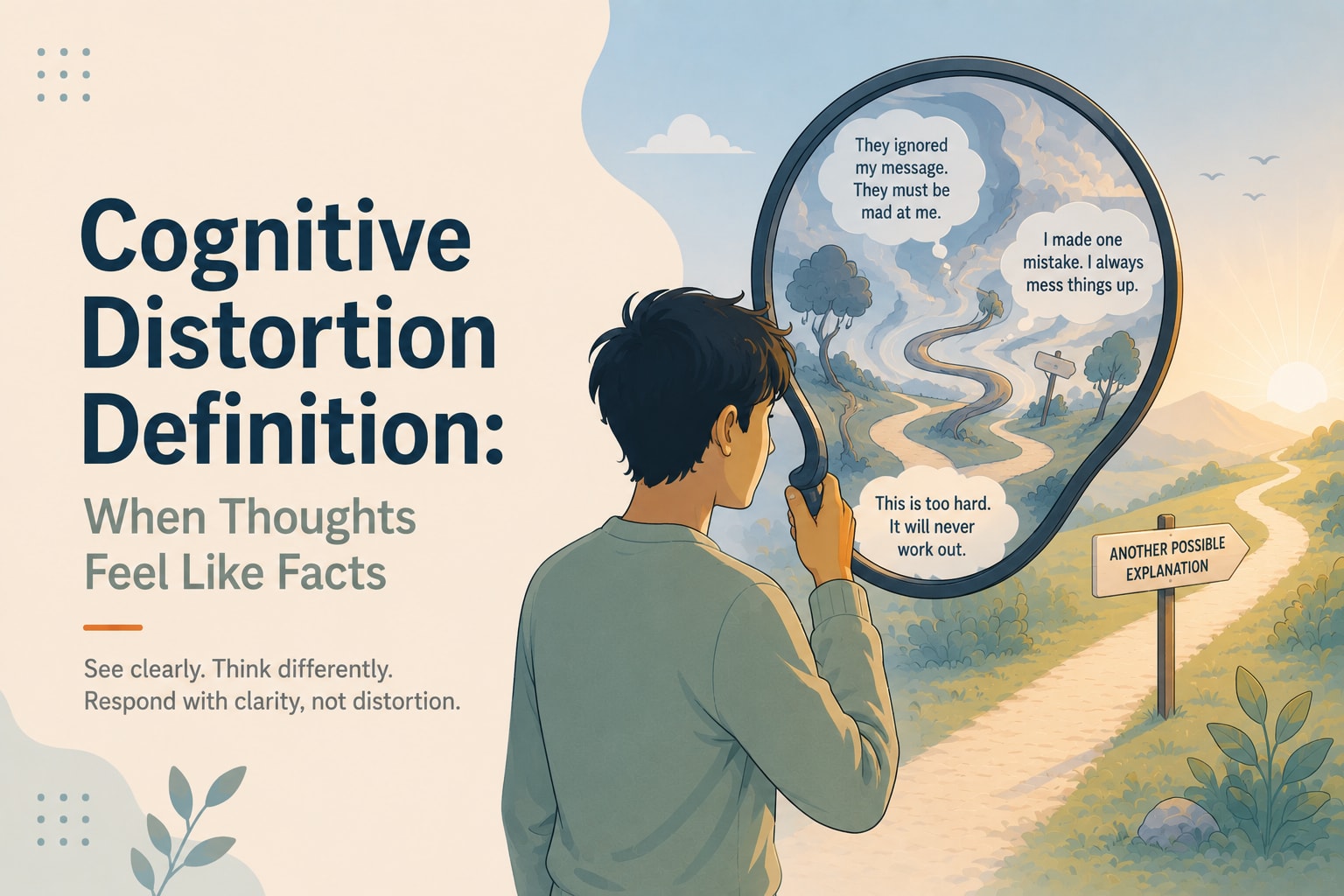
Cognitive Distortion Definition: When Thoughts Feel Like Facts
A cognitive distortion definition sounds simple: it is a habitual way of thinking that changes how you interpret a situation, often without you realising it.
But the experience itself rarely feels distorted.
It feels accurate.
A friend replies with fewer words than usual, and you assume they are upset.
You make one mistake during a presentation, and the entire performance begins to feel like a failure.
Someone disagrees with you, and your mind quietly turns the disagreement into proof that your idea was foolish.
Nothing about these conclusions feels invented in the moment.
They seem to follow naturally from what happened.
That is what makes cognitive distortions difficult to notice.
The mind does not announce that it is simplifying, exaggerating, or filling in missing information.
It simply presents an interpretation with the emotional weight of a fact.
You might not notice it at first.
The event happens quickly.
The interpretation appears almost immediately.
Then the feeling follows.
By the time you become aware of the thought, it may already feel like an obvious description of reality.
This pattern often appears inside larger self-sabotage patterns, especially when a distorted conclusion becomes the starting point for avoidance, hesitation, reassurance-seeking, or recurring overthinking loops.
The Behavior Most People Don’t Notice
A cognitive distortion is not simply a negative thought.
Sometimes negative thoughts are accurate.
A situation may genuinely be difficult.
A relationship may be unhealthy.
A decision may carry serious risk.
The distortion appears in the way the mind moves from limited information to a broad conclusion.
One mistake becomes evidence that you always fail.
One uncomfortable interaction becomes proof that someone dislikes you.
One delay becomes a sign that everything is going wrong.
The mind takes something real and stretches its meaning.
That is why distorted thinking can be hard to challenge.
There is usually a fact somewhere inside it.
The message was shorter.
The mistake did happen.
The person did disagree.
But the interpretation goes further than the evidence.
You might think:
"I failed at this task, so I am not capable."
The first part may be true.
The second part is a conclusion.
The mind joins them so quickly that the difference becomes difficult to see.
But if you look closely, something interesting appears.
The emotional reaction often belongs less to what happened and more to what the event was made to mean.
Why the Brain Does This
The brain prefers quick interpretations.
It is constantly trying to predict what matters, what might happen next, and what deserves attention.
To do this efficiently, it uses familiar shortcuts.
These shortcuts are not always harmful.
They help you recognise patterns without carefully analysing every detail of every situation.
The problem begins when an old pattern is applied too quickly or too broadly.
If rejection once felt especially painful, an unanswered message may now seem threatening.
If mistakes were treated harshly in the past, a small error may feel like the beginning of humiliation.
If approval became connected to safety, disagreement may feel more serious than it actually is.
The mind is trying to protect you by reaching a conclusion early.
But early conclusions often contain missing information.
Another person’s silence may have many explanations.
A difficult result may reflect timing, preparation, circumstances, or simple chance.
Yet uncertainty feels uncomfortable.
A definite negative explanation can sometimes feel easier to hold than an unanswered question.
That is where the pattern begins.
The brain chooses a familiar story because familiar stories create the appearance of certainty.
The story may be painful.
But it feels known.
Where This Pattern Shows Up in Daily Life
Cognitive distortions appear in ordinary moments, not only during major emotional events.
All-or-nothing thinking
You complete most of a task well, but one unfinished section makes the entire effort feel worthless.
The mind recognises only complete success or complete failure.
Everything in between disappears.
Mind reading
Someone seems distracted, and you assume you know what they think about you.
No clear explanation has been given, but the mind fills the silence with a conclusion.
Catastrophising
A small problem appears, and attention moves immediately toward the worst possible outcome.
A delayed payment becomes financial collapse.
One symptom becomes a serious illness.
One disagreement becomes the end of a relationship.
Overgeneralising
A single experience becomes a rule.
You are rejected once and think, "No one will choose me."
You struggle with one project and think, "I can never finish anything."
Discounting the positive
Something goes well, but the mind refuses to let the result count.
Success becomes luck.
Praise becomes politeness.
Progress becomes too small to matter.
This pattern appears strongly in Imposter Syndrome Explained, where real achievements are repeatedly separated from personal ability.
Emotional reasoning
You feel incapable, so you assume you must be incapable.
You feel guilty, so you assume you must have done something wrong.
You feel uncertain, so you assume the situation must be unsafe.
The feeling becomes evidence.
In each case, the mind is not inventing an entirely separate reality.
It is selecting one part of reality and treating it as the whole picture.
The Hidden Effect of This Pattern
The most immediate effect of a cognitive distortion is emotional.
A neutral event begins to feel threatening.
A manageable problem feels permanent.
A temporary mistake feels personal.
But the deeper effect appears in behaviour.
You withdraw because you assume someone is judging you.
You avoid applying because you treat possible rejection as inevitable rejection.
You keep editing because one imperfect sentence makes the entire project feel unready.
You ask for reassurance because your interpretation feels convincing but difficult to tolerate.
The thought changes the feeling.
The feeling changes the action.
The action then creates new evidence that seems to support the thought.
For example, you assume your ideas are not valuable.
You remain silent in meetings.
Because your ideas are never heard, you receive no evidence that others might value them.
The lack of recognition then appears to confirm the original belief.
This is how a cognitive distortion can become self-reinforcing.
It does not merely describe experience.
It quietly influences the experience that develops next.
That is why distorted thinking often connects with Why Doubt Grows the More You Think.
Repeated analysis can make the original interpretation feel more detailed and therefore more believable, even when no meaningful new evidence has appeared.
What This Reveals About Human Behavior
Cognitive distortions reveal that people do not respond only to events.
They respond to interpretations.
Two people can experience the same silence, mistake, delay, or criticism and leave with completely different conclusions.
One person thinks:
"That was uncomfortable."
Another thinks:
"That proves I do not belong here."
The event is similar.
The psychological meaning is different.
This does not mean thoughts should never be trusted.
It means thoughts are constructions, not direct recordings.
They are shaped by memory, expectation, fear, identity, and previous experience.
A thought can feel convincing because it is familiar.
A feeling can feel accurate because it is intense.
Neither quality guarantees that the interpretation is complete.
The important question is often not:
"Is this thought positive or negative?"
It is:
"How much of this thought comes from the evidence, and how much has my mind added?"
That question creates distance without pretending the concern is meaningless.
You are not denying what happened.
You are noticing where the event ends and the interpretation begins.
Final Reflection
A cognitive distortion does not feel like a distortion while you are inside it.
It feels like noticing what is obvious.
The person is quiet, so they must be upset.
The task was difficult, so you must be incapable.
The outcome was disappointing, so the entire decision must have been wrong.
The conclusion arrives quickly.
The emotion gives it weight.
The behaviour follows.
Only later might you recognise how much meaning was added between the event and the reaction.
That is the quiet pattern.
Something happens.
The mind interprets it.
The interpretation becomes a feeling.
The feeling becomes evidence.
The evidence appears to confirm the original thought.
Nothing about the process feels unusual because it happens so quickly.
Perhaps that is the most useful part of understanding cognitive distortions.
The goal is not to distrust every thought.
It is to remember that a thought can be sincere, emotionally powerful, and still incomplete.
Sometimes the mind is not showing you exactly what happened.
It is showing you what what happened means through the lens of everything you already fear, expect, and remember.
Q: What is a cognitive distortion in simple terms?
A: A cognitive distortion is an automatic thinking pattern that changes or exaggerates the meaning of an event, causing an interpretation to feel more certain than the evidence supports.
Q: Are cognitive distortions the same as negative thoughts?
A: No. A negative thought may be realistic. A cognitive distortion usually involves drawing a broad, extreme, or unsupported conclusion from limited information.
Q: Why do cognitive distortions feel so real?
A: They often form quickly and connect with familiar fears or beliefs. The emotional response they create can make the interpretation feel like a fact.
Q: Can overthinking make cognitive distortions stronger?
A: Yes. Repeatedly reviewing the same interpretation can produce more imagined evidence, making the thought feel increasingly detailed and convincing.
