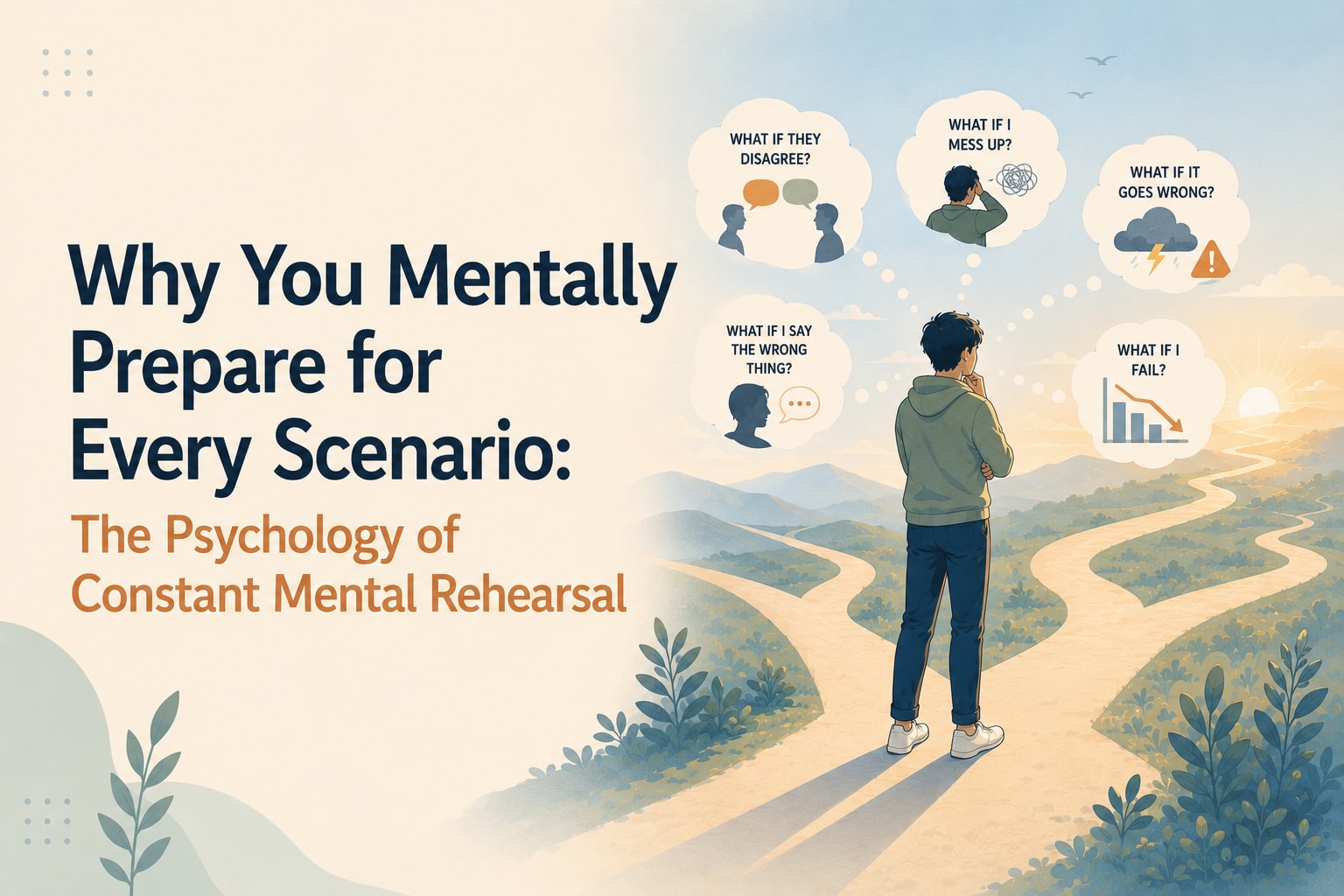
Why You Mentally Prepare for Every Scenario
Have you ever walked into a conversation that had already happened dozens of times inside your head?
You imagined what the other person might say.
Then you imagined your reply.
Then their next response.
Then another possibility.
Before anything actually happened, your mind had already explored countless different versions of the same moment.
At first, this feels responsible.
You are simply trying to be prepared.
But if you look closely, something interesting appears.
The more situations you mentally prepare for, the less prepared you often feel.
There always seems to be one more possibility you haven't considered.
That is the psychology behind why you mentally prepare for every scenario.
What This Concept Means
Why you mentally prepare for every scenario describes a psychological pattern where the mind repeatedly imagines future situations in an attempt to reduce uncertainty before they happen.
This is sometimes called mental rehearsal.
Mental rehearsal can be useful.
Athletes imagine performing well before competitions.
Speakers visualize delivering presentations.
Doctors mentally review procedures before entering surgery.
The difference is that healthy mental rehearsal prepares you to act.
Unhealthy mental rehearsal keeps expanding until preparation replaces action.
Instead of imagining one likely outcome, the mind begins exploring every possible outcome.
The conversation.
The interview.
The meeting.
The first date.
The difficult phone call.
Every possibility feels important because the brain believes missing one could be costly.
Over time, preparation quietly becomes endless.
This pattern often overlaps with larger self-sabotage patterns, where thinking creates the feeling of progress while postponing real experience.
Why the Brain Creates This Pattern
The brain naturally dislikes uncertainty.
Not knowing what will happen requires trust.
Trust can feel risky.
Planning feels safer.
When the future is unclear, the mind starts asking questions.
"What if they disagree?"
"What if I forget what to say?"
"What if something goes wrong?"
Each question creates another possible future.
The brain tries to answer them all.
It believes that if enough situations are imagined beforehand, fewer surprises will exist later.
For a brief moment, this creates relief.
The future feels slightly more predictable.
That relief teaches the brain to continue preparing.
Soon, preparation becomes the automatic response to uncertainty.
The problem is that uncertainty can never be completely removed.
There is always another possibility.
Another reaction.
Another unexpected outcome.
This is how overthinking loops quietly develop.
Thinking no longer helps you understand the future.
It simply creates more versions of it.
Instead of reducing uncertainty, the mind accidentally multiplies it.
How This Pattern Appears in Daily Life
This behavior is surprisingly common.
You rehearse an important conversation while driving to work.
You imagine every interview question before submitting the application.
You plan how to explain yourself before anyone has misunderstood you.
You replay possible disagreements before seeing a family member.
You prepare answers for criticism that may never happen.
You imagine dozens of ways a presentation could fail.
You mentally practice asking someone out.
Then imagine rejection.
Then imagine acceptance.
Then imagine what happens after acceptance.
Then imagine what happens if things become awkward.
Notice how quickly one situation becomes many.
Reality offers one future.
The mind creates hundreds.
The interesting part is that most of those imagined situations never happen.
Yet emotionally, the brain responds as though each one deserves preparation.
You might not notice it at first.
The process feels responsible.
After all, what could be wrong with being prepared?
The problem is not preparation.
The problem is believing you must prepare for every possibility before you are allowed to move.
Why People Often Miss It
People rarely recognize this pattern because it looks thoughtful.
You appear calm.
Responsible.
Organized.
You think things through.
Others may even compliment you for being prepared.
What they cannot see is the emotional cost.
While your body remains still, your mind may be running hundreds of simulations every day.
Each one asks for attention.
Each one consumes mental energy.
Another reason people miss this pattern is because preparation feels productive.
Thinking feels like work.
Planning feels like progress.
Imagining solutions feels useful.
Sometimes it is.
But there comes a point where new preparation stops producing new understanding.
Instead, it becomes emotional reassurance.
The mind is no longer gathering information.
It is trying to eliminate uncertainty.
That goal can never be fully achieved.
Eventually, preparation itself becomes the thing preventing experience.
Real confidence grows through reality.
Not imagination alone.
You discover how capable you are by living through situations, not by endlessly rehearsing them.
Final Reflection
Why you mentally prepare for every scenario is not really about preparation.
It is about the search for certainty.
The mind quietly believes that enough thinking can prevent enough discomfort.
Life rarely works that way.
Some conversations surprise you.
Some opportunities unfold differently than expected.
Some problems solve themselves without ever becoming problems.
The future has always contained uncertainty.
It always will.
The next time you notice yourself mentally rehearsing every possible outcome, pause for a moment.
Ask yourself:
Am I preparing for what is likely to happen... or trying to control everything that could happen?
Those are very different goals.
One helps you move forward.
The other quietly keeps you standing still.
Because confidence rarely comes from imagining every possible future.
More often, it comes from discovering that you can handle the one that actually arrives.
Q: Why do I mentally prepare for every possible scenario?
A: Your brain is trying to reduce uncertainty. Imagining different outcomes creates a temporary feeling of control, even though most of those situations never happen.
Q: Is mentally preparing for everything a form of overthinking?
A: It can become one. Healthy preparation helps you take action. When preparation expands endlessly and delays action, it often becomes part of overthinking loops.
Q: Why do I imagine conversations before they happen?
A: Many people mentally rehearse conversations because the brain wants to avoid embarrassment, rejection, or conflict. Rehearsing feels like protection, even though reality rarely follows the imagined script.
Q: Can mentally preparing for every scenario become self-sabotage?
A: Yes. When endless preparation prevents decisions, conversations, or opportunities, it often becomes one of the quieter self-sabotage patterns, where thinking replaces experience.
