Why Overthinking Feels Productive But Isn't
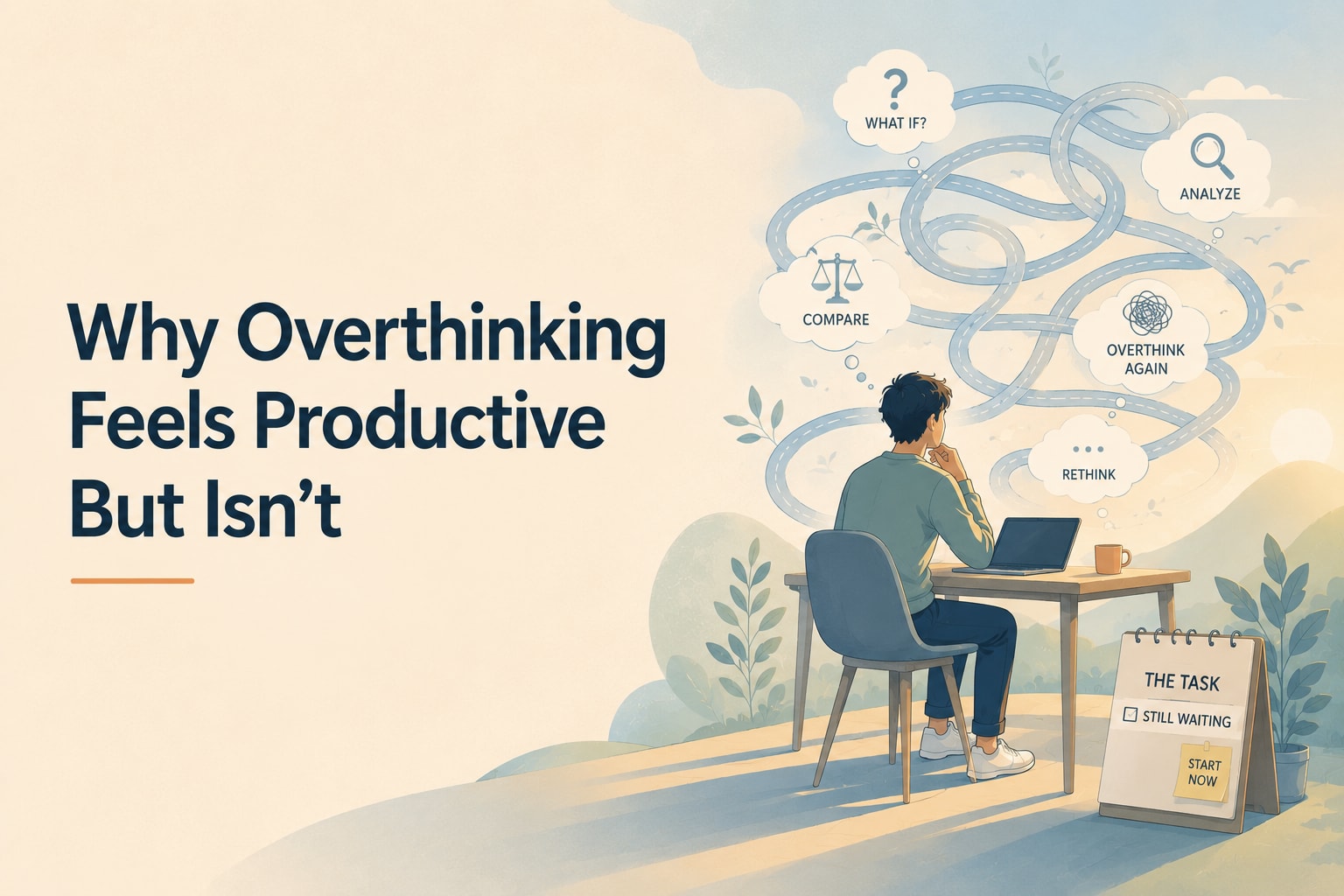
Why overthinking feels productive but isn't can be difficult to recognize because thinking looks like effort.
You are reviewing the situation.
Considering the consequences.
Looking for the best approach.
Trying to avoid a mistake.
Your mind feels active, so it seems as though something useful must be happening.
But hours can pass without a decision being made.
You may examine the same possibilities repeatedly, only from slightly different angles.
Nothing has changed outside your mind.
Still, you feel mentally exhausted, as though you have been working all day.
You might not notice it at first.
Overthinking rarely feels like avoidance while you are doing it.
It feels like preparation.
That is where the pattern begins.
The Behavior Most People Don't Notice
Overthinking often starts with a reasonable question.
What should I do?
What could go wrong?
How will this person respond?
Is this the right time?
A certain amount of thought is useful.
It helps you notice risks, compare choices, and prepare for likely outcomes.
The problem begins when thinking stops producing new information.
You revisit the same concern.
You imagine another version of the same future.
You reconsider a decision that was already clear.
The mind remains busy, but the process is no longer moving forward.
This is why overthinking can feel productive.
There is effort without visible inactivity.
You are not doing nothing.
You are thinking intensely.
But mental movement is not always progress.
Sometimes the mind creates activity to avoid the discomfort of choosing.
This is common within larger self-sabotage patterns.
You do not reject the goal.
You remain mentally occupied with it while postponing the action that would make it real.
Why the Brain Does This
The brain likes predictability.
Action introduces uncertainty.
Once you send the message, submit the application, publish the work, or make the decision, you lose control over what happens next.
Thinking feels safer because it keeps everything inside your private world.
There, every possibility can still be examined.
Every mistake can still be prevented.
Every outcome can still be imagined differently.
Overthinking creates a temporary sense of control.
The mind quietly believes that if it considers enough possibilities, it can remove uncertainty before acting.
But uncertainty is rarely removed through thought alone.
At some point, more analysis stops producing clarity.
It begins producing more analysis.
Thinking reduces immediate discomfort.
You do not have to risk being wrong yet.
You do not have to face feedback.
You do not have to discover whether the outcome matches your expectations.
That emotional relief teaches the brain to continue.
The next time uncertainty appears, the mind returns to the same strategy.
Think longer.
Check again.
Imagine more outcomes.
This is how overthinking loops become self-reinforcing.
The more you think, the more important the decision feels.
The more important it feels, the harder it becomes to act.
Where This Pattern Shows Up in Daily Life
Overthinking often hides inside ordinary decisions.
You spend an hour researching which simple product to buy, even though several options would work.
You write a message, delete it, rewrite it, and leave it unsent.
You replay a conversation, trying to determine what one sentence really meant.
You keep adjusting a business idea instead of testing it.
You plan a difficult conversation in detail but continue postponing it.
You compare job opportunities so thoroughly that you miss the application deadline.
You refine an article long after it communicates the idea clearly.
These situations look different.
The pattern underneath them is usually similar.
Uncertainty appears → the mind searches for certainty → more possibilities emerge → confidence decreases → action is delayed
This can also happen after an event.
You may replay something that already happened, trying to discover the perfect explanation.
You imagine what you should have said.
You search for hidden meaning in another person's expression.
You mentally edit a moment that can no longer be changed.
The mind treats repeated analysis as though it might create a different past.
It cannot.
But the activity still feels meaningful because it creates the impression that you are solving something.
The Hidden Effect of This Pattern
The obvious effect of overthinking is delayed action.
The hidden effect is reduced trust in your own judgment.
Each time you reach a reasonable conclusion and then reopen the decision, you teach yourself that your first judgment is not reliable.
You check again.
You seek more opinions.
You compare more possibilities.
Eventually, even simple decisions begin to feel heavy.
Another hidden effect is that overthinking increases the emotional importance of ordinary situations.
A short message begins to feel like a major test.
A small mistake begins to feel permanent.
A manageable choice begins to feel as though it could change everything.
The situation has not necessarily become more serious.
Your attention has simply stayed on it long enough for the mind to magnify it.
Overthinking can also create the illusion that you are preparing for reality while actually receiving less information from it.
You imagine how people might respond.
But you do not ask them.
You predict whether an idea will work.
But you do not test it.
You try to perfect the plan.
But you do not begin.
Real feedback remains unavailable because action never happens.
What This Reveals About Human Behavior
Why overthinking feels productive but isn't reveals that the mind often prefers familiar discomfort to unfamiliar reality.
Thinking may be exhausting.
But it is predictable.
Action may be simpler.
But it introduces outcomes you cannot fully control.
This explains why people sometimes remain in thought even after they know what to do.
The problem is no longer a lack of understanding.
It is a reluctance to cross the emotional distance between understanding and action.
But if you look closely, something interesting appears.
Clarity does not always arrive before movement.
Sometimes movement creates clarity.
You learn what matters after the conversation begins.
You discover which problem is real after the project launches.
You understand your ability after you attempt the task.
This is why the Start Before Ready Model is so useful.
It recognizes that thought has limits.
Some answers only appear after reality becomes involved.
Overthinking tries to solve the entire journey before taking the first step.
Human beings rarely learn that way.
We understand life through a combination of thought, experience, feedback, and adjustment.
Final Reflection
Overthinking is not useless.
Thought matters.
Reflection matters.
Careful decisions matter.
The problem begins when thinking is used to avoid the emotional risk of acting.
At that point, the mind may still feel busy.
But busyness is not the same as movement.
The next time you notice yourself returning to the same question, pause.
Ask yourself:
Has this thought produced new information, or is it helping me postpone uncertainty?
That distinction can be quiet.
But it changes the entire pattern.
Sometimes you genuinely need more time.
Sometimes you need better information.
And sometimes you already know enough.
The remaining step is not another thought.
It is allowing reality to answer what thinking cannot.
Q: Why does overthinking feel productive?
A: Overthinking feels productive because the mind is active, focused, and using effort. However, repeated analysis may create no new information or action, making it mentally demanding without producing meaningful progress.
Q: How can I tell whether I'm planning or overthinking?
A: Planning usually leads to a clear next step. Overthinking repeatedly revisits the same possibilities, increases uncertainty, and delays a decision without adding useful information.
Q: Is overthinking a form of self-sabotage?
A: It can be. When repeated thinking keeps you from making decisions, sharing your work, or taking practical action, it may become part of broader self-sabotage patterns.
Q: Why does overthinking make decisions harder?
A: Overthinking introduces more possibilities and imagined risks. As the number of possibilities grows, confidence often decreases, making even simple decisions feel unusually important.
