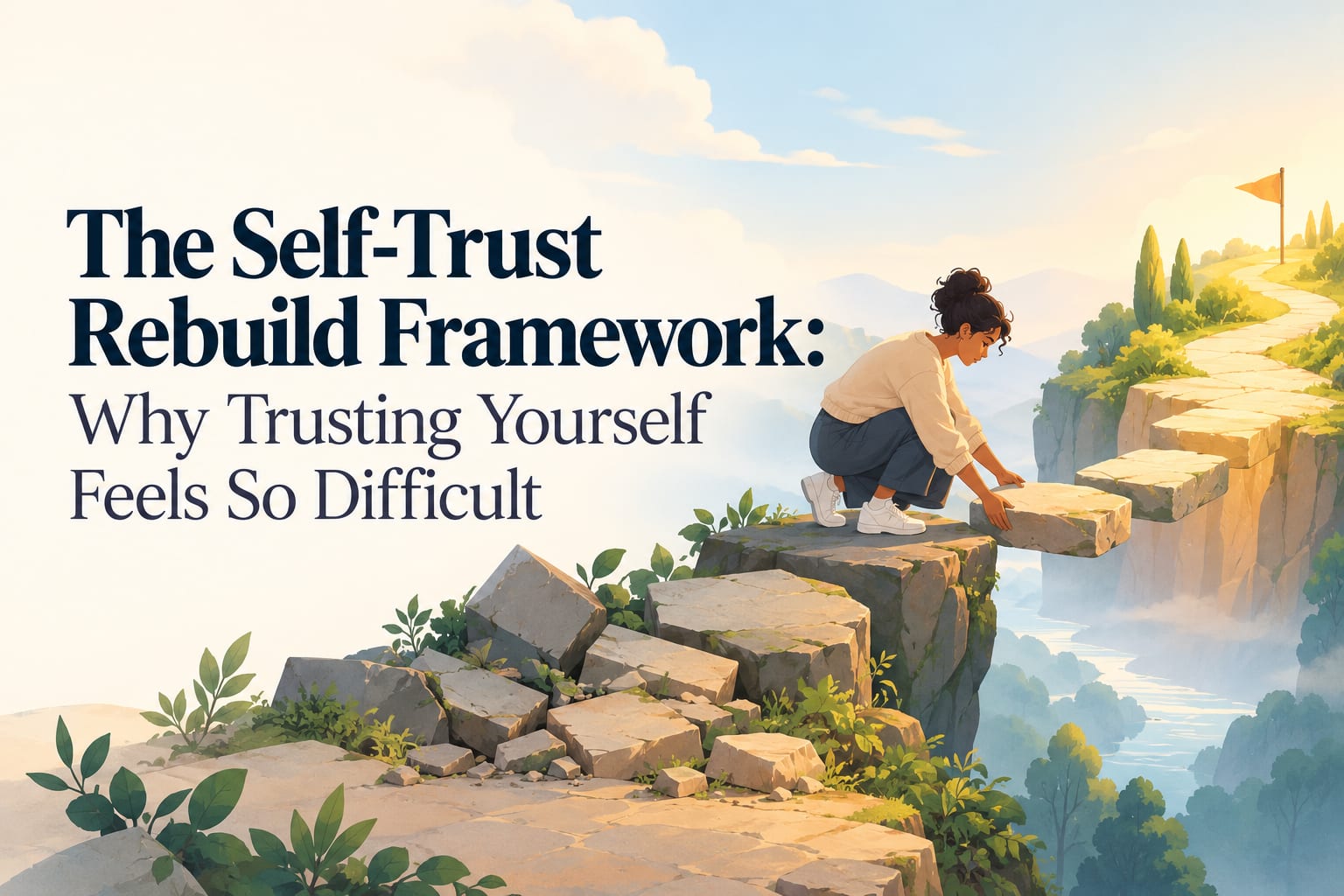
The Self-Trust Rebuild Framework begins with something you might recognize.
You make a decision.
Then you question it.
You promise yourself you'll do something.
Then you don't.
You tell yourself you know what is best.
Then someone offers a different opinion, and suddenly you're unsure.
Eventually, something strange happens.
You stop trusting your own judgment.
Not because every decision you've made was wrong.
But because you've become accustomed to treating your own decisions as unreliable.
You might not notice it at first.
Self-trust rarely disappears in one dramatic moment.
Sometimes it weakens through hundreds of ordinary interactions with yourself.
You decide.
You doubt.
You seek reassurance.
You change your mind.
Then you quietly learn:
"Maybe I shouldn't trust myself to know."
That's where the pattern begins.
The first shift: Your decisions stop feeling final.
You choose something.
But instead of allowing the decision to settle, you keep reopening it.
Was that the right response?
Should you have waited?
What if someone else would have chosen differently?
The decision becomes another opportunity to question your judgment.
This is closely connected to overthinking loops, where thinking stops helping you decide and begins making every option feel uncertain.
The second shift: You begin borrowing certainty.
You ask other people what they think.
Not necessarily because you need more information.
Sometimes you already know what you prefer.
But your own answer doesn't feel convincing until someone else agrees.
Their approval creates relief.
Their disagreement creates doubt.
Slowly, your confidence becomes dependent on reactions you cannot control.
The third shift: You stop collecting evidence that you can trust yourself.
This is the part people often miss.
You have made good decisions before.
You have handled difficult situations.
You have solved problems without knowing exactly how things would turn out.
But when a new challenge appears, those experiences suddenly seem irrelevant.
"That was different."
"I was just lucky."
"This time might not work."
The mind remembers the success without allowing it to change your self-image.
This is the same quiet contradiction explored in The You've Done This Before Loop.
The fourth shift: You begin rebuilding through ordinary evidence.
Self-trust does not necessarily return because you finally feel confident.
Sometimes it begins when you notice a different sequence.
You make a small, reasonable decision.
You allow it to stand without asking five people to confirm it.
You follow through on something manageable.
You acknowledge what happened, including what went wrong.
And when the outcome isn't perfect, you don't automatically turn it into proof that your judgment is defective.
The evidence is small.
But it is no longer being dismissed.
This doesn't mean every decision must be defended.
Trusting yourself also includes recognizing mistakes, changing direction, and knowing when outside expertise matters.
The difference is that correction no longer has to become self-rejection.
And here is the quieter realization.
Self-trust isn't the belief that you'll always make the right decision.
It's the growing expectation that you can make a reasonable choice, respond to what happens, and learn without abandoning confidence in your entire judgment.
You can be uncertain and still act thoughtfully.
You can make a mistake without treating yourself as incapable.
You can listen to other people without surrendering your own perspective.
That is what makes rebuilding self-trust different from simply trying to feel more confident.
Confidence often asks:
"Can I succeed?"
Self-trust asks:
"Can I rely on myself to respond, even when I don't know exactly what will happen?"
And perhaps that's why some self-sabotage patterns are so difficult to recognize.
They don't always look like fear or avoidance.
Sometimes they look like repeatedly asking the outside world to approve a judgment you were already capable of making.
If you look deeper, the question isn't only why you doubt yourself.
It's how often you dismiss the evidence that you can be trusted.
Related Patterns
If this feels familiar, these patterns reveal what may be happening underneath.
