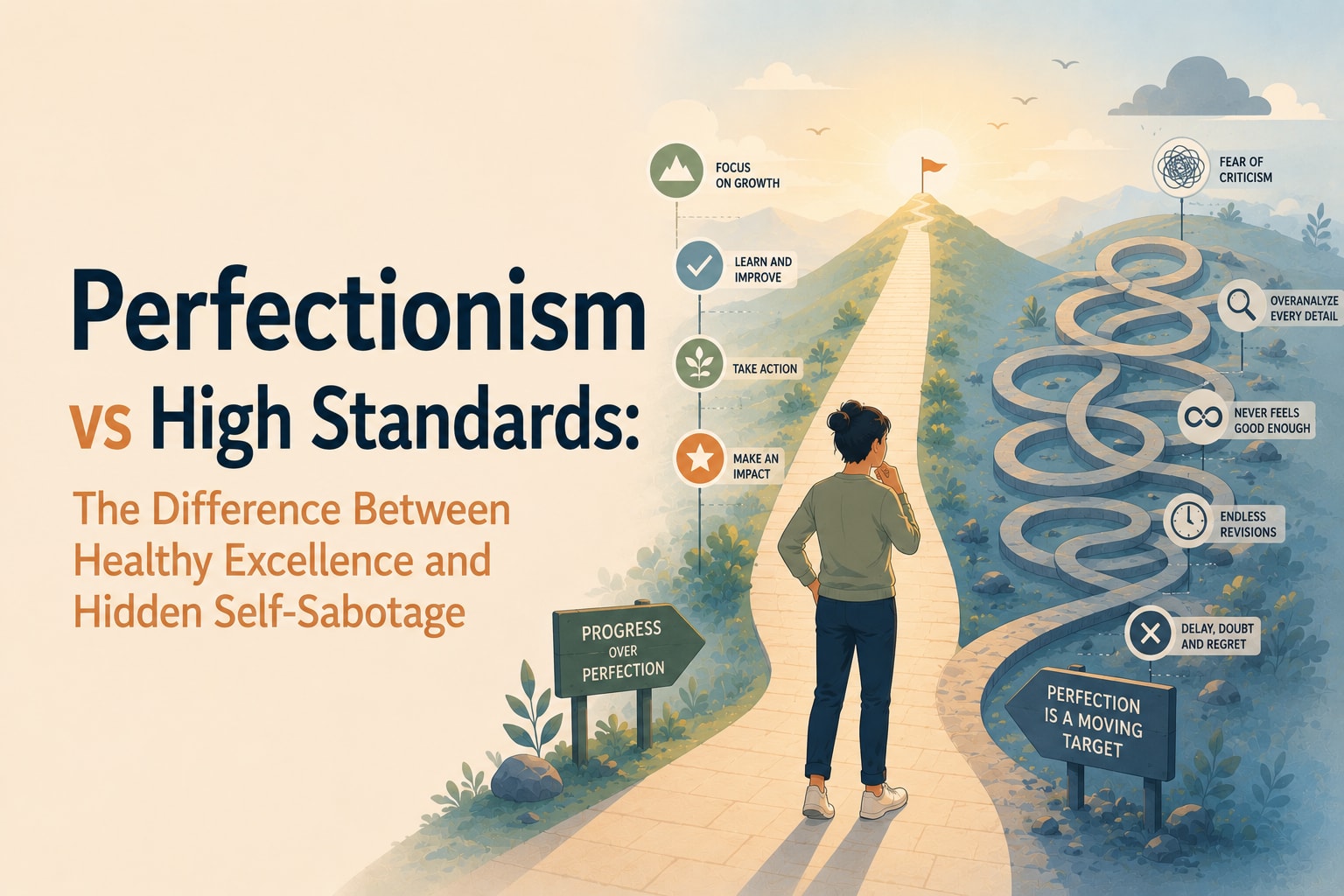
Perfectionism vs High Standards
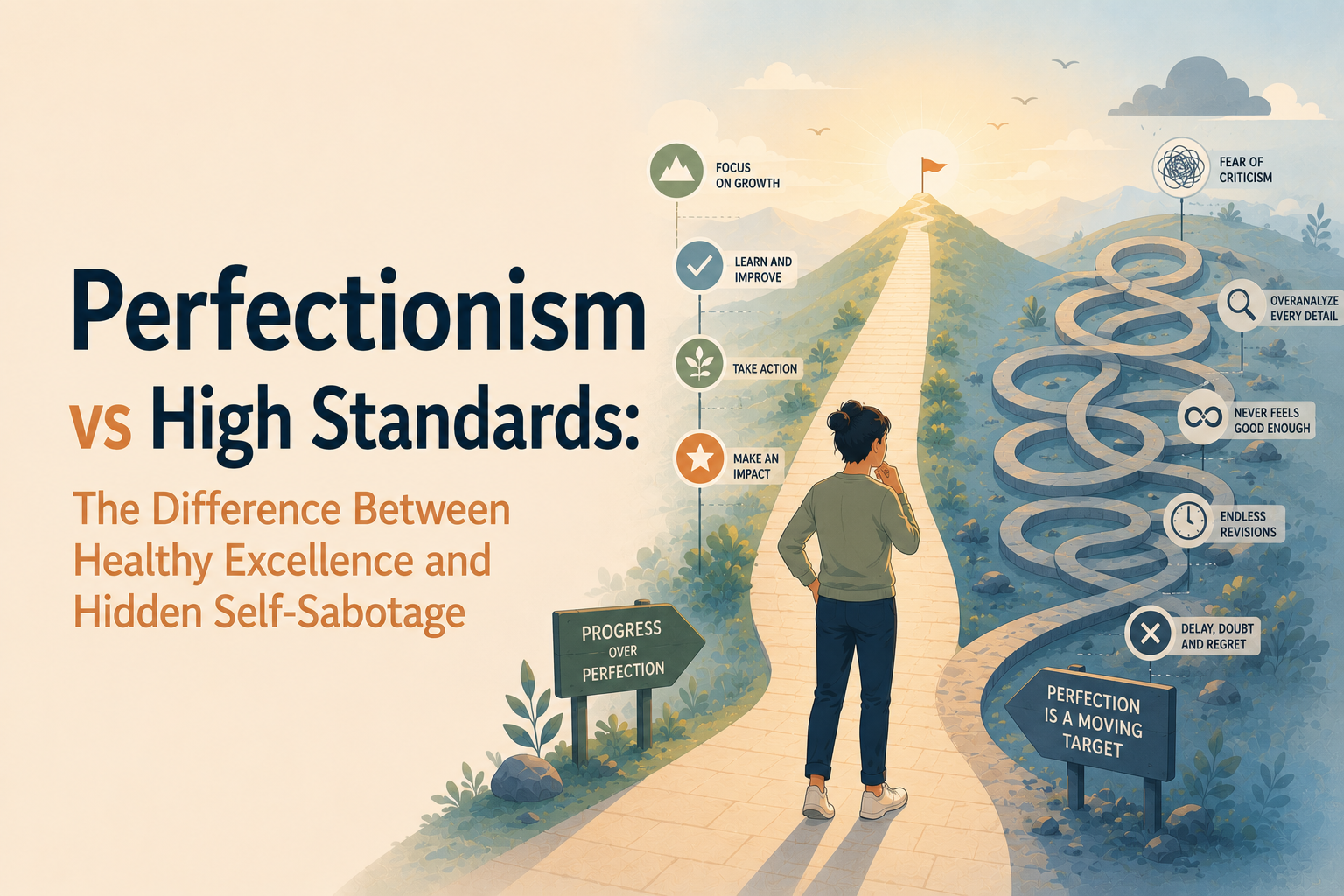
Perfectionism vs high standards is a comparison that confuses many people because, from the outside, they often look exactly the same.
Both people work hard.
Both care about quality.
Both want to do things well.
Both pay attention to details.
Yet one person consistently finishes meaningful work, learns from experience, and moves forward.
The other spends far more time preparing than completing.
You might not notice it at first.
The difference is not found in how much they care.
It is found in why they care.
That is where the pattern begins.
The Behavior Most People Don't Notice
People often believe perfectionism is simply having very high standards.
It sounds logical.
If someone produces excellent work, surely they must be a perfectionist.
But if you look closely, something interesting appears.
Healthy high standards and perfectionism are driven by very different motivations.
Someone with high standards wants to create something valuable.
Someone trapped in perfectionism wants to avoid creating something imperfect.
Those goals may produce similar behavior in the beginning.
Both people revise.
Both improve.
Both think carefully.
But eventually, the paths separate.
High standards eventually say,
"This serves its purpose."
Perfectionism says,
"It still isn't enough."
High standards have a finish line.
Perfectionism quietly moves it.
That is why perfectionism often becomes part of larger self-sabotage patterns.
It rarely stops people from starting.
Instead, it makes finishing emotionally difficult.
Why the Brain Does This
The brain naturally tries to avoid emotional pain.
Criticism hurts.
Failure hurts.
Embarrassment hurts.
So the mind begins searching for ways to reduce those experiences before they happen.
Perfectionism is one of those strategies.
If the work is flawless...
Perhaps nobody can criticize it.
If every possibility has been considered...
Perhaps nothing will go wrong.
The intention sounds reasonable.
The problem is that perfection is not something the brain can ever confidently declare.
There is always another improvement available.
Another sentence to rewrite.
Another decision to reconsider.
Another possibility to imagine.
This creates a powerful psychological illusion.
The brain begins confusing preparation with protection.
The more time you spend refining the work, the safer you feel.
At least temporarily.
That relief teaches the brain to keep refining.
Over time, this becomes automatic.
Instead of asking,
"Is this useful?"
The mind asks,
"Is this impossible to criticize?"
That question has no satisfying answer.
It also feeds the kind of overthinking loops where every decision feels increasingly important.
The goal quietly changes.
You are no longer creating excellent work.
You are trying to eliminate uncertainty.
Where This Pattern Shows Up in Daily Life
Imagine two people writing the same article.
Both notice awkward sentences.
Both improve the structure.
Both proofread carefully.
One publishes the article.
The other keeps reopening it for another revision.
Now imagine two people preparing for a job interview.
Both research the company.
Both practice their answers.
One submits the application.
The other waits because they still don't feel ready.
The same difference appears everywhere.
A business owner launches a website that can improve over time.
Another delays launching because one page still feels incomplete.
One student submits an assignment after reviewing it carefully.
Another spends hours adjusting formatting because the work never quite feels finished.
One person apologizes after making a mistake.
Another spends days mentally rewriting the conversation.
The difference is rarely effort.
It is the emotional meaning attached to mistakes.
For someone with healthy standards, mistakes are information.
For someone caught in perfectionism, mistakes begin to feel personal.
The Hidden Effect of This Pattern
The obvious effect of perfectionism is slower progress.
The hidden effect is something much deeper.
Perfectionism slowly changes your relationship with yourself.
You stop measuring success by what you complete.
You begin measuring it by what you failed to perfect.
Every achievement becomes accompanied by a list of flaws.
Every compliment feels incomplete.
Every success feels temporary.
Instead of celebrating progress, your attention immediately searches for what still needs fixing.
Over time, confidence becomes increasingly difficult to experience.
Not because you lack ability.
Because your standards never allow your mind to recognize what you have already accomplished.
High standards create momentum.
Perfectionism creates hesitation.
One encourages learning through action.
The other encourages endless preparation before action.
Ironically, perfectionism often produces the very thing it hopes to prevent.
More missed opportunities.
More unfinished work.
More self-doubt.
Because confidence rarely comes from flawless performance.
It usually comes from repeated experience.
What This Reveals About Human Behavior
Perfectionism vs high standards reveals that the human mind is motivated by more than quality.
It is motivated by emotional safety.
Sometimes people continue improving their work because it genuinely becomes better.
Other times they continue improving because releasing it feels emotionally uncomfortable.
Those two experiences can look identical.
Internally, they are completely different.
You might not notice it at first.
But if you look closely, something interesting appears.
People who consistently produce meaningful work are not always the ones with lower standards.
They are often the ones who know where their standards end.
They understand something that perfectionism forgets.
Completion is part of excellence.
Learning requires exposure.
Improvement requires feedback.
None of those things happen while the work remains hidden.
This is why the Start Before Ready Model is so powerful.
It recognizes that some lessons only appear after action.
Not before it.
Final Reflection
Perfectionism and high standards begin in the same place.
Both want quality.
Both want growth.
Both want meaningful work.
The difference appears at the finish line.
High standards allow you to cross it.
Perfectionism quietly moves it farther away.
The next time you find yourself making one more revision, one more adjustment, or one more delay, pause for a moment.
Ask yourself:
Am I improving the work... or protecting myself from what happens after it's finished?
That question changes everything.
Because excellence has never required perfection.
It has always required the courage to let your work exist before it feels flawless.
The people who grow the most are rarely those who make the fewest mistakes.
They are often the people who stop asking for certainty and start allowing reality to become their teacher.
Q: What is the difference between perfectionism and high standards?
A: High standards encourage you to produce meaningful work while accepting that mistakes are part of learning. Perfectionism focuses on eliminating flaws, often delaying completion and increasing self-criticism.
Q: Can healthy high standards become perfectionism?
A: Yes. High standards become perfectionism when your focus shifts from doing good work to avoiding mistakes, criticism, or uncertainty at all costs.
Q: Why does perfectionism make it harder to finish things?
A: Perfectionism keeps raising the standard for completion. Each improvement reveals another possible improvement, making it emotionally difficult to decide that the work is finally ready.
Q: Is perfectionism connected to overthinking?
A: Absolutely. Perfectionism frequently fuels overthinking loops because the mind keeps searching for certainty and hidden flaws instead of accepting that the work is complete enough to move forward.
